
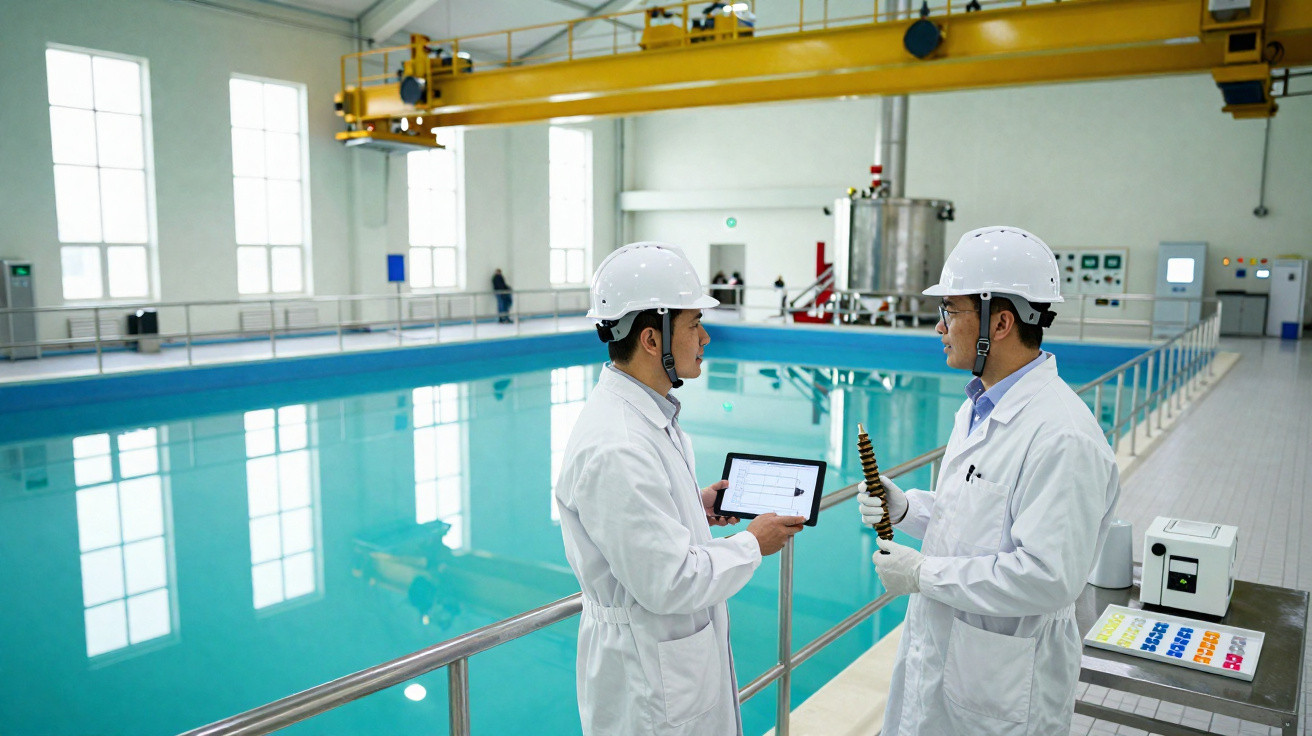
RJH will never supply electricity to the grid, but expectations for it are exceptionally high.
At Cadarache, engineers are building the Jules Horowitz Reactor (RJH), a high-flux testing facility intended to stress metals, validate fuels and secure medical isotopes for hospitals. It is a research reactor with major industrial implications, rather than a power-generating plant.
Why a reactor that makes no electricity matters
RJH is designed to shorten timescales. Its core will generate an intense neutron flux, bombarding samples until they display the effects expected after years inside a power reactor. This provides quicker answers on safety margins, life extensions and new reactor designs. In a matter of weeks, researchers can obtain insights that would otherwise require decades of operation.
Pressure-vessel steels become harder when irradiated. Fuel cladding can swell and fracture. Welds creep, seals deteriorate and alloys undergo subtle phase changes. These are not merely theoretical concerns: they impose real operational limits on gigawatts of generating capacity across Europe. RJH will allow researchers to drive materials to failure, record the data and refine designs rapidly.
What 20 years of wear do to metals, RJH can replicate in a few weeks under controlled, instrumented conditions.
As a modern materials-testing reactor rated at roughly 100 MW thermal, RJH will support loops that recreate conditions in operating plants. Engineers will be able to test components at power-reactor temperatures and pressures before transferring them to hot cells for immediate analysis. The findings will feed directly into design codes, maintenance plans and licensing documentation.
| Use case | Real world | Typical RJH campaign |
|---|---|---|
| Pressure vessel embrittlement | 15–30 years of neutron exposure | 8–12 weeks at equivalent dose |
| Fuel cladding behaviour | Multiple cycles in-core | Targeted weeks with in-situ gauges |
| Accident scenario tests | Rare, unplanned events | Scripted sequences with full diagnostics |
Inside the RJH test hall
Flexibility is central to RJH’s design. Specialised loops can replicate pressurised water reactor conditions at elevated temperatures and pressures. Removable rigs will enable teams to introduce novel alloys, advanced claddings and experimental fuels. The core’s neutron flux-orders of magnitude greater than that in most power reactors-will enable accelerated irradiation campaigns. Hot cells beside the pool will support post-irradiation microscopy and mechanical testing without delay.
The benefits are tangible. Grid operators will gain more reliable forecasts for component ageing. Suppliers can qualify new materials more quickly. Regulators will have deeper evidence for decisions on extending operating lifetimes. Universities and laboratories will have a European platform for training the next generation of nuclear engineers.
Medicine gets a backup it badly needs
RJH also has a second purpose: producing radioisotopes for diagnosis and treatment. Hospitals depend on a vulnerable supply chain that converts molybdenum-99 into technetium-99m, the tracer used in most nuclear-medicine scans. With a half-life of six hours, Tc-99m leaves no room for delay. When an ageing reactor is taken offline, scans are deferred and patient pathways can grind to a halt.
When it comes online, RJH can cover about a quarter of the European Union’s annual technetium‑99m needs-and ramp higher in a crisis.
Current supplies rely heavily on reactors constructed during the 1960s and 1970s. Several are approaching the end of their lives or face extended maintenance shutdowns. RJH will add capacity within the EU while reducing reliance on distant sources. This resilience is important for radiopharmacies and for patients requiring prompt scans for heart disease, cancer staging and bone assessments.
- Technetium-99m: the mainstay of gamma imaging in cardiology, oncology and neurology.
- Iodine-131: used for thyroid diagnosis and treatment.
- Lutetium-177 and other beta emitters: targeted therapies that are now expanding rapidly.
By combining isotope production with resilient logistics-including cold-chain transport, co-ordinated scheduling and backup targets-RJH can help stabilise the weekly rhythm on which hospitals depend. During shortages, its output can be redirected towards critical tracers to support the network.
Safety by design, not by slogans
Because RJH is located in seismic Provence, its designers have planned for severe conditions and close oversight. France’s nuclear regulator demands several independent barriers alongside proven mitigation arrangements. The facility follows this approach through redundant power supplies, diverse cooling routes and control-room redundancy.
- Reinforced confinement capable of withstanding a severe earthquake.
- Independent emergency diesel generators supplying safety systems.
- Air-based decay-heat removal for safe shutdown conditions.
- A second, separate control room that can assume control if the main room is compromised.
These measures increase the cost. However, they also reduce risk during outage periods and maintenance changes. For a shared research facility, dependable availability and repeatability are as important as maximum performance.
An international lab bench for Europe’s next reactors
A wide consortium funds and uses RJH. Industrial companies and public research organisations invest jointly, receiving priority access to beam time and hot-cell capacity. This shared arrangement distributes costs and keeps the work aligned with the needs of Europe’s operating reactor fleet.
Who is around the table
- Industry: EDF, Framatome, TechnicAtome.
- Public agencies and institutes: SCK CEN (Belgium), CIEMAT (Spain), UJV (Czech Republic), VTT (Finland), DAE (India), IAEC (Israel), NNL (United Kingdom), Studsvik (Sweden), plus the European Commission.
These partners will provide materials, fuels and instrumentation for campaigns addressing practical questions. How can silicon-enriched steel slow embrittlement? Could advanced claddings increase permitted burnup without a penalty? Which failure modes emerge during rapid transients, and how do engineered barriers react?
From small modular reactors to Gen-IV
SMR developers require extensive datasets to support licensing applications. Gen-IV programmes need to irradiate exotic alloys, advanced fuels and new coolants. Waste-management teams must test matrices and containers under dose to demonstrate long-term stability. RJH will be the facility where this evidence is produced and examined.
A shared neutron super‑lab cuts risk for new designs and strengthens life extension cases for the current fleet.
A rare build in a greying research fleet
Europe has commissioned few new research reactors in recent decades. Osiris, built near Paris in 1966, closed in 2015. Several isotope-producing workhorses have moved beyond mid-life. RJH counters this trend with a modern platform expected to begin operating between 2032 and 2034. Its budget is close to €1.6 billion, reflecting both its scale and demanding safety requirements.
Other schemes, including PALLAS in the Netherlands and MYRRHA in Belgium, are progressing to different schedules. Collectively, they will determine whether Europe can retain an onshore medical-isotope supply and maintain a credible pipeline of nuclear innovation.
What it means for grids, bills, and hospitals
RJH data will support decisions to operate safe reactors for longer, often providing the lowest-cost clean kilowatt-hour available. Improved materials can increase availability, reduce unplanned outages and optimise maintenance. Suppliers will be able to qualify components faster, helping to contain the risks of major projects. Regulators will receive direct, high-quality evidence rather than extrapolated assumptions.
In healthcare, additional isotope capacity reduces the likelihood of cancelled scans. This supports earlier diagnosis and shorter treatment pathways. For national health systems, greater predictability means fewer emergency purchases and less waste resulting from last-minute shortages.
Useful context if you follow the nuclear space
How time compression works: neutron damage is commonly measured in “displacements per atom” (dpa). By adjusting flux and spectrum, RJH can reach target dpa levels rapidly. Engineers can then link dpa to changes in hardness, fracture toughness, corrosion and stress-corrosion cracking. This relationship directly informs inspection intervals and safety factors.
How Tc-99m gets to a hospital: reactors irradiate targets to produce Mo-99; processors extract and purify it; pharmacy generators allow Mo-99 to decay into Tc-99m on site; technologists prepare and inject doses for same-day imaging. Any interruption in this chain delays care. RJH reinforces its first link within Europe.
Risks to monitor include schedule pressure on civil engineering works, supply-chain constraints for specialist equipment and the difficulty of staffing large-scale hot-cell operations. Benefits to follow include quicker qualification of accident-tolerant fuels, improved models of embrittlement in long-life reactors and more resilient isotope logistics during unforeseen outages.






Comments
No comments yet. Be the first to comment!
Leave a Comment