
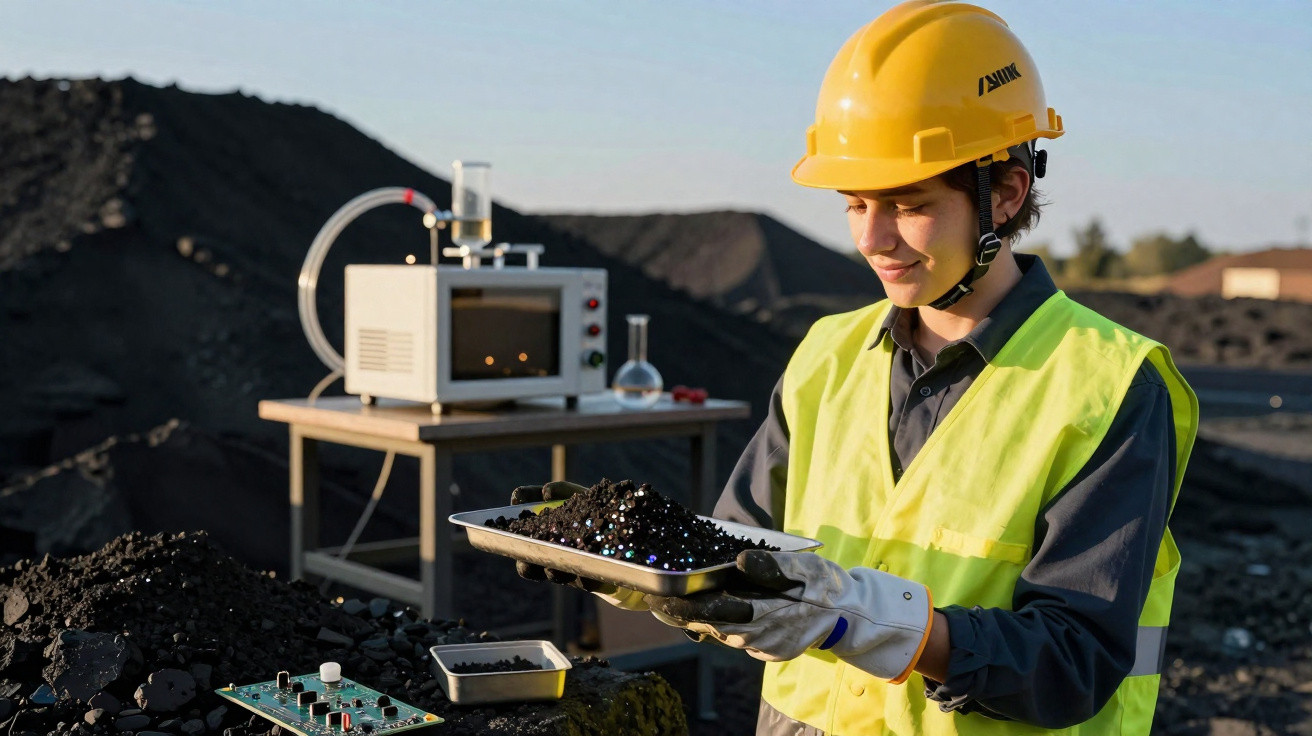
Across former coalfields and disused processing plants, vast heaps of grey industrial residue have been left behind as demand for high-tech metals continues to rise sharply.
For decades, these piles were regarded as a costly clean-up problem rather than a potential resource. A new extraction method now indicates that they could contain an enormous, largely unexploited supply of rare earth elements: the metals that power smartphones, keep wind turbines turning and enable electric cars to run.
From toxic liability to strategic asset
Waste produced by coal processing has traditionally been considered worthless material. It fills river valleys, damages landscapes and requires millions in monitoring costs. However, these residues contain traces of rare earth elements (REEs), which are increasingly vital to the technology economy.
In Pennsylvania alone, researchers estimate that coal-processing deposits may hold as much as 137,000 tonnes of recoverable rare earths. This is far from an insignificant reserve. It is comparable with the production of certain operating mines, although the metals remain trapped in a resilient mineral matrix that conventional chemistry cannot easily break down.
Conventional extraction techniques have limited success because the rare earths are embedded in complex aluminosilicate minerals, rather than occurring as separate grains that can be readily leached. Grinding and simple acid leaching achieve very little. As a result, industry dismissed these wastes for many years.
New lab work suggests those “worthless” piles might actually be one of the most accessible rare earth resources in industrialised countries.
A microwave-driven twist on rare earth extraction
Researchers at Northeastern University in the US have proposed another route. Rather than attempting to leach rare earths directly from the minerals in their original state, they first alter the minerals before recovering the metals.
The technique involves two main stages:
- Alkaline processing with concentrated sodium hydroxide (NaOH)
- Rapid microwave heating, followed by acid digestion
Although the combination may resemble an aggressive kitchen experiment, it is based on well-established mineralogy. Coal residues frequently contain kaolinite, a widespread clay mineral. When exposed to strong alkaline conditions and microwave heat, kaolinite is converted into a different phase known as hydrosodalite.
Why the mineral transformation matters
Hydrosodalite is both more porous and more reactive than the original clay. This structural and textural change is essential, as its more open framework enables acid to reach rare earth-bearing sites much more effectively.
During tests using genuine industrial waste samples, the researchers found that kaolinite largely dissolved or reorganised into the new porous phase. X-ray diffraction and spectroscopic analysis verified this transformation. Following it with nitric-acid digestion released rare earth elements at substantially greater rates.
The optimized protocol almost tripled the extraction yield of key rare earths such as neodymium and cerium.
The optimum results came under highly specific conditions: roughly 5 molar NaOH, microwave heating to about 180°C, and subsequent nitric-acid leaching. At these settings, the production of undesirable secondary minerals capable of trapping metals was reduced, allowing rare earths to be released more readily.
Critical metals, cleaner risks
The researchers also monitored additional metals released during the process. Coal-derived wastes often contain uranium at low, yet concerning, concentrations. Under this method, a significant portion of the uranium enters solution during the alkaline stage instead of the acid stage.
The order of these steps is important for safety. Dissolving radioactive elements in controlled alkaline conditions could lower radiation risks during the later acid-intensive stage, when corrosion and aerosol hazards are generally greater.
The team also noted that rare earths often seemed linked with elements including magnesium, calcium and iron. This strong relationship indicates that they occupy connected mineral structures. Treating aluminosilicate phases with alkali can therefore target several trapped metals simultaneously.
What the numbers say
The study, led by researcher Ayodeji Ajayi, was published in Environmental Science & Technology and reported by ScienceAlert. Its results show substantial improvements:
| Parameter | Conventional leaching | New alkaline + microwave process |
|---|---|---|
| Extraction efficiency | Baseline (1x) | Up to ~3x higher |
| Target elements | Mixed rare earths | Enhanced light REEs (Nd, Ce) |
| Uranium behaviour | Mostly freed in acid stage | Substantially solubilised in alkaline stage |
| Key control factor | Acid strength | Solid–liquid ratio and mineral phase change |
For policymakers concerned about supply chains, the figures send a clear signal: waste piles may help shield Western economies from geopolitical disruption in the rare earths market.
From lab bench to coal country
Converting an effective laboratory procedure into a large-scale industrial operation is rarely simple. This new approach presents challenges of its own, particularly in relation to chemical use and energy demand.
High-temperature alkaline treatment with concentrated NaOH is expensive. Microwave systems can provide efficient heating, but industrial-scale reactors still require considerable electricity. Where power generation remains dependent on fossil fuels, pollution could merely be transferred from the extraction site to the power station.
Waste management presents another obstacle. The most successful experiments generally rely on relatively low solid-to-liquid ratios or repeated processing cycles. Either method produces substantial quantities of alkaline liquid waste, which must be neutralised, recycled or carefully contained.
Whether this technology scales will depend on turning those “side streams” into manageable, possibly reusable process fluids.
Furthermore, no two coal basins are identical. Mineral compositions can differ between valleys and even across a single spoil heap. Operators would therefore require adaptable processes, capable of adjusting NaOH concentration, temperature and reaction duration for local feedstock.
A potential pillar of rare earth security
Despite these limitations, the idea arrives at a politically sensitive time. Rare earths are central to the energy transition and modern defence technologies. Their production, however, is controlled by only a small group of countries, with China holding an especially powerful position.
Accessing existing waste reserves would offer importing countries an additional route to supply. It would not require digging a new pit or blasting an untouched mountain. Instead, land already affected by coal mining could be given another industrial purpose, completing a cycle that began decades earlier.
Strategic planners increasingly refer to “urban mining” and “secondary resources” – recovering metals from goods and waste streams instead of virgin rock. Coal residues processed through this type of mineral transformation could align closely with that transition.
What rare earths are, and why they matter
Despite their name, rare earth elements are not particularly uncommon in the Earth’s crust. The difficulty is that they seldom occur in concentrated deposits. Their extraction commonly requires enormous volumes of rock to be moved and aggressive chemicals to be handled.
This category includes seventeen elements, among them neodymium, praseodymium, dysprosium and terbium. Many are used in high-strength permanent magnets for electric motors, MRI machines, wind turbines and headphones. Others serve as screen phosphors or petroleum-refining catalysts.
Light rare earths such as neodymium and cerium are currently recovered in much larger volumes than heavy rare earths, although both categories are strategically sensitive. Any method that can make their recovery cheaper or cleaner rapidly draws attention from carmakers, electronics companies and defence agencies.
What scaling up could look like
Should the alkaline–microwave technique reach commercial scale, former coal landscapes could take on a different appearance. Consider a place such as Pennsylvania’s anthracite belt, where old wash plants, tailings ponds and coal-refuse heaps might be restored not through burial, but by feeding their material into modular processing facilities.
These facilities would separate the material, carry out controlled NaOH treatments with microwave heating, and then leach rare earths through acid circuits. Wherever feasible, reagent solutions would circulate through closed loops. The remaining solids, stripped of much of their metal content, could be reshaped into safer embankments or used as building aggregates.
Regulators would still have to monitor dust, radionuclides and groundwater pollution. Even so, the total footprint could be smaller than that of establishing a new rare earth mine in a remote location without existing infrastructure.
Key risks and opportunities for communities
People living near coal-waste sites have heard many promises over the years. Any proposed rare earth project will understandably face close scrutiny. Local residents will seek clear information about air quality, lorry movements, noise and long-term monitoring.
On the positive side, waste reprocessing could create skilled employment in areas that lost coal-related jobs. It could also make land currently fenced off as hazardous available again, once residues are stabilised and metals have been recovered.
The balance depends on how operators manage three particularly sensitive issues:
- Management of alkaline and acidic process waters
- Control of radioactive elements like uranium and thorium
- Transparent sharing of monitoring data with local authorities
If handled badly, these factors could entrench public opposition. If managed responsibly, they could transform long-standing industrial scars into revenue sources while reducing dependence on imported strategic metals.
Looking beyond coal waste
The process underlying this breakthrough is not restricted to coal residues. Numerous industrial by-products – including bauxite tailings, or red mud, and certain forms of phosphogypsum – also contain rare earths or other critical metals held within resistant mineral phases.
If researchers can adapt similar mineral transformations to these materials, a new generation of “waste refineries” may emerge. Rather than viewing slag, ash and tailings as final destinations, industry could see them as intermediate reserves, ready for another processing stage when technology and prices make it viable.
This transition would not undo the environmental harm caused during the fossil-fuel era. It could, however, ensure that coalfields and refineries leave behind more than abandoned pits and leaking ponds: a store of strategic metals that had been visible all along.





Comments
No comments yet. Be the first to comment!
Leave a Comment