
In the shadow of the Black Sea coast, an ancient burial reopens a forgotten chapter about power, wealth and the emergence of elites.
Excavated almost by chance in Bulgaria during the 1970s, a prehistoric cemetery more than six millennia old reveals something startling: gold was already distinguishing those who ruled from those who obeyed long before the great civilisations studied at school.
An accidental discovery that became a history-book case
In autumn 1972, workers were operating on the outskirts of Varna, a port city on the Black Sea, when their spades struck human bones and pottery fragments. What initially appeared to be just another archaeological find became one of Europe’s most significant prehistoric sites.
Excavations carried out over two decades uncovered a necropolis dated between 4,600 and 4,300 BC. Around 300 graves were identified: some modest, others extraordinarily wealthy. Sixty-two of them contained gold objects in quantities unprecedented for such an early period.
Necklaces, bracelets, earrings, finely perforated pendants and small discs that were probably sewn onto clothing make up a collection of more than 3,000 artefacts. Together, they weigh more than six kilograms of worked gold.
“These six kilograms are not merely ancient jewellery. They are the earliest accepted evidence that humans had mastered goldworking around 6,600 years ago.”
A tiny gold bead found in 2016 at another Bulgarian site may be slightly older, but specialists still dispute its dating. For now, Varna remains the earliest known major ‘laboratory’ of gold.
Varna: the forgotten cradle of a prehistoric elite
When the origins of civilisation are discussed, the same places nearly always come up: Egypt, Mesopotamia and the Indus Valley. The Varna necropolis requires us to redraw that mental map. Here, on the Black Sea shore, a Copper Age community appears to have taken a bold step towards complex societies.
The graves differ sharply from one another. Some contain only a few items, occasionally no more than a ceramic vessel. Others display an abundance of adornments, suggesting that certain people were regarded as clearly superior.
- Some individuals were buried with weapons and metal ornaments.
- There are symbolic graves, containing no body but filled with gold.
- Certain burials hold dozens of objects, whereas others are almost empty.
This contrast indicates a stratified society, where wealth and prestige left very visible material traces. It was not simply a matter of different tastes; hierarchy was etched into the ground.
The enigmatic tomb 43: power taken to its furthest point
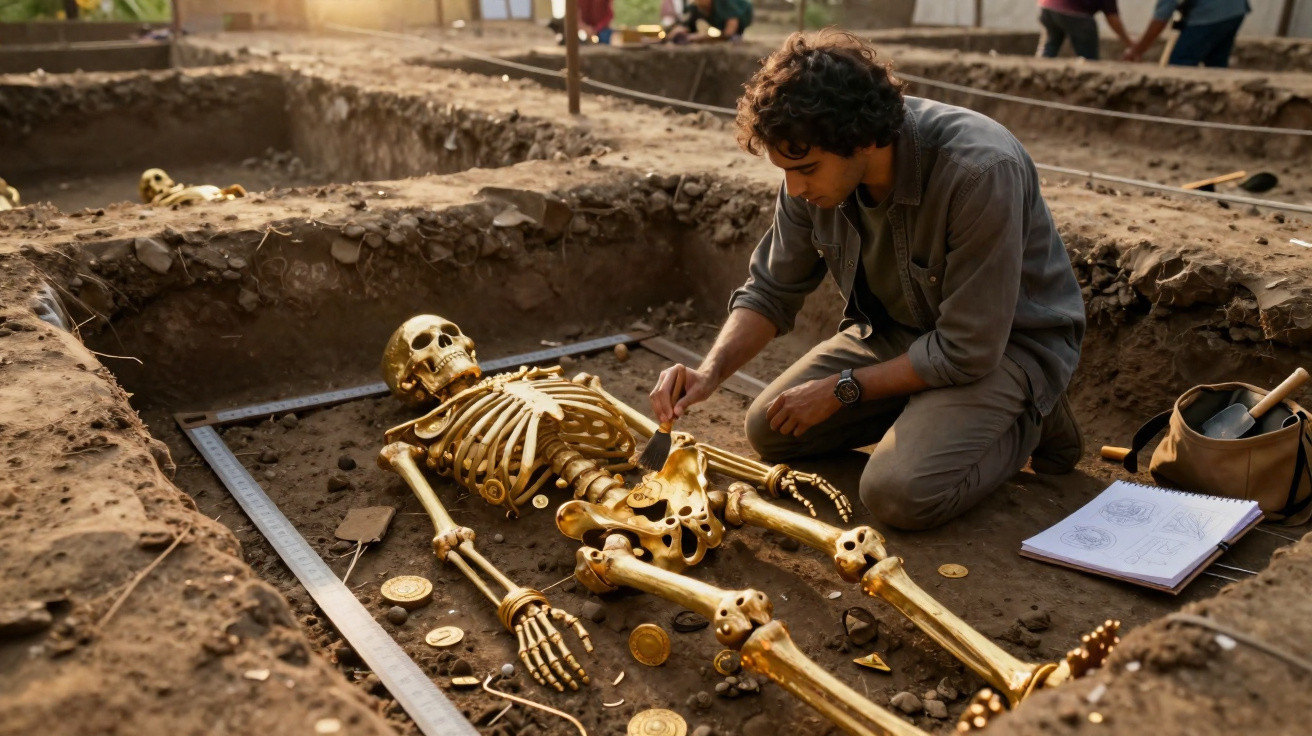
Among all the burials, one has acquired a reputation of its own: tomb 43. By itself, it contains around one third of all the gold from the necropolis. Archaeologists found within it the skeleton of a man aged over 60, an advanced age for the period.
Around his body lay plentiful jewellery, tiny beads sewn into fabrics and prestige objects. In his hands was a symbolic weapon: a type of axe with a gold-covered handle. Over the genital area was an item that still prompts debate: a gold penis sheath, with no known equivalent from this period.
“Tomb 43 seems to have contained someone who concentrated political, religious and economic power in a single ageing body surrounded by brilliance.”
According to the Varna Archaeological Museum, only a very limited group of people received this kind of funerary treatment. The wealth of gold was not mere luxury; it was a message. It signalled that this man occupied a special place in the community, perhaps as a leader, chief or central ritual figure.
What this penis sheath may signify
The unusual gold object in the genital region has generated several hypotheses. Rather than focusing on eroticism, current interpretations point to symbols of virility, fertility and power. In many ancient cultures, male sexuality was associated with political strength and success in warfare.
The sheath may have marked:
- a superior, almost sacred male status;
- a role as mediator between forces ‘of the earth’ and fertility;
- a way of distinguishing the bodies of leaders from the rest of the community.
There is no consensus, but the very existence of such a specific object suggests that Varna society developed a sophisticated symbolic language rooted in the body and precious metal.
Why gold emerged there, in the Balkans
During the Copper Age, the Balkans were a mosaic of innovations. Local peoples were already exploiting mines, producing copper and moving goods along long-distance routes that linked the interior with the Black Sea coast.
In this setting, gold became the ideal material for marking social differences. It was rare, eye-catching, resistant to the passage of time and difficult to obtain without some form of control over resources and human labour.
| Characteristic of gold | Social effect at the time |
|---|---|
| Intense, lasting shine | Strengthened its association with the ‘divine’ and prestige |
| Rarity | Allowed it to be used as an elite marker |
| Malleability | Made it easier to create complex, personalised symbols |
| Resistance to corrosion | Ensured that status remained visible even in the grave |
Viewed in this way, tomb 43 is almost a ‘manual’ for how gold helped organise society: those with access to it controlled narratives of power, local religions, rites of passage and even memories of who deserved honour after death.
Varna and the rise of structured inequality
Archaeologists describe Varna as a prototype hierarchical society. It was not yet a state, but it was already far from an egalitarian community. There are signs of specialisation: some people produced metal, others controlled trade, and a minority appears to have held command.
The lavish burials reinforce the idea that inequality was not only economic. It was embedded in funerary rituals and passed between generations. Children buried with adornments also suggest that status could be inherited rather than gained solely during life.
“Varna shows that inequality was not born with the pharaohs, but was being tested in small communities long before the pyramids cast their shadows.”
Because it carried such powerful symbolic value, gold became the perfect tool for making this difference appear natural. Anyone seeing a tomb glittering with yellow metal would understand, without a word being spoken, that someone above the rest lay there.
Terms and ideas that help explain tomb 43
Some concepts frequently appear in discussions of Varna and may be confusing for non-specialists. Two deserve particular attention:
- Copper Age (or Chalcolithic): the transitional phase between the Neolithic and Bronze Age, when farming communities still used many stone tools but began making objects from copper and, on a smaller scale, gold.
- Necropolis: a large burial area, like an organised cemetery, with burial patterns, specific rituals and sometimes sections reserved for different groups.
These terms place Varna at a crucial point in time: neither as ‘primitive’ as once imagined nor as urban as the cities that would emerge millennia later.
What the story of tomb 43 suggests about us today
In a hypothetical scenario, if a visitor from that community watched a burial in tomb 43, they would see dozens of people gathered together, lengthy rituals, perhaps offerings of food and drink, chanting and coded gestures. The presence of gold would mark the occasion as something rare, reserved for very few.
Today, the forms have changed, but the logic remains familiar. Luxury jewellery, expensive cars, particular brands and exclusive parties convey the same message as Varna’s golden discs: distinction. Tomb 43 acts as a distant mirror, showing how humanity began using objects to signal who held greater social value.
For museum visitors or readers of archaeological news, knowing this story helps place other discoveries in context. A simple gold bead or bracelet buried with someone may not be decoration alone. It may be a clue to power relationships, political alliances, internal disputes and deeply held beliefs that were never written down, but remained imprinted in the earth - in yellow metal still shining six thousand years later.






Comments
No comments yet. Be the first to comment!
Leave a Comment