
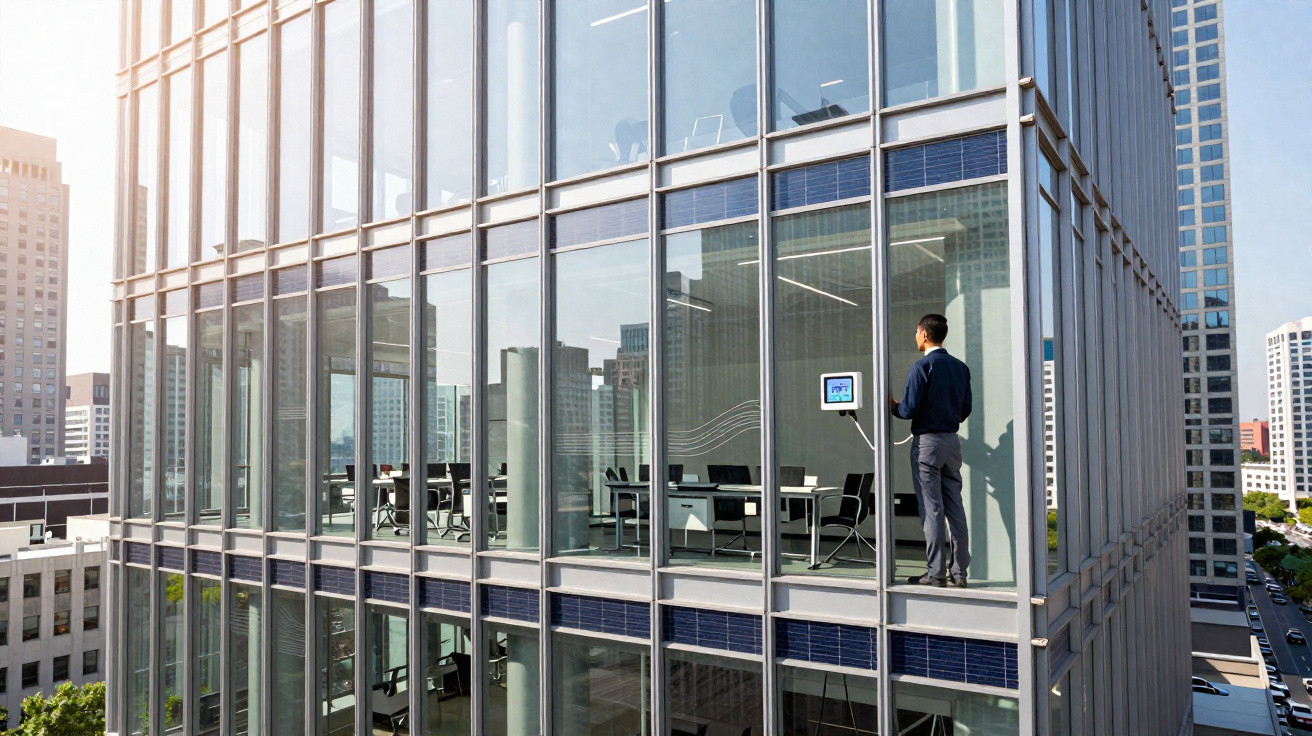
Engineers believe the same panes may soon draw on sunlight and discreetly supply electricity to the buildings they enclose. Transparent solar tech is moving beyond a laboratory novelty towards an urban application, with every tower potentially in its sights.
From a high-floor city-centre laboratory, I saw a square pane of glass take in the early morning sun. At first glance, it resembled an ordinary office window: spotless, colourless and unassuming. Then a small meter at its side started to flicker. Cables were concealed within the frame, while an ultra-thin coating across the pane diverted invisible light; as the sun climbed, the readings slowly increased. I placed my hand against the glass, half expecting to sense the electricity. It remained cool. The meter continued regardless. The glass was doing its job in silence.
Glass that gathers light
The concept feels like science fiction: clear glass, real power. But it is straightforward in principle: visible wavelengths are allowed through for daylight and views, while wavelengths beyond human vision are collected. Engineers adjust organic or hybrid materials to capture ultraviolet light and selected infrared wavelengths, directing that energy towards slim solar cells concealed around the edges. Anyone walking by sees only the view and their own reflection. Across a large surface, however, a façade turns into a quiet, gleaming generator. City life continues, slightly brighter and slightly less reliant on the plug.
Consider the scale. A high-rise office building can be clad in tens of thousands of square metres of glazing. When they remain highly transparent, today’s transparent photovoltaic coatings can produce single-digit watts per square metre under full sun, while darker tints can deliver greater output. Apply that across all four elevations of a building over lengthy summer days, and the figures start to become significant. Some pilot projects indicate that a glazed tower might supply a worthwhile proportion of its daytime lighting and plug loads. It will not cover everything, but it can alter both the energy bill and the wider story.
Its operation sounds like useful magic. Certain prototypes use transparent luminescent solar concentrators: they absorb chosen wavelengths, re-emit the light sideways and send it to the edges, where small cells collect it. Other designs use organic photovoltaics calibrated to bypass most visible light while capturing what remains. Electrical connections sit inside the mullions, coatings function much like advanced low-E layers, and the glazing can still comply with safety regulations. Transparency and efficiency must be balanced, giving architects an adjustable setting: clearer glass means lower output, while a subtle tint means more power. That balance is where the system operates.
From lab pane to city block
Bringing this technology into use need not involve demolition. One approach is to install it in insulated glass units as part of routine window replacement programmes. Low-voltage busbars run through the mullions, microinverters are kept out of sight in plant rooms, and a building management system monitors the installation. Teams can prepare panels overnight, make replacements at weekends and return floors to service with little disruption. The benefits combine energy generation, UV filtering that can reduce cooling demand, and daylight that preserves colour rendering. It is effectively a window refurbishment that performs like a roof-mounted solar array.
Several potential problems can be avoided through good planning. Cabling crossing expansion joints requires enough flexibility and suitably designed connectors. Drainage routes for condensation must remain unobstructed, otherwise electricity generation may come at the cost of misted glazing. Façades contend with wind, dirt and pigeons, so maintenance plans count for more than publicity. Warranties need to protect both the glass and its power-generating layer against heat, cold and ageing. We have all seen a new device perform brilliantly until the first storm arrives. Let’s be honest: nobody really does that every day. Design for what happens after the ribbon-cutting.
Trust and timing can also determine whether projects succeed. Tenants want to retain their views. Building owners need revenue and reliable payback periods. Facilities teams prefer fewer failure points rather than additional ones.
“The moment glass starts paying rent, the business case changes.”
The approach is easy to set out in a project kick-off meeting:
- Set the transparency requirement first, then calculate the likely yield.
- Design the electricity route within the façade rather than across the floor.
- Combine the work with essential window replacement to reduce the cost impact.
- Test one elevation for a season before committing fully.
The city after the switch
Imagine a street block where every south-facing façade quietly collects energy, with morning demand spread across thousands of panes rather than concentrated in a few rooftop panels. Office towers take a small share of their own electricity demand. Residential high-rises reduce their air-conditioning peak. Grid planners see gentler demand profiles instead of alarming drops and surges. Turn every skyscraper into a generator, and the shape of the urban energy system shifts. This technology will not eliminate fossil fuels alone, nor will it perform at its best on every overcast winter day. Yet it can make glazing pay its way without sacrificing its appearance. That is a quiet revolution worth passing on.
| Key point | Detail | Why it matters to the reader |
|---|---|---|
| - | Transparent PV captures UV/IR while keeping views clear | Retain daylight and the skyline while adding power without visual clutter |
| - | Retrofit through insulated glass units and concealed edge cells | A practical route for existing buildings without major disruption |
| - | Transparency versus output is an adjustable balance, not an on/off choice | Select the level of generation you want without making rooms feel like caves |
FAQ:
- How transparent can these solar windows be? Many demonstrations achieve 40–80% visible transmittance. Greater clarity produces less electricity, while a slight tint increases output. Architects can set that balance room by room.
- How efficient are they compared with rooftop panels? Conventional rooftop modules are considerably more efficient. Transparent systems sacrifice peak efficiency for surface area and appearance, recovering ground over vast façades.
- What about cost and payback? Think of premium glazing with an added power-generating layer. Payback is better when installations are combined with planned window replacements and where energy prices are high.
- Do they affect indoor comfort? They can filter UV and some infrared light, much like advanced low-E coatings. This can reduce glare and cooling demand while keeping daylight comfortable.
- Can older towers be retrofitted? Yes. Phased insulated glass unit replacements and hidden mullion wiring make it possible. Begin with one elevation as a pilot, then extend the system across the façade.






Comments
No comments yet. Be the first to comment!
Leave a Comment