
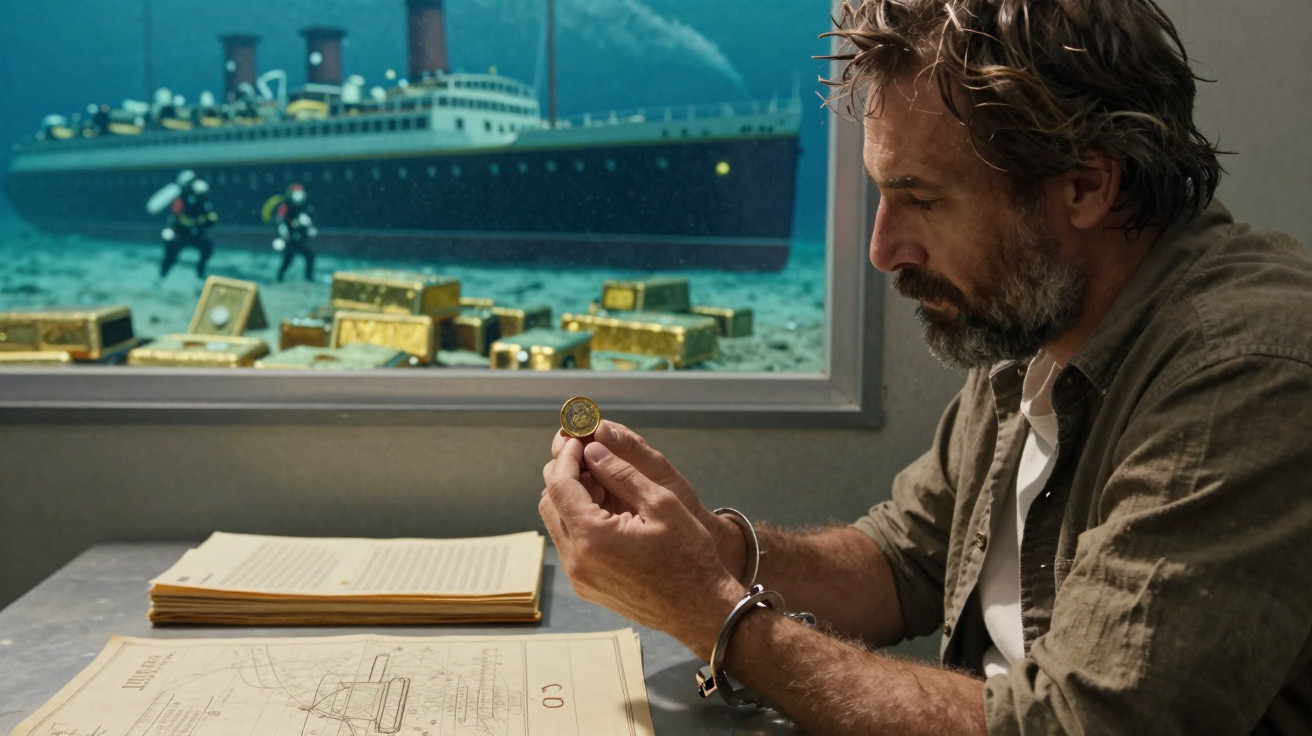
In the late 1980s, an Ohio scientist achieved what treasure hunters had imagined for generations: he located the “Ship of Gold”, carrying tonnes of precious metal. Yet rather than fame and fortune, the discovery led to an exhausting legal battle, evasion of the authorities and a prison term that many still regard as disproportionate.
The hunt for the “Ship of Gold”
In 1988, engineer and research diver Tommy Thompson found the wreck of the passenger steamship S.S. Central America off the coast of South Carolina. In the United States, the vessel is legendary: it represents the Gold Rush, but also one of the era’s most devastating maritime disasters.
The S.S. Central America went down in the Atlantic in 1857. On board were around 425 passengers and crew members, along with approximately 13,600 kilograms of gold. The precious metal had come from the mint in San Francisco and was intended as a financial reserve for banks on the East Coast. Its loss worsened an already fragile financial situation in the United States at the time.
Thompson and his team located the wreck at a depth of more than 2,100 metres. For the late 1980s, this was a major technical achievement. The expedition used specialised robots, sonar equipment and recovery systems developed in-house. Initially, the US press celebrated Thompson as a pioneer: part scientist, part treasure hunter and part high-tech innovator.
For more than 150 years, the gold lay beyond reach on the seabed – until a small crew from Ohio located it.
Gold, millions and disappointed investors
Searching for a wreck more than two kilometres below the surface required enormous sums. To fund the venture, Thompson raised money from investors. Around 160 backers from the United States are believed to have taken part, including wealthy individuals, banks and funds. They expected substantial returns from the sale of the recovered gold.
The recovery operation was partly successful. More than 500 gold bars and thousands of coins were brought to the surface. An initial portion of the treasure was sold, with US media reporting proceeds of roughly $50 million. This was where the dispute began: many investors did not receive a single cent of that money.
In 2005, several financiers took legal action. They accused Thompson of cheating them out of millions. According to their claims, he had concealed or diverted the profits rather than distributing them as agreed. For a man who had long presented himself as a sober-minded researcher, this marked a dramatic shift in reputation: from celebrated discoverer to alleged fraudster.
How Thompson explained his actions
Thompson denied deliberately defrauding his investors. He said that he had transferred the gold to a trust company in the Central American state of Belize. The approximately $50 million in proceeds, he maintained, had gone towards legal fees, litigation and repayment of bank loans. Investors found that explanation difficult to follow.
- Investors claim: They received no share of the proceeds from the sale of the gold bars and coins.
- Thompson claims: The money was mainly spent on legal disputes and liabilities.
- Courts demand: Disclosure of the precise location of the gold and the proceeds.
It was at this point that the conflict became entrenched. Judges demanded clear answers, documents and the names of trustees. Thompson remained silent or, in the view of the courts, gave only vague responses. What began as a commercial case became a matter of contempt of court.
Flight, manhunt and ten years in prison
Rather than cooperate, Thompson disappeared for years. Investigators searched for him and arrest warrants were issued, but the treasure hunter remained missing. Public perception changed accordingly: the pioneer became a man on the run, seemingly trying to escape the consequences of his own success.
Eventually, the authorities arrested him. Thompson appeared before the court. It was not the original treasure hunt that sent him to prison, but the allegation that he had persistently ignored court orders. Above all, the judges wanted to know where the missing gold was and what had happened to the millions.
At one hearing, Thompson said in essence that he did not know where the precious metal was. He spoke of losing his personal freedom and complained that he was being compelled to make statements he could not make because, he claimed, he lacked specific information.
Thompson insists: “I do not know where the gold is.” To the court, that sounded like defiance – not ignorance.
Many observers in the United States consider the roughly ten years he ultimately spent in prison excessive. They argue that the case was more a complex financial and contractual drama than a conventional criminal matter. Others view the court’s severity as a deliberate signal: anyone who stalls investors and the justice system to this extent must expect serious consequences.
The legend of the S.S. Central America endures
Although Thompson is now free again, part of the treasure remains disputed. Some has been sold, other items are held in seizures and secure storage, while further holdings may still be in private hands. One thing is clear: the story of the S.S. Central America did not end with a treasure hunter’s release papers.
The market for historic gold items from this wreck is booming. Collectors in the United States pay huge sums for bars and coins with an unbroken provenance. They are not simply buying precious metal, but a tangible relic of the Gold Rush era – including the 1857 disaster and the modern legend surrounding Thompson.
In 2022, one particularly large item made headlines: a gold bar weighing 866.19 troy ounces, known as the “Justh & Hunter” bar, was auctioned in Dallas. The hammer came down at around $2.16 million. A single piece from a wreck more than 150 years old thus passed the two-million-dollar mark.
| Fact | Details |
|---|---|
| Date / period | Mid-19th century, Gold Rush era |
| Sinking | 1857 off the US East Coast in the Atlantic |
| Gold cargo | Around 13,600 kilograms from San Francisco |
| Rediscovery | 1988 by Tommy Thompson and his team |
| 2022 auction | “Justh & Hunter” bar for $2.16 million |
Why treasures like this trigger so many disputes
Spectacular wreck discoveries can seem romantic: a lone researcher, roaring seas, glowing sonar screens and a first glimpse of gold in the darkness of the deep ocean. In reality, they are often underpinned by complicated legal and financial arrangements. Insurers, states, descendants of former owners and investors may all have potential claims.
Wrecks from the 19th century raise a particular question: who owns something that has rested on the seabed for decades? The state under whose flag the ship sailed? The insurers that settled losses at the time? The discoverer who invested millions in the search? Some of these issues remain unresolved and repeatedly result in international disputes.
Anyone investing in such ventures is effectively taking a high-risk capital gamble: millions are at stake, the legal position is uncertain and the technology can fail at any moment. Success can bring extraordinary profits. Failure leaves only expensive expert reports and recovery equipment that nobody needs any more.
What the Thompson case reveals about modern treasure hunting
The S.S. Central America case clearly shows how narrow the divide can be between pioneer and defendant. Several points stand out:
- Transparency: Anyone using other people’s money must fully disclose what has been recovered, sold and paid out.
- Contracts: Vague arrangements between researchers, investors and states almost inevitably lead to lawsuits later on.
- Court orders: Anyone refusing to answer judges’ questions about gold and money risks imprisonment – even without a conventional “theft”.
- Myth factor: The more legendary a wreck is, the greater the media and financial interest – and therefore the greater the potential for conflict.
For many professional wreck researchers, the case is a warning. They now place greater emphasis on cooperation with museums, universities and states in order to avoid grey areas. At the same time, the appeal of finding another cargo of gold somewhere in the darkness of the deep sea remains undiminished. After all, a single discovery can completely transform careers and fortunes in a short time – or, as in Tommy Thompson’s case, cost a decade behind bars.






Comments
No comments yet. Be the first to comment!
Leave a Comment