
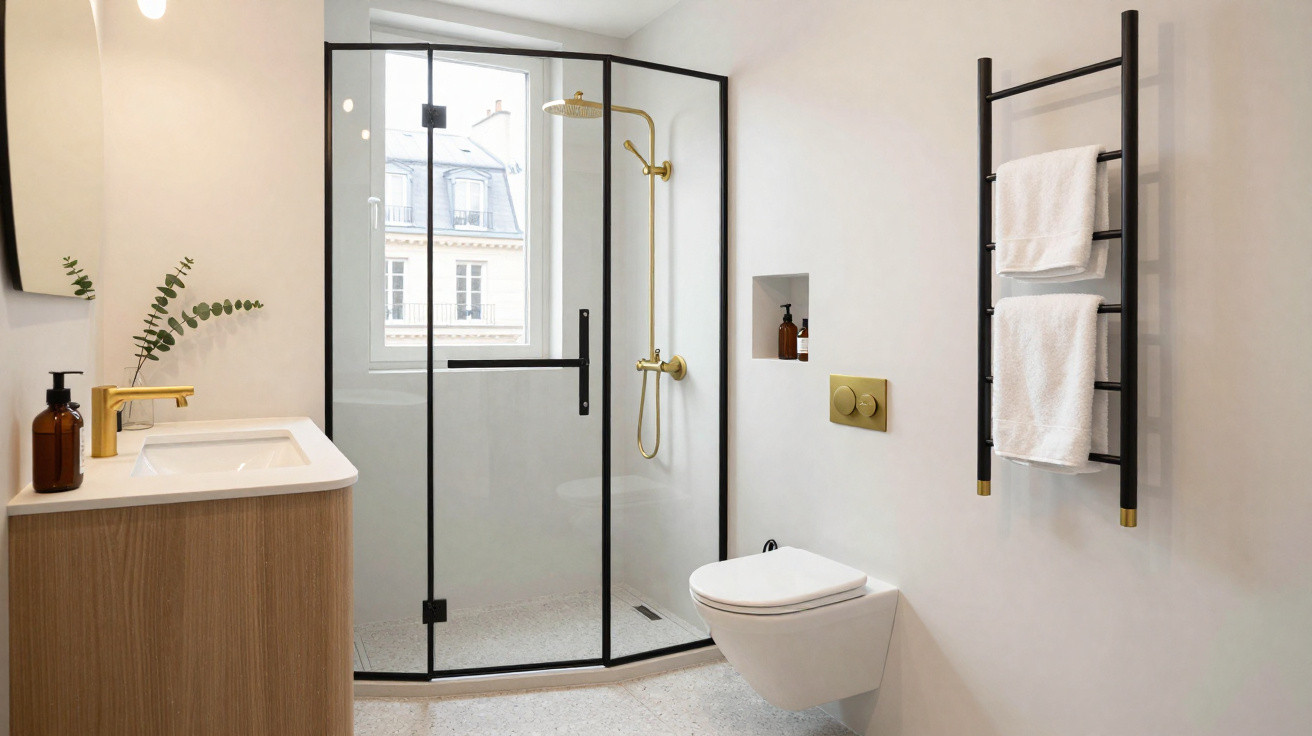
Behind an ageing door in a Paris apartment block, a cramped and old-fashioned shower room has been discreetly transformed into a stylish miniature spa.
Atelier Ceben, a French design practice, has completely reshaped this previously overlooked part of a 15 m² studio in the 13th arrondissement. What was a dark, impractical washing area is now a compact contemporary haven, with every centimetre put to purposeful use.
From depressing cubicle to tiny urban retreat
Before the work began, calling it a “bathroom” was generous. The tenant had one stark choice: shower virtually over the toilet, or go without a shower altogether.
Its arrangement could not have been more rudimentary. A tiny hand basin was fixed against an unfinished wall, while the shower and toilet had no meaningful division between them. Washing meant lowering the WC lid and standing beneath a shower head installed immediately above it. There was nowhere to store anything, and there was no comfort either.
This tiny space forced the designers to treat every square centimetre as a design decision, not an afterthought.
The room appeared just as uncared-for as it was impractical. Exposed plain walls, poorly matched fittings and a total lack of decorative detail made it feel like a student bedsit left untouched since the late 1990s.
The 15 m² challenge: fitting a proper bathroom into almost no room
The brief for Atelier Ceben sounded straightforward but was difficult in practice: create a pleasant, fully functional shower room in an area more comparable to a wardrobe than a bathroom. The wider studio also had to retain a unified feel from the moment the front door was opened after a long day.
Strategic layout: making the most of the corner
Rather than merely replacing the existing fittings, the designers' first major intervention was to reconsider the plan. They positioned the vanity unit in a corner, immediately releasing valuable room for movement through the middle.
This move also made another essential element possible: a wall-hung toilet. As its cistern is hidden within the wall, the pan extends less far into the room and leaves the floor looking more visible and open. When a room is this small, the mental effect of a larger expanse of visible flooring is considerable.
- Corner vanity unit to open up the route through the room
- Wall-hung WC to minimise visual clutter
- Compact shower door designed for small bathrooms
- Slim towel radiator that also heats the room
Every principal fitting came from “small space” collections offered by accessible retailers including Leroy Merlin, ManoMano and Castorama. The result demonstrates that tiny bathrooms need not depend on bespoke, luxury-only products.
Compact fixtures with reduced depth and width turn what feels like a cupboard into something that behaves like a real bathroom.
Practical details that improve comfort
The designers addressed daily usability as well as the floor plan. The shower now occupies a clearly defined zone, complete with a proper door to contain splashing water. A heated towel rail provides warmth while offering a place to dry towels, a modest addition that makes winter mornings considerably easier.
Storage, which had previously been entirely missing, has been built into the vanity unit. Even a micro bathroom feels calmer and is simpler to clean when toiletries can be put away out of sight.
A unified style: gentle curves with an industrial touch
For the decorative scheme, Atelier Ceben selected softened, rounded shapes to prevent the room feeling confined or overly “boxy”. The curved outlines of the accessories and mirror lead the eye around the space instead of allowing it to stop abruptly at angular corners.
Those gentler forms sit alongside a more graphic urban feature: black metal detailing. The mirror surround, shower frames and every tap use the same dark finish. Repeating this black metal creates a visual link between the small bathroom and the studio's main living area, which already featured industrial-style elements.
The repeated use of black metal creates a clear design language, giving a cheap studio the kind of visual coherence you usually see in boutique hotels.
Lighting has an understated yet important function. Stronger fittings, positioned more effectively, reflect light across the pale surfaces and make the compact room appear both taller and wider. Compared with its former cave-like mood, the difference really is “night and day”.
How the transformation improved everyday life
For the resident, the improvement is about much more than appearance. Instead of having to wash over the toilet, they can now move sensibly and comfortably between basin, WC and shower. The room has become somewhere to prepare for the day, rather than somewhere to put up with.
This kind of upgrade can also alter people's relationship with compact homes. A studio that once seemed like a short-term compromise can begin to feel like a genuine home.
What this Paris renovation can teach small-space owners
Older flats across European cities commonly present the same difficulties: miniature bathrooms, awkward configurations and dated finishes. This Paris project provides several practical takeaways for anyone dealing with a comparable space.
| Problem | Design response |
|---|---|
| Tiny footprint | Compact fixtures, corner vanity, wall-hung WC |
| Visual chaos | Unified finishes (black metal), repeated materials |
| Lack of comfort | Heated towel rail, proper shower enclosure |
| No storage | Vanity unit with built-in cupboards and drawers |
Costs for renovating such a small room may seem expensive when measured per square metre, yet the lasting gains are meaningful: increased rental value, reduced maintenance and substantially better everyday comfort for owners or tenants.
Key ideas to reuse in your own micro bathroom
A number of approaches used in this Paris scheme could work elsewhere, whether the property is a London bedsit or a New York studio.
First, view corners as useful assets. A corner basin, corner shower tray or even a corner cupboard can release space in the centre of the room. Being able to move in a direct route from the door to the shower and toilet is much more comfortable than weaving around obstructions.
Second, explore wall-hung fittings where the building structure permits. Toilets, vanity units and even radiators raised above the floor can make the room feel more open while making cleaning easier. As not every wall is capable of carrying these fixtures, a structural inspection is vital before choosing this option.
Third, reduce visual noise. Restricting the scheme to a small number of recurring finishes - such as white tiles, warm timber and one metal shade - helps limit the impression of clutter. In a very compact room, visual consistency can feel almost like gaining extra floor area.
Why small-space bathrooms deserve the investment
An uncared-for shower room can undermine the impression of an entire home. In rental markets, an inefficiently arranged bathroom is often what persuades prospective tenants to leave, even when the location is otherwise ideal.
Conversely, a well-planned bathroom of modest size can become a significant selling feature. For landlords, this may mean shorter void periods and steadier rents. For homeowners, it can help support a stronger resale price as well as a more pleasant daily routine.
This Paris studio proves that a vast floor area is not necessary to achieve a “hotel feel.” Instead, it requires a set of carefully judged choices: the position of every item, the dimensions selected, and the repetition of colours and materials to make the room feel peaceful rather than disorderly.
For anyone looking at a cramped, dated washroom and questioning whether a change is possible, this project delivers a clear message: detailed planning and suitable compact fittings can turn even the most miserable little shower room into a modern, comfortable cocoon.






Comments
No comments yet. Be the first to comment!
Leave a Comment