
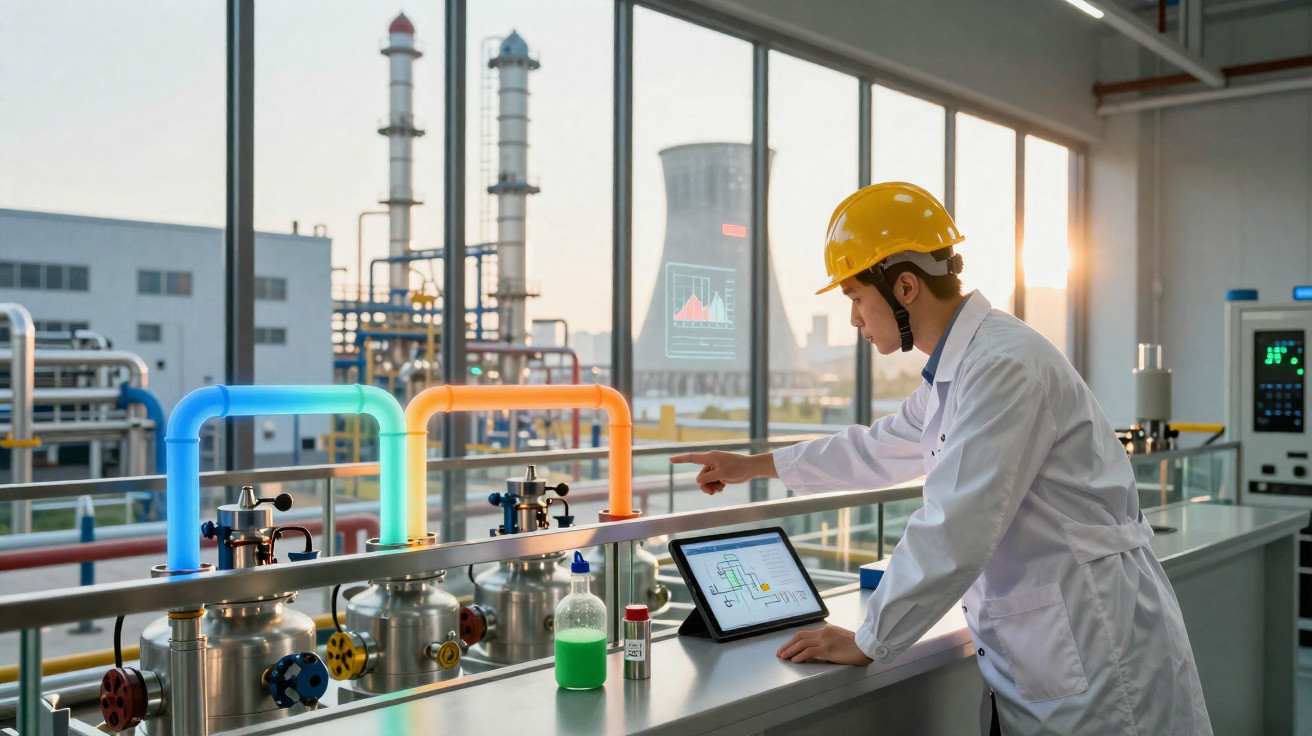
Ammonia is playing an increasingly important role in contemporary life, but making it continues to release substantial climate pollution.
Engineers have now outlined a workable approach intended to produce the same chemical with lower energy consumption and fewer emissions.
A factory-ready design
Ammonia serves numerous purposes in the modern economy. It is essential to inorganic fertilisers, while ammonia plants also supply industries producing plastics and explosives.
It is also under investigation as a liquid medium for carrying hydrogen.
The research was headed by Dr Sunghyun Cho, an assistant professor at Jeonbuk National University (JBNU) in South Korea.
His team develops carbon-neutral process systems, covering waste-to-resource projects, clean fuel production, CO2 capture and process optimisation.
Rather than requiring industry to replace its entire infrastructure, the researchers devised an interconnected reaction network that recycles important materials.
Ammonia’s energy requirements
The leading production method relies on pressure and heat, both of which are generally supplied by fossil-fuel combustion.
Under the Haber-Bosch process, facilities compress nitrogen and hydrogen to trigger a reaction, before cooling the mixture and recycling unreacted materials.
According to that assessment, ammonia manufacture accounts for roughly two per cent of total final energy use and generates around 1.3 per cent of energy-system CO2.
Any alternative process must reduce those demands while remaining capable of operating at the vast scale needed by agriculture and industry.
A lower-intensity chemical route
Rather than forcing gases through extreme conditions, chemical looping uses solids to transfer oxygen between reactors and can reduce energy losses.
Metal oxides are reduced in one reactor and re-oxidised in another, preventing air from being mixed with fuel streams.
“This method enables ammonia synthesis without the energy-intensive steps, significantly improving both sustainability and efficiency,” explained Cho.
However, the approach still relies on robust solid materials, as carriers that break down or become easily poisoned would undermine plant operation.
Oxides for nitrogen storage
One cycle in the proposed system employed aluminium oxide to bind nitrogen within a solid before using steam to release ammonia.
Initially, the material captured nitrogen in the presence of carbon, creating aluminium nitride, a compound that retains nitrogen until ammonia is liberated by steam.
Water vapour subsequently reacted with the nitrogen-rich material, releasing ammonia as the stored nitrogen was transferred once more.
Repeated operation was particularly important, since fragile solids would increase waste, downtime and costs over an industrial operating cycle.
Methane supplies carbon when needed
Carbon must be fed into the loops because the aluminium oxide stage requires solid carbon to capture nitrogen.
The researchers suggested methane thermal decomposition, in which methane is heated without oxygen until it separates into hydrogen gas and solid carbon.
The resulting solid carbon supplied the nitrogen-capture reaction, while the hydrogen could be used elsewhere within an integrated facility.
The climate benefit relies on managing that carbon properly, as burning it or allowing it to escape would remove the advantage.
Iron oxide completes the ammonia loop
A second loop using iron oxide managed nitrogen supply, removing the need for a separate nitrogen plant.
During this cycle, iron oxide moved between oxidised and reduced states before delivering nitrogen for the aluminium oxide reaction.
Carbon monoxide produced in the aluminium loop could also be used as feedstock, helping to advance the iron loop.
Such close integration can improve efficiency, although an interruption in one loop could also halt the other.
Energy performance assessed in two measures
To establish whether the concept could operate at industrial scale, the team evaluated simulated plant configurations.
They measured energy consumption and exergy – energy that is usable for performing work – to identify losses that heat measurements alone can conceal.
Compared with the conventional route, the integrated configuration increased energy efficiency by 8.4 percent and exergy efficiency by 19.0 percent.
Heat exchangers enhanced every design tested, demonstrating that effective heat recovery remains vital even when the underlying chemistry changes.
Measuring the climate effect
Efficiency influences costs, but climate impact depends on the warming caused by each pound of ammonia produced.
In the strongest scenario, the model reduced impacts by 15.85 pounds (7.2 kilograms) of CO2-equivalent, a standard measure for comparing heat-trapping gases, per pound.
This result was attributed to recycling reactants within the loops, which reduced the number of additional stages requiring extra fuel.
Actual emissions will depend on electricity generation sources and on whether the solid carbon is used, stored or sold.
Costs and risks under pressure
Emissions reductions are meaningful only if the economics are viable, especially as ammonia plants commonly operate for decades after construction.
For 2,204 pounds (1,000 kilograms) of ammonia, the integrated case cost 336.97 dollars, which the authors described as a 60.9 percent reduction.
Sensitivity analyses changed carbon prices and energy costs, yet the simulated system maintained stable performance under those variations.
“Our dual-looping technology can be applied across industries that require large-scale ammonia production while reducing carbon emissions and maintaining economic feasibility,” concluded Cho.
Potential applications for the system
The dual-loop approach illustrated how connecting carbon, nitrogen and heat streams could make ammonia with less waste.
Pilot-scale trials must demonstrate durable materials over the long term and safe carbon management before the design can be introduced into operating plants.






Comments
No comments yet. Be the first to comment!
Leave a Comment