
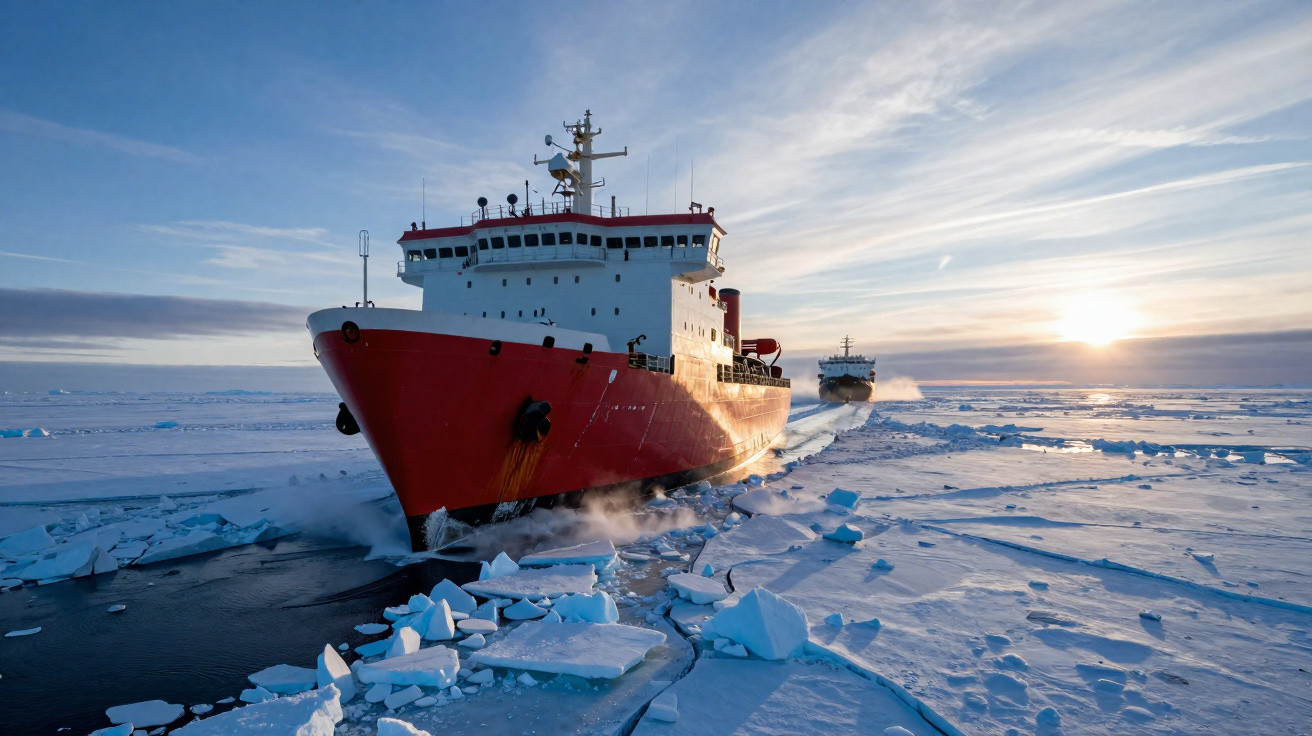
Russia is advancing a clearly defined model for polar trade, centred on compact nuclear power. Its latest step is Yakutia, the newest vessel in an expanding fleet of heavy icebreakers intended to keep the Northern Sea Route open for longer and make it safer.
A flag ceremony with a strategic purpose
On 1 January, Moscow celebrated Yakutia’s completion with a flag-raising ceremony that combined ceremony with policy. Senior officials took part by video link, while Rosatom’s leadership argued for year-round Arctic logistics. The message was unmistakable: Russia is seeking actual shipping traffic, rather than merely symbolic presence, in its polar waters.
Yakutia joins a nuclear icebreaker program built to shift Arctic shipping from a seasonal gamble to a managed corridor.
Yakutia and the Project 22220 design
Yakutia is part of Project 22220, the core class within Russia’s modern icebreaking fleet. It is 172.7 m long and has a beam of 34 m. Its variable draught allows the vessel to work in both deep Arctic channels and shallower coastal waters.
Its hull form and bow geometry are designed for ice measuring up to roughly three metres thick. The ship is able to make consistent headway through dense pack ice, helping to limit delays for cargo convoys travelling in its wake.
Propulsion is supplied by two compact RITM-series nuclear reactors. Combined, they produce 350 MW of thermal energy, providing substantial shaft power for propulsion and allowing long periods between refuelling.
Two reactors provide years of autonomy, which keeps the ship on station during the long polar season.
Key specifications at a glance
| Feature | Yakutia (Project 22220) |
|---|---|
| Length | 172.7 m |
| Beam | 34 m |
| Minimum operating draught | 9.03 m |
| Icebreaking capability | Up to ~3 m ice |
| Reactor power | 2 × 175 MW (thermal) |
| Endurance | Multi-year between refuelling |
| Primary role | Convoys, channel maintenance, Arctic escort |
Fleet growth and delivery plans
Yakutia is the fourth ship in its class, after Arktika, Sibir and Ural. Its sister ship, Chukotka, remains under construction. Officials have indicated that further hulls will arrive by 2030, with the target being a 17-ship nuclear icebreaker fleet for Northern Sea Route operations. This total covers both existing vessels and planned ships under separate project numbers.
That scale is important to Arctic logistics. Individual vessels cannot manage thousands of kilometres of ice alone. A fleet can position escorts, cycle ships through maintenance and increase capacity during peak cargo periods.
Northern Sea Route by the numbers
The Northern Sea Route (NSR) follows Russia’s Arctic coast, connecting the Barents Sea with the Bering Strait. Where ice conditions permit safe transit, it can shorten journeys between Asia and Europe.
Cargo volumes on the NSR reached fresh highs during 2024. Reported annual throughput was about 38 million tons, including energy cargoes, metals and project shipments.
About 38 million tons moved on the route in 2024, a record that underlines steady commercial interest.
- On selected Asia-Europe routes, distance reductions can be 30–40 percent compared with the Suez route.
- During favourable transit windows, voyage times can be reduced by one to two weeks.
- Dependability is determined by ice conditions, weather, escort availability and insurance terms.
- Current cargo volumes are weighted towards energy exports and industrial materials.
Sanctions and the drive for self-reliance
Sanctions have removed Western components from the supply chain. In response, Russian shipyards and suppliers have localised important systems. Yakutia incorporates domestically manufactured equipment across numerous subsystems. This approach lowers exposure to foreign restrictions while also accelerating learning within Russia’s marine nuclear sector.
Economics, strategy and the Arctic map
For Moscow, heavy icebreakers function both as strategic assets and economic instruments. They protect access to ports, terminals and resource areas along Siberia’s coastline. They also present foreign shipping operators with an alternative route when other corridors face congestion or disruption.
The benefits increase when operations become predictable. Convoy schedules that meet planned windows can attract insurers and charterers that might otherwise remain cautious. Routine escorts lower the risk of hull damage, while dependable pilots reduce delays. In this way, a seasonal passage can develop into a plannable corridor.
Environmental issues that remain unresolved
Nuclear propulsion reduces local air emissions from the vessel itself and removes the need for refuelling operations in vulnerable waters. These are significant operational advantages in the Arctic. However, nuclear equipment still carries a non-zero risk of accidents and demands rigorous management of spent fuel and radioactive waste.
Operators cite multiple containment layers, established naval procedures and remote monitoring. The vessel’s design includes double protection around reactor compartments, and emergency procedures have been practised for cold-weather scenarios. Oversight continues to be an active concern for coastal communities and scientists.
Ice, wildlife and indigenous livelihoods
Icebreaking alters the way sea ice forms and moves. This can affect seal haul-out sites and hunting routes that rely on predictable ice edges. Higher shipping volumes also increase noise during sensitive periods. Consultation with local communities and the sharing of data can help, although tensions may grow when shipping schedules conflict with traditional practices.
Who currently uses the corridor
Russian Arctic energy projects underpin demand for the route. LNG from Yamal and oil from northern fields depend on heavy icebreaker escorts during winter. Mining businesses transport nickel, copper and equipment through coastal ports, while international liner operators trial seasonal sailings when freight rates and ice charts are favourable.
The central issue is volume. Large and steady cargo flows require reliable transit windows and competitively priced insurance. Icebreakers reduce uncertainty, while port services, pilots and satellite ice mapping provide the remaining support.
What to watch next for Yakutia and the Northern Sea Route
Chukotka’s launch and sea trials will be key developments to follow. Additional hulls will increase escort capacity and provide greater redundancy. Spring and autumn shoulder-season activity also deserves attention, as longer operating seasons directly create more predictable schedules.
Satellite ice analysis will influence future planning. Improved models can reduce convoy idle time and lower fuel consumption for escorted vessels. As volumes grow, expect closer coordination among Rosatomflot, cargo owners and insurers.
Additional context for readers
The “350 MW” figure commonly describes the combined thermal output of the two reactors. Only part of that energy is converted into mechanical power at the propellers. Even so, the conversion produces sufficient thrust to force a reinforced bow through heavy, refrozen ice slabs. The distinction is relevant to both performance expectations and public discussion.
One practical method of understanding the route’s value is to run a straightforward planning exercise. Choose a summer operating window, then model Yokohama-Rotterdam voyages via Suez and via the NSR using conservative speeds and available icebreaker escort slots. Include insurance assumptions and delay allowances. In many instances, the model indicates a 10–15-day saving for the NSR, with costs becoming more appealing when freight rates rise on other routes.





Comments
No comments yet. Be the first to comment!
Leave a Comment