
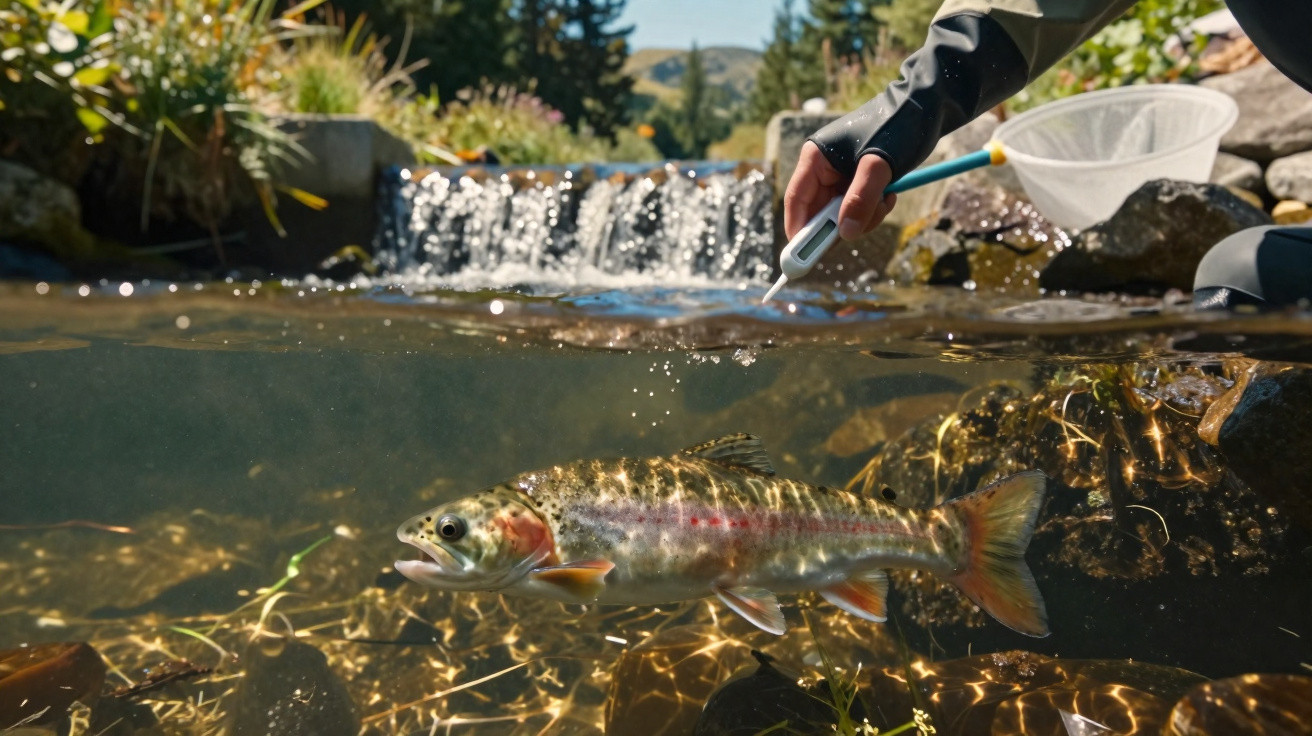
Small dams seldom attract significant notice. They neither loom above valleys nor command news coverage, and many appear to be insignificant features in rivers that otherwise seem healthy. Yet fresh research indicates that these unassuming barriers may subtly shift conditions against fish as summers become warmer.
By heating water downstream during the year's most demanding season, small reservoirs may produce circumstances in which trout struggle to persist and become more susceptible to illness.
A research team headed by Anti Vasemägi, a fisheries geneticist at the Estonian University of Life Sciences (EMÜ), examined brown trout above and below small dams in rivers across Estonia and Sweden.
The scientists identified a recurring trend: in summer, releases of warm surface water increased downstream temperatures by several degrees at precisely the point when trout are nearing their physiological thresholds.
These heated river stretches do more than place fish under stress. They also provide favourable conditions for parasites and the spread of disease, illustrating how small dams may exert disproportionate effects in a warming climate.
Trout parasites flourish downstream of dams
Below these reservoirs, young brown trout, Salmo trutta-a game fish valued by anglers-were found to carry more parasites than trout upstream.
The researchers linked this increase to Tetracapsuloides bryosalmonae, a microscopic parasite that infects trout and related salmon species.
In warmer sections of river, trout showed greater infection prevalence, larger parasite burdens and more serious proliferative kidney disease (PKD), a parasite-caused condition that damages the kidneys of fish.
This finding is important because PKD already occurs in wild and farmed salmonids-including cold-water trout and salmon-throughout Europe and North America.
Trout die-offs caused by disease
In 2016, PKD contributed to a large-scale fish kill in Montana's Yellowstone River, demonstrating how rapidly an outbreak can intensify.
Scientists put fish mortality at tens of thousands, while managers shut the river for several weeks in an effort to safeguard stocks.
The same report associated the outbreak with economic losses of almost $500,000, illustrating how disease can harm tourism and public finances.
Such incidents make the findings on dams seem more than academic, since disease-prone warm-water zones can endanger local livelihoods.
Warm water drives disease
As temperatures climb, trout must work harder to breathe because their bodies consume oxygen more rapidly.
Meanwhile, warmer water contains less dissolved oxygen, meaning that even heating of only a few degrees can greatly reduce their scope for survival.
Even before parasites begin multiplying, fish experience this pressure, with hearts and gills required to work harder simply to satisfy fundamental oxygen needs.
Heat subsequently offers the parasite a further benefit. Increased temperatures shorten its life cycle, enabling infections to accumulate rapidly after fish are exposed.
Before infecting trout, the parasite also passes through freshwater bryozoans-small colonial creatures attached to plants and rocks.
“Warmer water also increases parasite proliferation and accelerates disease progression, making salmonids anemic and less capable of extracting sufficient oxygen from the water,” Vasemägi said.
When heatwaves occur, this double effect-reduced oxygen and more rapid parasite growth-can transform a controllable infection into an abrupt die-off, particularly in small streams.
Kidney disease leaves trout weakened
PKD damages trout by enlarging their kidneys, organs responsible for regulating salt levels and clearing waste from the bloodstream.
While the immune system combats the parasite, inflamed kidney tissue may displace healthy cells and place strain on the entire body of the fish.
Affected fish may find it difficult to supply oxygen to their muscles, making routine swimming and feeding more demanding during hot periods.
This additional burden helps account for why juvenile fish frequently display the most severe symptoms and why hot summers can result in sudden losses.
Dams do not stop trout parasites
The study also provided limited evidence that dams form effective barriers to the parasite's movement through river systems.
Spores may be carried downstream by the current, while fish can transport infections as they travel, leaving barriers alone with little protective value.
This matters because one warm reservoir may increase risk not only nearby but also throughout connected downstream stretches.
Managers expecting a dam to contain disease could overlook these concealed pathways, especially in rivers containing numerous small barriers.
Signs of warning below dams
River reaches below reservoirs may function as sentinel sites, providing early indications of ecological problems.
When water temperatures increase or signs of disease become more common in these reaches, observers can identify concerns before they extend further downstream.
Monitoring need not be complicated: temperature loggers and regular fish-health inspections can be concentrated on the most vulnerable months.
However, an alert is useful only if agencies are able to respond swiftly, and many small dams stand on rivers that receive limited scrutiny.
Heat connects dams and disease
Although dams can provide electricity and water storage, restoration strategies are increasingly balancing those advantages against less visible biological consequences.
The new findings connect small dams with a closely linked chain of impacts: warmer water, parasites that spread more quickly, and trout deprived of oxygen during heat stress.
Removing certain dams and increasing streamside shade could maintain cooler water over the summer, reducing strain on cold-water fish and potentially slowing disease outbreaks.
The authors maintain that environmental impact assessments should directly consider temperature-driven disease, rather than focusing solely on habitat loss or obstructed fish passage.
This more comprehensive assessment could alter river-planning choices where funding is limited-deciding which dams remain, which are altered and which are removed.
Upcoming removal and retrofit schemes provide an opportunity to establish whether cooling rivers during heatwaves can sever the connection between warmer water and increasing disease risk.






Comments
No comments yet. Be the first to comment!
Leave a Comment