
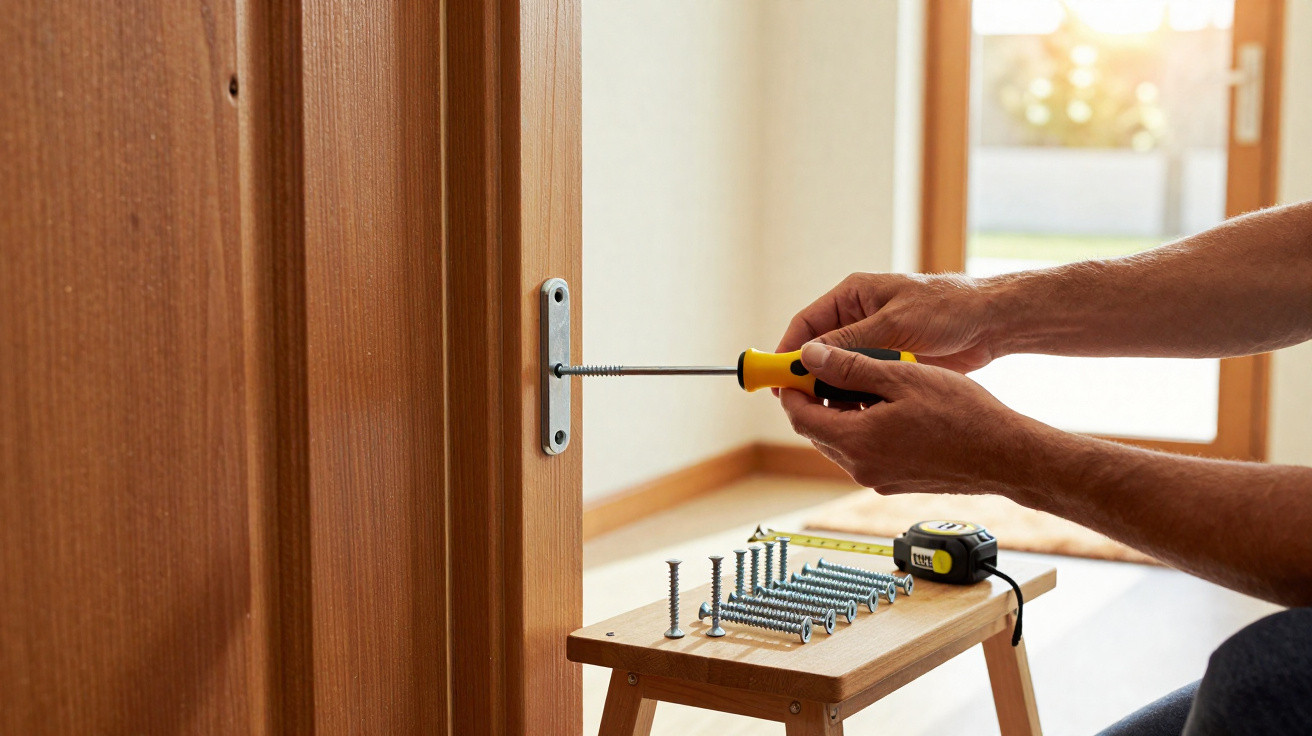
When you come home one evening with arms full of shopping, you rarely think about the door behind which you feel safe. Yet even a sturdy front door can have a surprisingly simple weak point: the small metal plate fixed to the frame that receives the lock bolt. If its screws are too short or only anchored in the trim, it will not withstand much force. The good news is that this can be addressed with a straightforward, affordable job, without replacing the lock or embarking on a lengthy project.
We all know the moment of checking twice that the door is locked before leaving for a weekend away. The click of the lock is reassuring, but security does not depend on the lock alone: it also relies on what is happening inside the frame. In around ten minutes, changing a few screws can make the whole assembly far more resistant to forced entry or a shoulder blow. It is an unobtrusive detail, but not an insignificant one.
The lock is not always the real weak point
On many doors, attention naturally goes to the cylinder, handle and keys. However, the bolt finishes its movement in a component known as the strike plate, fitted to the door frame. When this strike plate is held by short 15 or 20 millimetre screws, they may secure only the thin, sometimes hollow decorative moulding, without reaching the solid timber or wall structure.
Locksmiths often encounter the same situation: the door is still locked, but the frame has split around the strike plate after a heavy impact. The lock has done its job; the supporting material has failed. With suitable 70 to 80 millimetre screws that reach the solid door jamb behind the trim, the force is spread more effectively and the level of resistance genuinely changes.
This small DIY task will not turn a lightweight door into a safe, so it is important to be realistic. It does, however, address a common weak link, particularly in older properties, homes where work was completed hastily, or doors fitted with highly decorative finishes. Home security is often determined by these unseen details that no one notices until something goes wrong.
Reinforcing the strike plate: ten minutes, a screwdriver and suitable screws
Start by opening the door and inspecting the strike plate: this is the small perforated plate screwed into the frame opposite the lock bolt. Remove and replace one screw at a time so that the plate stays correctly positioned. Use a longer timber screw or appropriate fixing screw of the same diameter, ideally between 70 and 80 millimetres, depending on the true thickness of the frame.
The usual mistake is to buy the longest screws in the DIY aisle without checking what lies behind the frame. In a property with a metal frame, concrete wall, lightweight partition or uPVC frame, the approach needs adapting; an unsuitable screw may spin freely, distort the component or strike something concealed. Let us be honest: nobody really deals with this every day, and asking for advice with a photograph of the strike plate can prevent plenty of mistakes.
Before tightening everything fully, close the door gently to check that the bolt enters its opening without resistance. A slightly misaligned strike plate puts unnecessary strain on the lock every day and creates that frustrating need to push, pull or lift the handle before it will lock.
“A door is only as strong as the point where the lock bolt bears against it.”
- Select screws with heads that fit the holes in the strike plate;
- Fix into load-bearing material, rather than only the finishing trim;
- Test the door by closing it several times before putting the tools away;
- Stop and seek professional advice if the timber is cracked or crumbly.
A modest reinforcement that changes how you assess the rest
This upgrade often costs less than ordering a meal on a tired evening, yet it strengthens a critical part of the door. It can also have a very practical everyday benefit: you lock up without thinking about it, leave home with greater peace of mind, and finally understand why a door felt vulnerable despite having a recent lock. The right solution is not necessarily the most expensive one.
Take the opportunity to inspect the general condition of the frame, the gap between the door and its frame, the security of the hinges and the lighting outside the entrance. A properly adjusted door that is visible from the street and fitted with a good-quality cylinder creates a more coherent level of protection than a single dramatic accessory bought in a hurry. If you rent your home, a simple conversation with your landlord or letting agent may be enough before making any alteration.
There is something reassuring about these modest actions: they do not promise invulnerability, but they reduce an avoidable weakness. A few longer screws are no replacement for a certified door or an alarm where the situation calls for one, but they give the lock anchoring that matches its role. This discovery is also often passed from neighbour to neighbour, after someone has opened up their door frame and wondered why nobody had shown them this sooner.
| Key point | Detail | Benefit for the reader |
|---|---|---|
| Reinforce the strike plate | Replace short screws with suitable 70 to 80 mm screws | The lock bolt anchors into a stronger section of the frame |
| Check the supporting material | Identify timber, metal, uPVC or masonry before buying | Prevents ineffective fixings and unnecessary damage |
| Test the door closure | Check alignment after tightening | Protects the lock and ensures smooth locking |





Comments
No comments yet. Be the first to comment!
Leave a Comment