
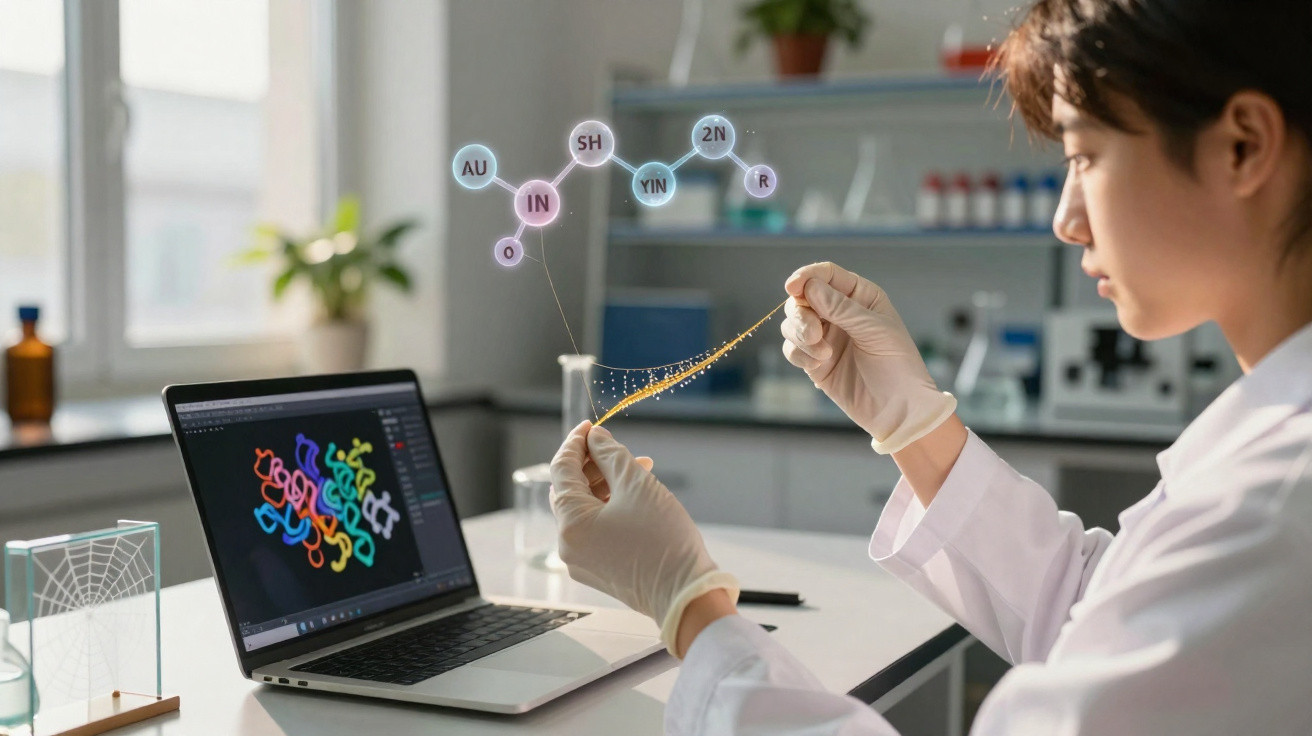
Spider silk is renowned for pairing strength with flexibility in a way that very few materials can equal. However, scientists have struggled for years to determine precisely how spiders transform liquid proteins into threads with such lasting durability.
New research suggests the explanation may be unexpectedly straightforward: a persistent chemical attraction holds protein chains together at the pivotal point when silk starts to solidify.
Scientists at King’s College London followed this minute molecular bond as silk proteins progress from liquid droplets to completed fibre. Their findings show that the same interaction helps shape the structure of the finished thread.
Pinpointing this crucial connection gives engineers a more defined guide for creating next-generation synthetic fibres for protective equipment, medical materials and other advanced applications.
Protein links initiate spider silk
Within the silk protein chain, two amino acids - arginine and tyrosine - repeatedly come together to create an important bond.
Arginine has a positive charge, whereas tyrosine contains a flat carbon ring that naturally attracts that charge. Chemists refer to this as a cation-pi interaction.
The attraction recurs throughout the protein, helping to keep neighbouring chains close during the first stages of silk production. In a spider’s gland, the proteins are held as “silk dope”, a viscous liquid that stays stable until the spinning process starts.
As chemical conditions change - particularly when certain salts are present - the mixture divides into concentrated protein droplets within a clearer liquid.
Phosphate ions help direct arginine towards tyrosine, increasing the strength of their attraction and promoting droplet formation.
After the droplets emerge, they provide an early template that directs the proteins as the fibre subsequently contracts and dries into a completed thread.
Droplets form a tough fibre
As spinning takes place, the spider pulls the droplets into a strand while proteins start to align as water is removed.
Rather than separating, the attraction between arginine and tyrosine continues to join nearby chains, allowing the developing thread to retain those same links.
More loosely arranged sections remain flexible, while the recurring bonds help organise the material into stronger regions as the strand becomes narrower.
“This study provides an atomistic-level explanation of how disordered proteins assemble into highly ordered, high-performance structures,” said study co-author Christian Lorenz, the head of the Department of Engineering from King’s College London.
Simulations reveal spider silk structure
After the strand had formed, some sections of the silk protein became densely packed and others stayed elastic, producing its unusual combination of strength and flexibility.
Within the compact areas, beta sheets - flat, layered folds that secure protein chains together - formed the structural backbone of the thread.
Around the edges of these sheets, arginine could become part of the ordered layers, whereas tyrosine often curved the chain into turns, helping to form the nearby structure.
By weight, this structure enables spider dragline silk to match steel in strength while exceeding Kevlar in toughness.
Since silk develops extremely rapidly and at dimensions too small for direct observation, the researchers also used computer simulations to investigate the process.
The King’s College London researchers found that phosphate ions displaced water, raising the frequency with which arginine and tyrosine encountered each other and formed their key attraction. AI-based structural models subsequently located these amino acids near the boundaries of the ordered regions, closely corresponding with laboratory measurements.
Despite this close match, the researchers stress that simulations cannot represent every force within a living silk gland. Actual spinning conditions therefore remain significant.
Developing improved synthetic fibres
Materials engineers seek fibres that are durable, lightweight and able to break down safely after use. Following silk’s pattern, they can introduce a small number of persistent chemical links into a chain while allowing the remainder to move freely.
Earlier efforts to spin laboratory-produced spider silk have frequently failed to achieve the desired results, and one review outlines why the process is so sensitive.
“The potential applications are vast – lightweight protective clothing, airplane components, biodegradable medical implants, and even soft robotics could benefit from fibers engineered using these natural principles,” said Lorenz.
Why brains are mentioned
Some human proteins also divide into droplets, and evidence associates this behaviour with neurodegeneration, the gradual loss of nerve cells.
In several diseases, including Alzheimer’s disease, proteins that initially blend as liquids can eventually set into beta-sheet-rich clusters that damage cells.
Spider silk gives scientists a way to observe this transition without the complicated conditions of a human brain, before looking for points at which it could be controlled.
Nevertheless, any medical significance will require thorough follow-up, as silk evolved to create strong spun fibres rather than to transmit signals between neurons.
Inspiration for engineered materials
This detailed King’s College London research still examined only one part of silk production, concentrating on the chemistry that initiates clustering.
In living organisms, the actual spinning ducts also compress, extend and acidify the liquid, and these effects could further alter the same molecular contacts.
Future studies can investigate other charged and ring-shaped amino acids, as well as whether newly engineered fibres preserve their strength after exposure to heat or prolonged wear.
For industry, the results provide a design principle that can be reproduced, though scaling up production will continue to demand patience.
By connecting one particular chemical attraction with both droplet formation and the final thread, the research explains how silk combines structural order with molecular movement.
Using this principle in manufactured proteins could enhance recyclable fibres and medical materials, while helping scientists understand how to regulate protein phase behaviour more effectively.






Comments
No comments yet. Be the first to comment!
Leave a Comment