
The first truly cold evening of the year always seems to arrive at exactly the wrong time. You get home with icy fingers, turn the thermostat up slightly, then wait for the comforting rush of heat that never arrives quickly enough. The radiator is hot when you touch it. The room, however, remains cold.
Someone online swears that aluminium foil behind radiators is the answer. A friend says the real solution is heavier curtains. You test a little of everything, partly hopeful and partly doubtful, while each new attempt seems to push your energy bill higher.
Yet there is a quieter, almost unnoticed change that can make a room feel warm much sooner.
And it has nothing to do with foil.
No, foil is not the real issue
Aluminium foil placed behind radiators has become the DIY version of a magic charm. It is inexpensive, reflective and easy to stick to a wall, so it appears ingenious and we want to think it will work wonders. For plenty of homes, though, its benefit is minimal and can sometimes be almost impossible to measure.
The more mundane truth is also more effective. How quickly a room heats up depends less on foil than on the way heat travels through the air and around your furnishings. If warm air is trapped, obstructed or directed poorly, it can take a long time before the room genuinely feels comfortable.
Imagine a compact living room with a large, soft sofa pushed directly against the radiator “to save space”, while a heavy curtain covers part of the window and part of the radiator. The occupant complains that “these old heaters don’t work anymore” and repeatedly raises the thermostat.
A thermal camera would reveal another picture. The air behind the sofa and curtain, close to the radiator, is extremely hot. Yet at head height in the middle of the room, the temperature is several degrees lower. The heat has been generated and paid for, but it is being held back exactly where the air needs to move.
In physical terms, radiators do more than radiate heat; they heat mainly by convection. Hot air rises and cool air sinks, creating an unseen cycle that gradually distributes warmth around the room. Obstruct the radiator at the bottom, across the front or in the area immediately above it, and you interrupt that cycle.
This is why foil can be a distraction. It may modestly limit heat loss through an uninsulated wall, but a sofa, full-length curtains, drying clothes or a large cabinet pressed close to the radiator will still leave the room painfully slow to warm. Altering the airflow around the radiator produces results that are much faster and easier to notice.
The smarter radiator trick: release heat and direct the air
The more effective approach begins with a straightforward step: create a 20–30 cm “breathing zone” around each radiator. Avoid placing sofa backs against it, shelving in front of it, storage boxes beneath it or curtains over its top. There should be room below for cool air to enter and room above for warm air to rise without restriction.
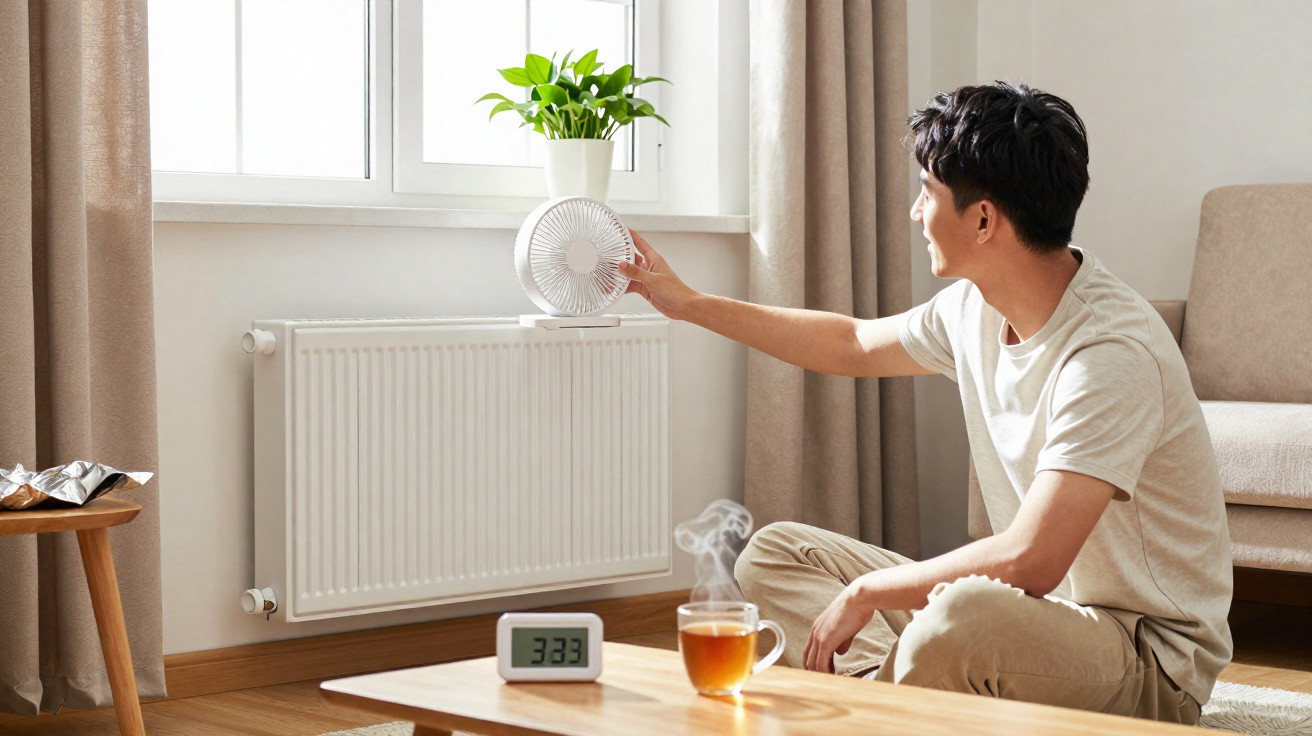
Next, use items you already own to help “direct” the warm air. A compact, quiet fan on the floor, running at its lowest setting and aimed slightly upwards near the radiator, can dramatically reduce the time a room takes to warm. It does not create extra heat. Instead, it mixes the air more quickly, preventing warmth from lingering by the wall and helping it reach you.
This runs counter to the way many of us think. Fans are seen as appliances for cooling, while radiators can feel like separate, untouchable fixtures. However, energy specialists have repeatedly carried out the same comparison: two similar rooms, two similar radiators, but only one with a small fan circulating the air.
The room with the fan reaches a comfortable perceived temperature several minutes sooner, often with the thermostat set lower. The explanation is almost too straightforward. The fan disrupts pockets of hot air that gather near the radiator and ceiling. Rather than only sensing warmth by the window, you begin to feel it at sofa level.
There is a mental trap here. We often fixate on gadgets - foil rolls, radiator boosters and smart stickers - while overlooking the fundamentals: room, air and movement. A radiator squeezed into a corner and covered by fabrics may be operating perfectly while providing only half of its potential comfort.
Free it up and increase the airflow slightly, and the same heating output feels entirely different. Warmth becomes more evenly spread, draughts seem less harsh and the “cold corner” becomes usable. It is not about generating more heat; it is about allowing the heat you already pay for to reach your skin.
How to create a “fast-warm” room
Begin with a careful walk around your home, room by room. Stand before every radiator and consider what is obstructing the air route. If a sofa is against the radiator, move it away; even 10–15 cm can make a difference. Where curtains hang over the top, shorten or tie them back so they finish immediately above or below the radiator rather than covering it halfway.
After that, clean the radiator fins or panels. Dust behaves like a soft blanket, slowing the transfer of heat. Usually, a quick vacuum followed by a wipe with a damp cloth will do. Realistically, nobody does this every day. Completing it once at the beginning of the heating season is already a worthwhile improvement.
Then try the “fan trick”. Use a small desktop fan or a quiet tower fan. Set it on the floor near, rather than directly against, the radiator, aiming it across the room or gently upwards. Keep it on its lowest speed. You are not trying to make a chilly breeze; you want a mild current that blends the air.
On their first attempt, many people make the same error: they run the fan too powerfully or point it straight at their face, making themselves feel colder. If this happens, tilt it towards the ceiling or the opposite wall, allowing the air to rebound and circulate gently. Within ten minutes, you may often find that your hands and feet feel warmer without changing the thermostat.
“Once I stopped obsessing over tricks like foil and just moved my sofa and used a tiny fan, my living room finally felt warm without turning the heat higher,” says Laura, 37, who lives in a poorly insulated rental. “The bill didn’t explode, and I actually enjoy sitting by the window now.”
- Keep space around radiators
Leave 20–30 cm clear wherever possible, particularly at the top and bottom. - Run a fan at low speed
Position it near the radiator to distribute warm air evenly without causing a draught. - Manage your curtains
Shorten or tie them back so they do not cover the radiator or hold heat against the wall. - Leave the radiator top clear
Avoid decorative shelves, books or clothing on top, as these prevent warm air from rising. - Focus on one room at a time
Start with the room where you spend your evenings, so you gain quicker comfort where it matters most.
Rethinking comfort during the cold season
After seeing how fast a room can heat up when warmth moves freely, it is difficult to return to old habits. The fixation on foil begins to resemble faith in a lucky charm. Comfort is not simply about purchasing equipment or increasing the thermostat; it is also about how your home breathes.
We have all had that moment when we blame the heating system, the building or even the weather, although the answer is quietly sitting in the layout of the room. Move a sofa, alter a curtain hem or repurpose a small summer fan, and the room can suddenly feel changed: more welcoming, more alive and less uninviting when you arrive home at night.
Some people will continue sticking foil to the wall and praising the results, and that is fine. The more important change is one of mindset: replacing quick, shiny solutions with smarter, nearly invisible adjustments that have a genuine effect. They are the sort of changes guests may not spot, except that they keep asking, “Your place feels so cosy lately, what did you do?”
You may find yourself trying further changes: shutting doors to retain heat where you are, laying rugs to reduce the chill from the floor or arranging furniture around the way warmth travels rather than simply where the television fits. That is when a home starts to work with you, instead of against you, every winter.
| Key point | Detail | Value for the reader |
|---|---|---|
| Free the radiator | Keep 20–30 cm clear around radiators and do not obstruct them with furniture or curtains | The room heats more quickly without additional energy use |
| Use a small fan | Place a low-speed fan near the radiator to mix warm air and minimise hot and cold areas | More even comfort at a lower thermostat setting |
| Prioritise airflow | Clean radiators, adjust fabrics and consider how air moves around the room | Makes existing heating feel like effective, usable warmth |
FAQ:
- Does aluminium foil behind radiators work at all? It may slightly reduce heat loss through thin, uninsulated external walls, but its effect is often small compared with improving airflow and removing obstacles around the radiator.
- Will a fan “cool” the room rather than warm it? A fan does not alter the air temperature; it circulates air. When used gently near a radiator, it distributes warm air around the room, which generally helps you feel warmer sooner.
- How far away should furniture be from a radiator? Ideally, keep at least 20 cm between the radiator and large furniture. Greater clearance is better still, especially above and below, where air needs to circulate.
- Are long curtains really that much of a problem? Yes, when they cover the radiator. They hold hot air between the fabric and wall, stopping warmth from spreading into the room. Shorten or tie them back to let the radiator “breathe”.
- Can these tricks lower my heating bill? Their main benefit is improving the speed and distribution of comfort. Once a room feels warm sooner, many people find they can reduce the thermostat slightly, which may lead to noticeable savings across a full winter.





Comments
No comments yet. Be the first to comment!
Leave a Comment