
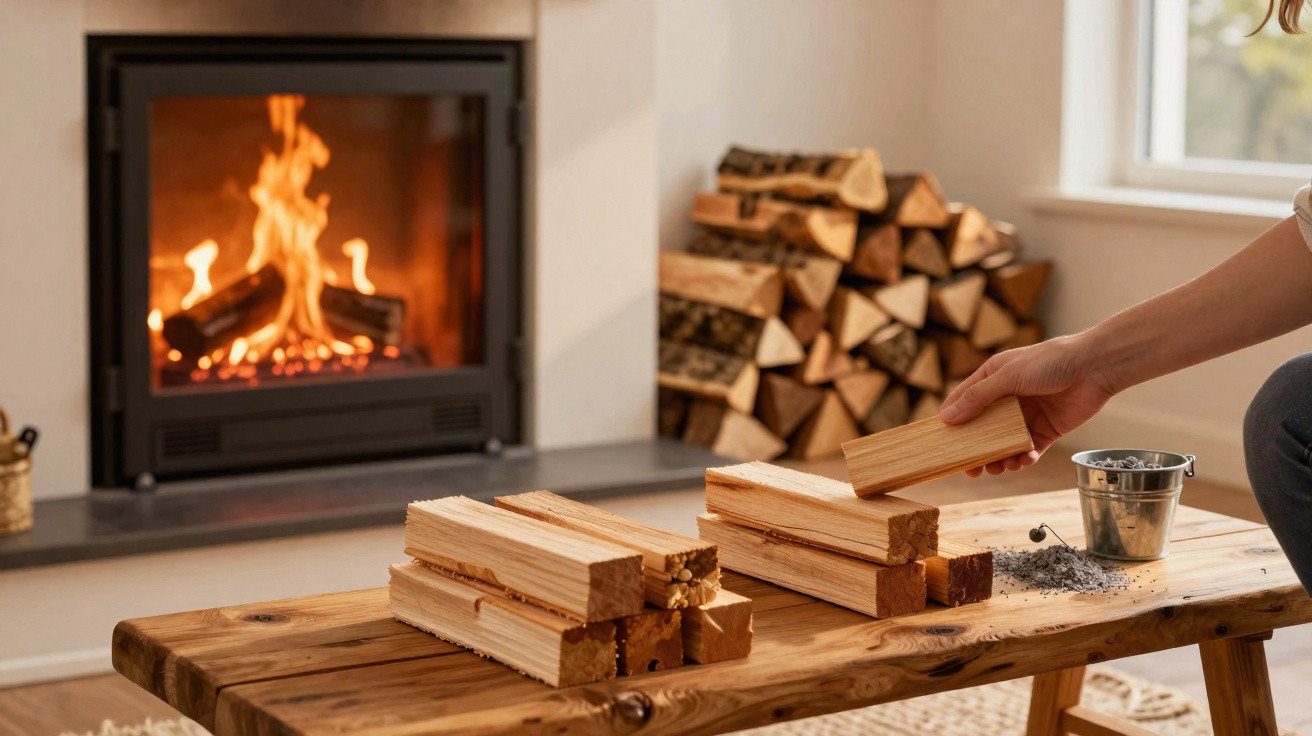
People who rely on wood in winter usually think of traditional firewood from a DIY retailer or forestry supplier. Yet another fuel is now gaining ground: highly compressed wood briquettes made from sawdust and wood shavings. They may look unremarkable, but in day-to-day heating they can make a substantial difference to both household budgets and the environment.
What compressed wood briquettes are made of
Compressed wood briquettes, often called pressed-wood or fireplace briquettes, are produced from dry sawdust and leftover wood material compressed under immense pressure. No adhesive is added; the wood binds through its own lignin structure.
This creates a particularly dense, consistently formed fuel with clearly defined properties. In contrast to conventional logs, there are few surprises concerning moisture content or wood type.
“Because they are so densely compressed, wood briquettes can deliver up to 300 per cent more usable heat per kilogram than many conventional logs.”
That predictability is one reason why a growing number of households are switching from loose logs to briquettes, at least in part.
Why pressed wood performs so much better in a stove
High energy density rather than ‘air in the wood’
The key factor is calorific value. Compressed briquettes generally achieve around 4.8–5.2 kWh per kilogram. Even well-seasoned firewood often reaches only about 2–3 kWh per kilogram.
- Briquettes: around 4.8–5.2 kWh/kg
- traditional firewood: around 2–3 kWh/kg
This is largely down to moisture. Briquettes usually contain less than 10 per cent moisture, whereas ordinary firewood, even when properly stored, is more commonly at 20–30 per cent. Moisture in the wood must evaporate before the stove can properly get going. That energy is then unavailable for heating the room itself.
Clean, consistent combustion
Since briquettes are dense and uniform, they burn more steadily and predictably. They create less smoke, reduced flickering and fewer flying sparks. Those with a fireplace fitted with a glass door will notice that the glass stays clean for considerably longer.
The chimney benefits too. Less soot and tar means fewer deposits, which in turn reduces the risk of chimney fires and cuts cleaning costs.
Less ash and less carrying
Their high calorific value means less ash remains once combustion is complete. This reduces the work of emptying the stove and limits dust in the living area. At the same time, less fuel is simply needed to produce the same quantity of heat.
“Anyone who previously needed a trailer full of logs can achieve a similar heating output with roughly a quarter of the volume in briquettes.”
A space-saver in the cellar: storage and handling
Storage space is another advantage. Compressed wood briquettes make efficient use of available room. They are supplied in manageable packs, can be stacked like bricks and do not fall apart.
For households without a large garage or shed, this is a genuine benefit. Roughly speaking, briquettes take up only a quarter of the volume needed for the same amount of energy in log form.
How to store briquettes correctly
- Keep them dry and well ventilated, such as in a cellar or beneath a canopy.
- Do not place them directly on a damp floor; a pallet or wooden battens are better.
- Open the plastic wrapping only partly so that residual moisture can escape.
Provided the packs are kept dry, they can generally be stored for several years without any significant loss of quality.
How pressed wood compares with firewood
| Feature | Compressed wood briquettes | Traditional firewood |
|---|---|---|
| Calorific value (per kg) | approx. 4.8–5.2 kWh | approx. 2–3 kWh |
| Moisture content | < 10 % | 20–30 % |
| Space required | very low | considerably higher |
| Ash volume | low | noticeably higher |
| Environmental balance | good (use of leftover wood) | heavily dependent on forestry practices |
From an environmental perspective, briquettes score well because, ideally, they are made from by-products that would otherwise need to be disposed of. Sawdust, planer shavings and industrial wood offcuts are therefore given a second use.
Using briquettes properly in everyday life
Briquettes are handled slightly differently from conventional logs. However, following a few basic points makes them easy to use quickly.
The ideal way to start a fireplace or stove
- Build the fire first using firelighters and small pieces of very dry wood.
- Only place one or two briquettes on top once a stable bed of embers has formed.
- Keep the air supply more open initially, until the briquettes are burning properly.
Briquettes need a slightly higher starting temperature, but then burn for a long time and at an even rate. Many users get used to adding just one briquette in the evening rather than continually putting several logs into the stove.
Air control: the key to efficiency
Managing the air supply sensibly gets more from the fuel. Too much air causes briquettes to burn away quickly, while too little produces smoke and incomplete combustion. It is worthwhile carrying out short trials with different settings on your own stove.
Drawbacks of briquettes – and who they suit
Naturally, there are disadvantages too. Briquettes generally seem more expensive to buy than a cubic metre of firewood. Once calorific value is taken into account, however, the difference often evens out or may even favour briquettes.
- Higher individual price: You pay more per pack, but use less fuel.
- Local availability: In rural areas with an established wood supply, briquettes are still scarce in some places.
- The feeling of a fire: Some fireplace enthusiasts miss the characteristic crackle and irregular flame of logs.
Nevertheless, briquettes can be the more sensible option, particularly for people with limited space, no wood store of their own or a greater heat requirement over winter.
Where to buy the fuel and what to look for
DIY retailers, heating-fuel merchants and many online shops now stock a range of wood briquettes. The selection can quickly appear confusing, but quality differences are real.
Quality criteria buyers should check
- stated calorific value in kWh/kg
- moisture content (ideally < 10 per cent)
- origin of the wood (for example, PEFC- or FSC-certified sources)
- clear confirmation that no chemical binders are included
It is worth buying one or two packs as a trial before ordering an entire pallet. This allows you to see how your own stove responds and how the warmth feels throughout the house.
What consumers should also know
The term ‘calorific value’ repeatedly causes confusion. What matters is not the volume of a stack of wood, but the energy per kilogram and how much of it actually reaches the room. Wet wood wastes a large share of its energy as water vapour in the chimney.
Those seeking a combination of convenience and low emissions can also combine briquettes with other measures, such as a hydraulically balanced heating system, good insulation, or support from a heat pump or solar thermal system. The more efficiently the house operates overall, the greater the effect high-quality fuels have on heating bills.
The main risks result from incorrect use: adding too much fuel at once, closing off the air supply or having an inadequate flue draw. Guidance from a fireplace installer or chimney sweep, together with checking the stove’s operating instructions, prevents damage and ensures briquettes can fully deliver their potential.
Comments
No comments yet. Be the first to comment!
Leave a Comment