
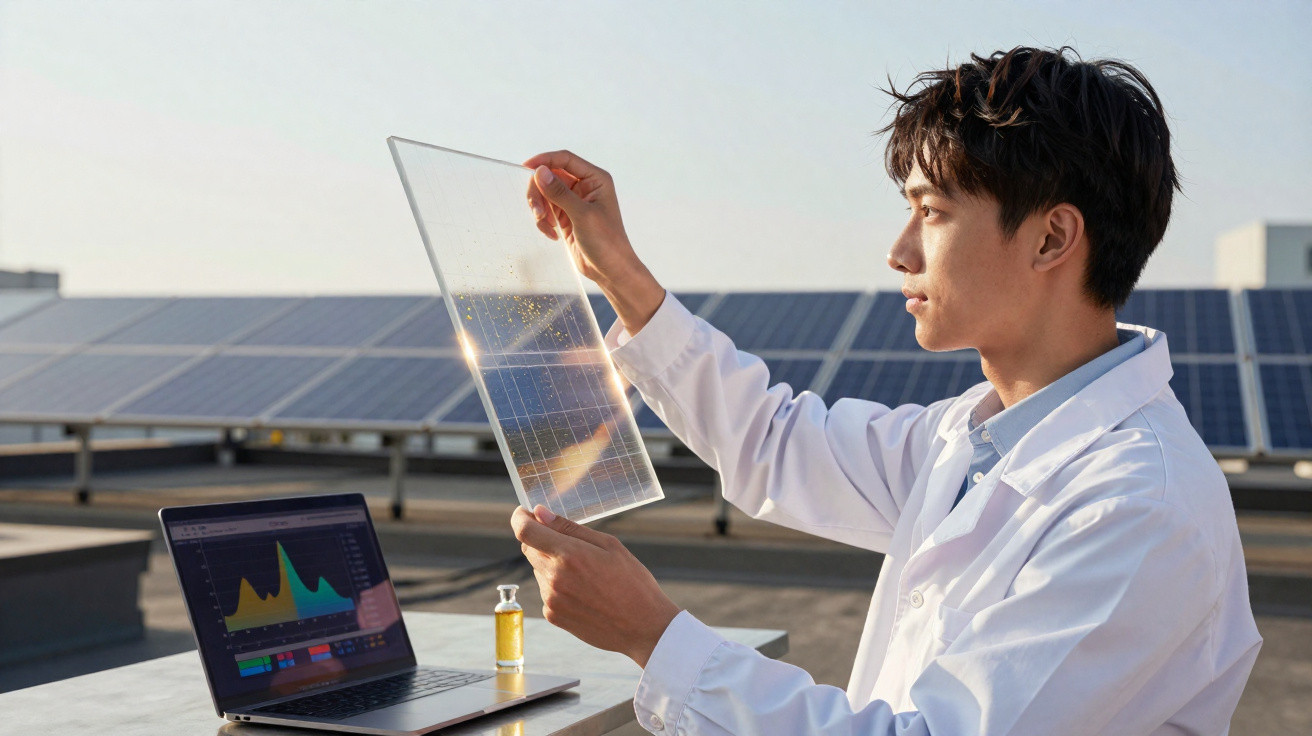
Researchers in South Korea have reported a gold nanotechnology capable of absorbing far more sunlight than earlier approaches. Rather than creating entirely new exotic solar cells, they apply a thin coating of specialised “gold spheres” to existing technology. Initial measurements sound spectacular – but there is still a long way to go before it could appear on rooftops.
Why conventional solar panels waste so much solar energy
Every second, the Sun sends enormous quantities of energy to Earth – theoretically enough to meet global electricity demand in full almost every hour. In reality, solar panels capture only a fraction of it. Even high-quality monocrystalline silicon modules currently tend to achieve efficiencies of between 20 and 22 per cent.
The reason is partly physics. Sunlight contains a broad range of wavelengths, stretching from ultraviolet through to deep infrared. Silicon solar cells, however, respond only to a particular portion of that range. The remaining light is either reflected or simply heats the cells without producing usable electricity.
In specialist circles, this is often discussed in relation to the so-called Shockley–Queisser limit. It defines the theoretical maximum for a conventional single-junction solar cell made from one semiconductor material, such as silicon. For years, researchers have been looking for ways to push this limit by directing and splitting light more effectively, or by using several layers of different materials.
What makes gold nanoparticles unusual
Gold is more than a precious metal used in jewellery and investments: at nanoscale, it has intriguing optical properties. Gold nanoparticles behave very differently from a gold bar kept in a vault.
The key phenomenon is known as “localised surface plasmon resonance”. Put simply, when light strikes a gold nanoparticle, the metal’s free electrons begin oscillating collectively. This enables the particle to absorb light very efficiently, rather than merely reflecting it.
“Nanoscale gold can swallow light that an ordinary lump of gold would simply reflect with a shine.”
Each individual nanoscale sphere does, however, have a drawback: it is sensitive to only a relatively narrow wavelength range. The precise colour it responds to is directly determined by its size and shape. A single particle size can therefore use only a narrow segment of the solar spectrum.
The “supraball” concept: multiple sizes within one gold sphere
This is where the team at Korea University comes in. Instead of continuing to use isolated, uniform nanoparticles, the researchers developed tiny spheres made up of numerous gold nanoparticles of different sizes – effectively clustered spheres.
They call these structures “supraballs”. Their advantage is that the particles inside each ball respond to different wavelengths. Working together, they can absorb a much wider range of light than a conventional film containing nanoparticles of equal size.
The way these supraballs form is also notable. They are not laboriously assembled particle by particle; instead, they create themselves. Under the right conditions, the gold nanoparticles spontaneously arrange into spheres. This self-assembly effect is of interest to industry because it could potentially reduce both costs and manufacturing stages.
Simulations as the first stress test
Before starting laboratory work, the researchers used supercomputers to run calculations. In their simulations, they adjusted the diameter and composition of the supraballs until the model covered as much sunlight as possible. On paper, the result suggested that the structures could theoretically absorb more than 90 per cent of the relevant wavelengths in the solar spectrum.
Predictions of this kind are not proof, but they are an important stage. They indicate whether an approach is worth pursuing at all or would deliver only marginal gains in practice.
Laboratory test: almost twice as much light captured
The next step was a rigorous test using real hardware. Rather than building a new solar cell from scratch, the team coated a commercially available thermoelectric generator with a solution containing the supraballs. Once dried, it left a thin film across the surface.
They then used an LED-based solar simulator. This illuminates devices consistently with light resembling solar radiation, allowing different prototypes to be compared objectively.
“The generator with the supraball film achieved an absorption rate of around 89 per cent – while the comparison device with a conventional gold nanoparticle film reached only about 45 per cent.”
In other words, under identical conditions the supraball film captured almost twice as much light. For researchers who have spent years pursuing tiny efficiency improvements, results of this scale are spectacular.
What does this mean for rooftop solar panels?
It is important to put this into context: the study demonstrates that light absorption can be improved substantially. It does not prove that a solar panel will ultimately produce twice as much electricity. Many further losses occur between photon absorption and the final electron entering the electricity grid.
Numerous effects contribute, including electrical losses in the material, contact resistance, heat generation, shading, ageing and more. A coating film that captures more light is one component, not a complete solution.
- Greater absorption initially means that more potential energy is available.
- How much of that energy a particular module actually converts into electricity depends on its construction.
- The technology must fit established manufacturing processes, cost limits and standards.
Why the long route to market readiness is often underestimated
The researchers themselves make no secret of the fact that this is fundamental research. Nobody on the team is promising that supraball modules will be available from DIY retailers within a few years. Developments of this sort often take many years, and sometimes decades.
The solar industry is now a mature and intensely competitive market with very low margins. Manufacturers optimise every penny spent on materials, production and installation. Any new technology must therefore do more than work technically: it must also be suitable for production in millions of units and withstand high temperatures, moisture, hail and UV radiation over a lifespan of 20 to 30 years.
There are also regulatory tests, certifications and the reluctance of major manufacturers to jeopardise production lines that already work. Against this backdrop, many highly promising laboratory concepts fail during the transition to mass manufacturing.
Where supraballs could play a role in future
Even so, the concept becomes more appealing because of how it could be used: in theory, a thin film can be applied to existing modules or other energy converters. That means the entire solar architecture would not need to be reinvented; an additional layer could simply be added.
Potential applications extend beyond conventional solar panels to include:
- concentrating solar systems, in which mirrors focus light
- thermoelectric generators that convert temperature differences into electricity
- hybrid modules that deliver both electricity and heat
- small sensors and IoT devices that need to operate with weak ambient light
In all of these cases, increased sunlight absorption would offer a clear benefit. For miniature devices in particular, even a small gain can determine whether something “works” or “fails constantly”.
How expensive is gold in this form?
At first, gold sounds like a luxury material. Solar cells are more commonly associated with inexpensive metals and large surface areas. With nanostructures, however, that impression changes because the quantities involved are extremely small.
A nanoparticle is tiny, and a supraball remains microscopic. The amount of metal used per square metre stays limited, even if the surface is densely covered with such particles. The main cost drivers are more likely to be the process itself: chemicals, specialist equipment, clean rooms and quality control.
If supraballs can be manufactured through simple, scalable wet processes, material prices could become less significant. Ultimately, the decisive issue is not the price of a gram of gold, but whether the coating line can operate reliably at gigawatt scale.
What non-specialists can take from this development
For homeowners currently considering a solar installation, nothing changes in the short term. Today’s available modules are mature, falling in price and deliver solid efficiencies. Nobody should delay a purchase while waiting for a laboratory idea that may or may not eventually become ready for series production.
The study is especially interesting as a glimpse of a possible future for solar technology. It shows that there is still room for improvement in optics. Carefully designed nanostructures could one day allow a module to use substantially more light without changing its basic principle.
Anyone who looks more closely at energy issues will encounter a central pattern: many advances do not come from a single “miracle cell”, but from clever additional layers, new coatings or smart combinations of different materials. The gold supraballs from South Korea fit precisely into that picture – as another building block on the long path towards even more efficient solar energy.






Comments
No comments yet. Be the first to comment!
Leave a Comment