
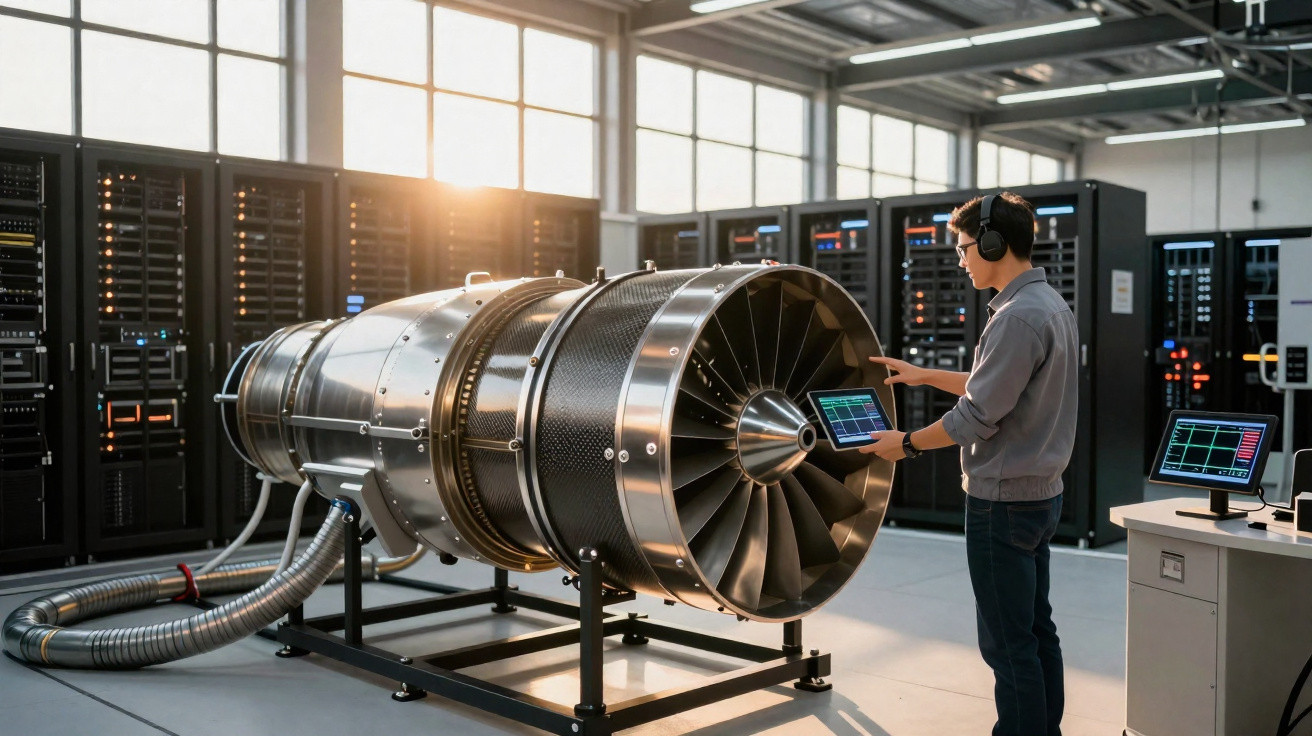
A fresh US energy experiment is discreetly bringing together military aviation engineering and the rapid expansion of cloud-computing infrastructure.
Across America, engineers and policymakers are exploring an unusual proposition: deploying a turbine based on supersonic aircraft-engine technology to supply the vast volumes of electricity required by today’s data centres, offering greater flexibility while reducing pressure on public grids.
Why data centres are stretching the grid to breaking point
Data centres are now as essential as ports and railways. They support social media, streaming services, banking networks, AI models and an increasing range of public services. A single new site can use as much electricity as a small city.
In the United States, growth in AI training clusters and cloud services is gathering pace. Virginia, Texas, Ohio and Georgia are among the states experiencing double-digit increases in electricity demand from data centres. Local grid operators are finding it difficult to match this demand, particularly where transmission networks are already congested.
Some new data centre projects are being delayed, not for lack of funding or land, but because the local grid cannot promise enough megawatts in time.
This pressure is leading companies and public authorities to consider other options, including on-site gas turbines, small modular reactors over the longer term, large-scale battery installations and direct agreements with renewable-energy schemes. The latest American initiative forms part of this wider hunt for controllable, high-density power sources.
A supersonic turbine adapted for land-based use
The central proposition is simple: modify a turbine configuration first developed for supersonic aircraft so that it can operate as a fixed power plant. Rather than propelling a jet through the air, the engine would turn a generator, supplying electricity to server racks.
Engines built for supersonic aircraft are designed to withstand extreme heat, abrupt changes in thrust and exceptionally high compression ratios. On the ground, those traits may be converted into efficient and compact gas turbines.
The same technology that once aimed to break the sound barrier could soon be feeding electricity to AI clusters and cloud storage farms.
In reality, the stationary version would be substantially reworked. Afterburners and variable-geometry air intakes would not be required. The priorities instead are efficient fuel use, dependable operation, straightforward maintenance and closely managed emissions.
How a supersonic-derived turbine supplies a data centre
A standard arrangement would resemble a small industrial power station located beside, or within, a data-centre campus:
- A gas turbine based on an aviation engine burns natural gas or an alternative fuel.
- The turbine powers an electrical generator, producing several tens or hundreds of megawatts.
- The turbine’s waste heat may be used in a combined-cycle system to operate a steam turbine and deliver additional output.
- Sophisticated power electronics match the generated electricity with both the local grid and on-site battery installations.
Such a system could allow operators to operate partly or entirely “off-grid” during peak periods, reducing their reliance on public lines when the wider network is under strain.
Strategic reasons for the American push
US interest in the technology combines energy security, economic expansion and military expertise.
Firstly, data centres accommodate an increasing proportion of vital government and commercial services. Power outages caused by grid faults or severe weather can interrupt payment networks, public administration and defence systems. Embedded generation provides some operational independence.
Secondly, competition in AI and cloud services is fierce. Faster delivery of new campuses is therefore a strategic advantage. An operator that can secure its own electricity supply through a turbine package can avoid waiting several years for new high-voltage grid connections.
Thirdly, the US defence industry has spent decades developing high-performance turbines. Applying part of that expertise to civilian electricity projects would support both contractors and policymakers seeking to strengthen domestic manufacturing and aerospace employment.
Potential benefits compared with conventional generators
Conventional gas turbines are already common in power generation. Why, then, choose a design derived from supersonic aircraft? Advocates identify several possible advantages:
| Aspect | Conventional industrial turbine | Supersonic-derived turbine concept |
|---|---|---|
| Size and weight | Large, heavy equipment | A more compact footprint for equivalent power |
| Ramp-up speed | Takes minutes to respond fully | May allow quicker changes in output |
| Operating temperature | Lower material-stress range | Higher-temperature capability, optimised for efficiency |
| Use case | Grid-scale baseload or peak stations | Dedicated on-site generation for energy-dense facilities |
If these turbines can increase output rapidly, they may track the uneven demand of AI training clusters, which surge when fresh tasks are scheduled and decline when servers sit idle or workloads are moved.
Climate footprint and fuel options
Any turbine fuelled by fossil gas continues to produce CO₂. This creates questions over whether projects of this kind align with national climate objectives. Supporters maintain that, over time, the technology could be integrated with lower-carbon fuels.
Engineers aim to certify these turbines for operation with blends of hydrogen, synthetic fuels or biogas, reducing lifecycle emissions while keeping performance high.
Another possibility is to combine on-site turbines with carbon-capture equipment. Exhaust gases would be processed to extract CO₂ before they are released; the captured carbon dioxide would then be compressed and stored. This increases cost and technical complexity, but could be attractive in areas imposing strict emissions limits on data-centre campuses.
Meanwhile, dedicated on-site generation could make additional grid capacity available to households and smaller firms. In rapidly expanding suburbs, that compromise may matter: major technology companies would take less electricity from public infrastructure at peak times, leaving greater headroom for homes and municipal services.
Grid operators’ concerns and regulatory barriers
The proposal does not have universal support. Grid planners caution that extensive private generation could make the wider system more difficult to manage. Forecasting is more challenging if numerous data centres switch between running their turbines and drawing large amounts of power from the grid.
Regulators must also establish how such facilities contribute towards maintaining the grid. When a data centre uses its own turbine at peak demand but continues to depend on the public network as a back-up, questions emerge about fair charges for connections and reserved capacity.
Locally, developers require permits covering noise, air quality, safety perimeters and fuel storage. Communities near data-centre campuses already raise concerns about land use and water needed for cooling. The addition of industrial turbines could intensify those discussions.
Risks, resilience and plausible scenarios
One practical illustration is a hypothetical hyperscale campus on the outskirts of an expanding US city. It accommodates AI training clusters, government workloads and commercial cloud tenants. A grid connection exists, but the regional operator expects constraints to persist for at least a decade.
The developer fits one or more supersonic-derived turbines, supported by large batteries:
- In normal circumstances, the campus relies chiefly on its turbines, with the grid acting as a stabiliser.
- During heatwaves or storms, when the external grid is vulnerable, the facility can isolate itself and maintain operations.
- Overnight, surplus turbine output can charge on-site batteries, which then handle brief daytime peaks.
The model involves obvious risks, including turbine mechanical failure, fluctuating fuel prices and longer-term CO₂ restrictions. Nevertheless, it delivers resilience that many operators now see as non-negotiable, particularly following recent widespread blackouts and extreme weather events.
Key concepts readers may want clarified
Here, “turbine” means a rotating machine that draws energy from hot, high-pressure gas. In aviation engines, fuel combustion produces this gas, which drives a fan that moves the aircraft forwards. In a power station, it turns a generator instead, converting mechanical rotation into electricity.
“Supersonic” refers simply to speeds above the speed of sound, approximately 1,235 km/h at sea level. Engines intended for these conditions tolerate greater stresses than subsonic designs. Once modified for stationary use, they run at less extreme settings, exchanging raw thrust for durability and efficiency.
During the coming decade, links between aerospace engineering and digital infrastructure are likely to expand. Data centres require dense, controllable energy supplies. High-performance turbines are one potential answer, positioned between traditional power plants and experimental nuclear micro-reactors in terms of both readiness and risk.





Comments
No comments yet. Be the first to comment!
Leave a Comment