
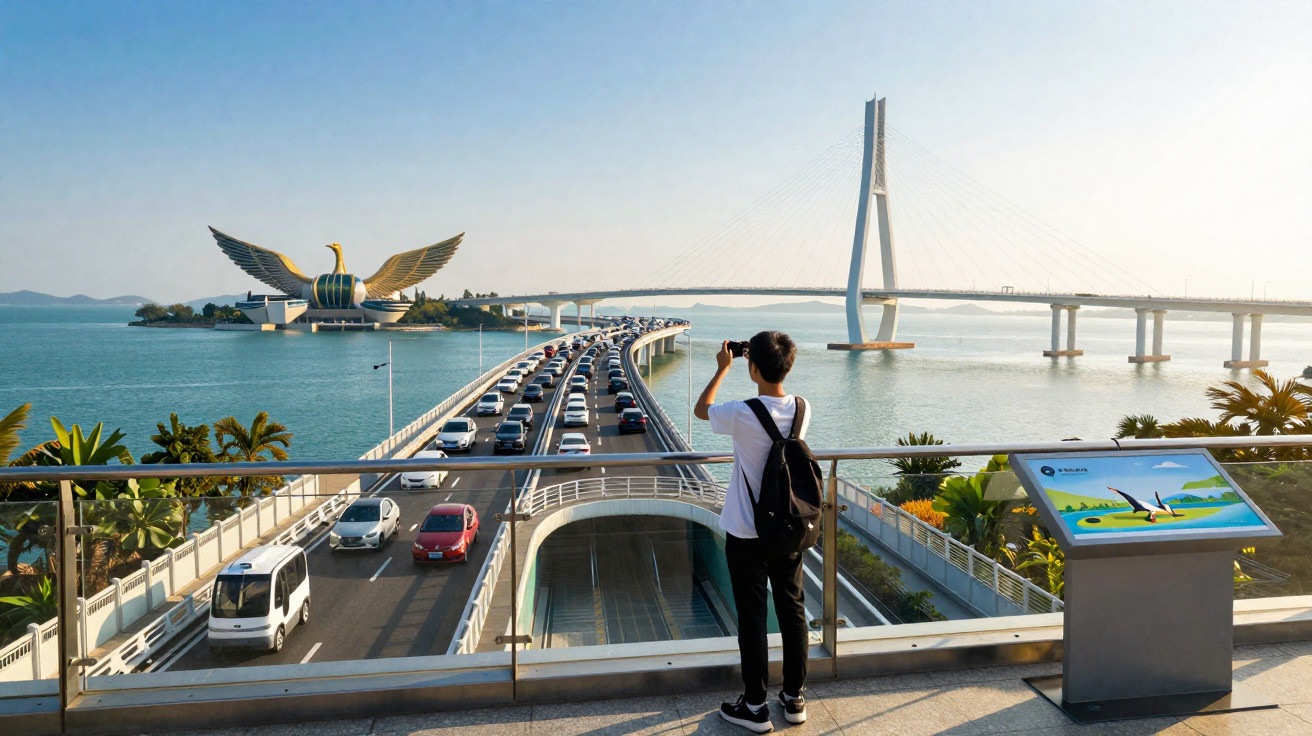
Driving above the sea, abruptly disappearing into a tunnel and then arriving on an artificial island with a technology museum: in southern China, this is now everyday travel.
A newly completed motorway link between the megacities of Shenzhen and Zhongshan reads more like science fiction than a conventional long-distance road. Across 24 kilometres, China has combined record-breaking bridge engineering, a vast undersea tunnel and two artificial islands, including an exhibition centre dedicated to high-tech civil engineering.
A new bottleneck in China’s booming region
The bay area encompassing Guangdong, Hong Kong and Macao is among the world’s most important economic regions. Manufacturing, logistics and research all depend on rapid transport links here. Until recently, drivers travelling from Shenzhen to Zhongshan needed almost two hours, frequently relying on congested roads and ferries.
The new route, which follows the G2518 corridor, cuts the journey to roughly 30 minutes. The toll is the equivalent of around 10 euros. For commuters, haulage firms and delivery services, the dramatic reduction in travel time also translates directly into financial savings.
The route links two megacities in half an hour, where people previously lost half a working day in traffic jams.
Shenzhen–Zhongshan superstructure of steel, concrete and artificial islands
From an engineering perspective, the route brings together several major schemes that would ordinarily each make headlines in their own right. In this case, they have been incorporated into one transport project.
- Total length: 24 kilometres above and beneath the sea
- Components: two enormous bridges, one undersea tunnel and two artificial islands
- Journey time between Shenzhen and Zhongshan: around 30 minutes
- Average daily traffic: approximately 86,000 vehicles
- Peak figures: more than 181,000 vehicles per day on travel days
One bridge section is particularly striking: an exceptionally long suspension-bridge span with steel pylons that holds several world records. To support it, engineers poured what is currently the world’s largest concrete anchorage foundation, using around 344,000 cubic metres of concrete. Dimensions on this scale are needed to protect the structure from typhoons, waves and extreme loads.
Its wind testing was equally demanding: the system withstood gusts of almost 84 metres per second. At wind speeds of that magnitude, conventional structures would already be suffering severe damage.
The undersea tunnel: eight lanes in an enormous tube
The tunnel beneath the bay is no less remarkable. Running underground for almost seven kilometres, it is regarded as the world’s widest immersed tunnel constructed from steel and concrete.
Measuring 46 metres across, the tunnel system can accommodate up to eight traffic lanes. Several lanes in each direction can therefore operate simultaneously without capacity being rapidly exhausted. To motorists, it resembles a broad, brightly lit tube, but the technology operating behind the scenes is exceptionally complex.
Robots acting as tunnel police
A digital network of sensors and machines monitors the entire tunnel tube to keep traffic safe in this sensitive section. According to the project information, the operators use 14 specialised robots that patrol the tunnel and continuously analyse data.
The machines can immediately report unusual events, including broken-down vehicles, obstacles or smoke. In an emergency, they help organise an evacuation before emergency services reach the location. Systems of this kind substantially reduce response times following accidents.
The smoke extraction system operates around 42 per cent more efficiently than conventional installations and is intended to save valuable minutes in the event of a fire.
Every minute matters in long tunnels. Modern smoke extraction, ventilation and emergency exits help prevent people from panicking or becoming trapped by smoke. China is using this project to trial new standards that could later be deployed elsewhere.
A traffic giant with its own visitor attraction
Since opening, the route has demonstrated how eagerly the region had awaited this shortcut. On average, around 86,000 cars use the new connection every day. The total rises sharply on public holidays and during major travel periods, with more than 181,000 journeys already recorded within 24 hours.
An express bus network has proved especially popular, covering the route quickly and providing an alternative to travelling by private car. Nearly three million passengers have already used this service. Hotels, restaurants and visitor attractions across the area report significant increases as a result, while tourism activity rose by more than 100 per cent during China’s National Day holiday.
An island shaped like a mythical creature
An unusual feature sits above the route itself. The westernmost of the two artificial islands serves not only as a technical hub, but also as a cultural stop. It is home to a new science museum with approximately 2,200 square metres of exhibition space.
The museum focuses chiefly on marine engineering, high technology and climate risks affecting coastal areas. Visitors can learn how undersea tunnels are built, what forces pull at bridges over the sea and how computer technology helps keep such structures safe over the long term.
The island’s shape has also been carefully considered. Seen from above, it resembles the “Kunpeng”, a legendary figure from Chinese mythology that can transform from an enormous fish into a mighty bird. The symbolism is clear: a sea that appears impossible to cross suddenly becomes an airborne leap between cities.
What the project means for China – and the rest of the world
For China, the new connection is far more than a shortcut. It illustrates how strongly the government is seeking to interlink its coastal metropolises even more closely. Projects of this kind support entire industrial clusters: semiconductor plants in Shenzhen, factories around Zhongshan, logistics centres and ports can work together more effectively.
At the same time, the project sends a message to other countries. Anyone seeking to cross major straits, fjords or long bays in future will be watching hybrid approaches like this closely: combinations of bridges, immersed tunnels and artificial islands tailored to the shape of individual coastlines.
| Feature | Detail |
|---|---|
| Total route length | 24 kilometres |
| Structural elements | 2 bridges, 1 tunnel, 2 artificial islands |
| Journey time between the cities | approx. 30 minutes |
| Average daily traffic | 86,000 vehicles |
| Maximum tunnel width | 46 metres, 8 lanes |
| Monitoring | 14 patrol robots operating in real time |
| Toll | around 10 euros |
Opportunities, risks and unanswered questions
Mega-projects of this nature bring major opportunities: less congestion, shorter supply chains and new jobs in construction, maintenance and tourism. Commuters gain time in their day, while businesses can plan more reliably. The museum element also gives the project a more welcoming public face, attracting school groups and technology enthusiasts.
However, questions remain about environmental impacts. Artificial islands alter currents, marine habitats and bird migration routes. Building tunnels and bridges in open water places pressure on ecosystems, particularly during construction. Supporters argue that modern methods reduce these risks, while critics call for long-term monitoring and stricter standards.
Dependence on digital control is another issue. Robots, sensors and automated safety systems make the installation efficient, but they also create new points of vulnerability. In a serious situation, cyber-attacks or software faults could have greater consequences than traditional technical failures. Operators are therefore investing heavily in redundant systems and emergency plans that can still function without high technology if necessary.
For other countries, the Shenzhen–Zhongshan link provides a real-world testing ground. Engineering consultancies and transport planners can examine how this combination of bridges, tunnel and islands performs in daily use: how durable are the materials in saltwater? How do traffic flows behave in this arrangement? And how well do drivers cope with the rapid transition from bridge to tunnel to island?
One point is certain: the new superstructure off the Guangdong coast demonstrates just how far highly complex infrastructure construction can now go, and how close science-fiction scenarios have become to the daily commute.






Comments
No comments yet. Be the first to comment!
Leave a Comment