
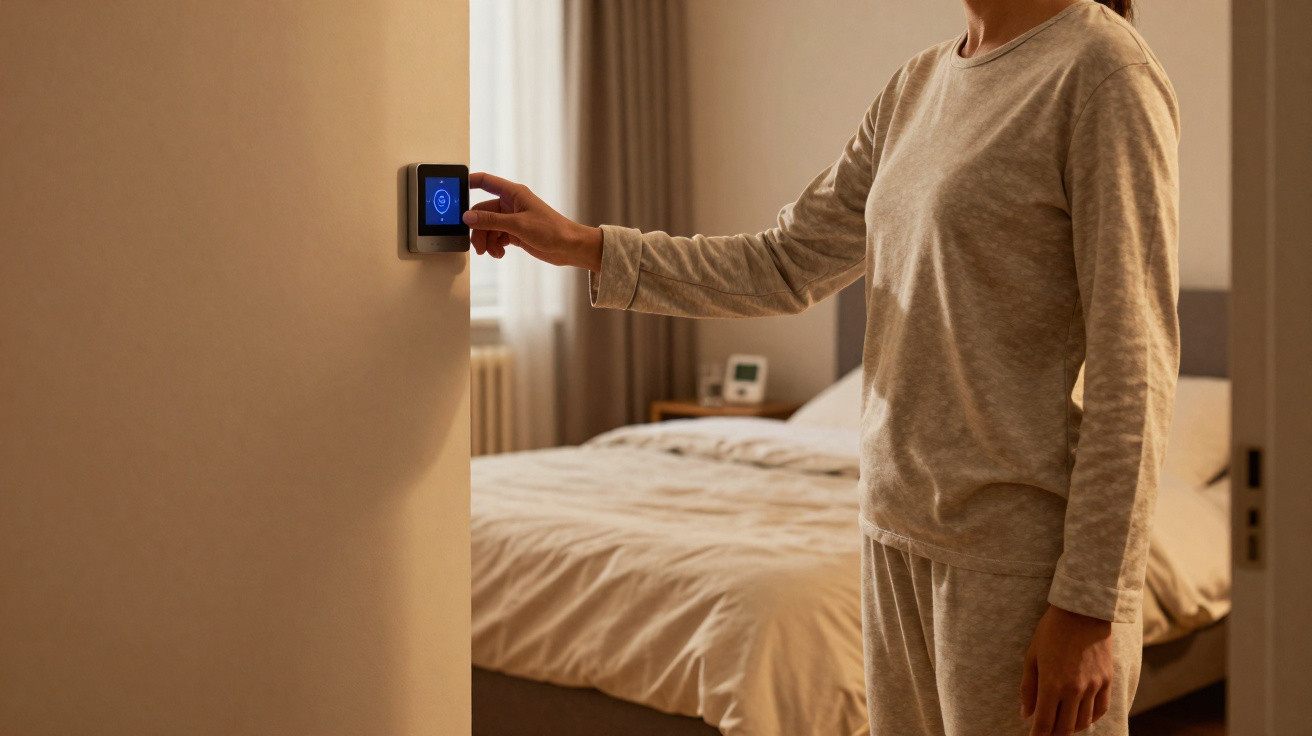
The thermostat digits shine in the darkness like a miniature score display for your energy costs.
It is 11.23 pm: you are wearing socks and a worn hoodie in the hallway, with your finger poised above the “off” button. Gas prices, news reports and the neighbour who insists, “I turn the heating off at night and save a fortune” all seem to tell you to follow suit.
You press it. Everything goes quiet. It feels like a modest triumph. Once you are beneath the duvet, the cool air seems fresh and “healthy”. Yet by 3 am, your nose is icy, your shoulders are clenched, and you are asking yourself why the house resembles a refrigerator.
The following morning, you crank up the thermostat, put the kettle on twice and hover by the radiator like a cat in January. When the bill then arrives in your inbox, another thought appears: perhaps this nightly routine is not saving any money after all.
Why turning the heating off at night is not always cheaper
In theory, turning the heating off at night appears sensible, even responsible. Eight hours without heating should mean less gas used and a smaller bill. Straightforward enough. But a home is not like a kettle, cooling and warming again within moments.
The walls, floors, furnishings and even the air in your home all hold heat. Leave the heating off for several hours and the entire building gradually gives up that warmth. By morning, you are heating more than just the air: you are warming a cold house.
This explains the familiar sense of whiplash for many households: they “save” through the night, then fire up the boiler at 7 am, forcing the system to work harder, for longer and at a higher output. The calculation is less simple than pressing a button.
Imagine a typical British semi-detached house during a frosty February night. The family goes to bed at 10.30 pm and switches the heating off while the living room is a comfortable 20°C. Outdoors, the temperature falls to 1°C. By 3 or 4 am, the indoor temperature may have dropped to 14–15°C, or even lower in older properties.
At 6.30 am, somebody wakes up cold and pushes the thermostat to 23°C “just to warm the place quickly”. The boiler comes on forcefully. Radiators shift from mildly warm to blazing hot. For the next one or two hours, the system operates close to maximum capacity, heating chilled walls as well as cold air.
Energy researchers have found that heat escapes more quickly when the gap between indoor and outdoor temperatures is greater. A house that repeatedly swings from warm to cold may lose more heat overall than one maintained gently at a lower, stable setting. That sensation of a “quick warm-up” can carry an unseen cost.
The reason for that additional cost comes down to basic physics. Heating systems operate most efficiently at a steady pace rather than in sharp bursts. A boiler that repeatedly goes from off to full power and back again uses energy getting up to temperature, much as a car consumes more fuel in stop-start traffic than it does on an empty motorway.
Once the house has cooled substantially, the difference between the indoor and outdoor temperatures becomes enormous. Heat escapes through windows, roofs and the small gaps you scarcely notice. Your boiler must then supply far more energy to recover those missing degrees in the morning.
A modest overnight reduction - for example, from 20°C to 17°C - may reduce costs. Completely turning off the heating and allowing the home to approach outdoor temperatures can have the opposite effect. The boundary between a smart saving and a false economy is narrower than many energy-saving tips imply.
How to use heating at night without blowing the budget
The answer is not to run the heating at full blast overnight, but to prevent the home becoming a cold shell. Most modern thermostats allow you to choose a lower temperature for the night rather than switching the system off entirely. Treat it as leaving your heating at “idle”, not shutting it down.
For many homes, an overnight setting of roughly 16–18°C is the ideal range. It is warm enough to stop the building losing all its stored warmth, while remaining cool enough to avoid unnecessary energy use. You do not need tropical nights to be comfortable in the morning.
With a programmable thermostat, set up a straightforward routine: use a daytime temperature while you are awake, move to a night temperature at bedtime, then raise it slightly 30–60 minutes before your alarm. Aim for gradual changes rather than harsh jumps.
This is also where human behaviour enters the picture. On a cold evening, few of us are thinking about energy curves or efficiency graphs. We think, “I’m freezing, I’ll just turn it off now and whack it back on later.” When a month brings hefty bills, it is easy to panic and choose extreme options.
That is why so many people land on the least helpful combination: high heating in the evening because they feel they “deserve comfort”, no heating overnight, then an intense burst at dawn. Your body dislikes it. Your boiler dislikes it. Your bill shows the result.
Let us be honest: nobody genuinely follows these perfect, minute-by-minute settings every day. Life intervenes. Children wake up, late-night Netflix happens, and someone forgets to adjust the programme. The objective is not perfection, but fewer dramatic temperature shifts and fewer “all or nothing” choices.
“People think the choice is ‘heating on’ or ‘heating off’,” says an energy adviser in Manchester. “In reality, the real savings come from ‘heating smarter’ - small tweaks, steady temperatures, and less drama for the boiler.”
A simpler approach is to target quick wins instead of attempting a complete lifestyle overhaul. These small measures can quietly help protect your money overnight:
- Choose a night temperature of 16–18°C rather than turning the heating off completely.
- Use the programmer to warm the home gradually before you get up.
- Bleed radiators once or twice each year to ensure heat is distributed evenly.
- Close doors to unused rooms, so you are not heating the staircase.
- Add layers of bedding and wear pyjamas, allowing you to keep the thermostat at a modest level.
None of these measures will impress your ultra-frugal uncle at Christmas. They simply do their job, steadily and unobtrusively, while you sleep.
The real question: comfort, cost or control?
Beneath the technical discussion lies something more personal. Heating is about more than kilowatt-hours; it is also about the degree of control you feel over your home. As prices increase and headlines warn of an “energy crisis”, the little thermostat can become a symbol of anxiety.
Switching the heating off at night may feel like regaining control. You are taking action. You are being “good”. If the bill keeps rising anyway, it becomes easy to blame the supplier, the weather or anything except the understated truth: some approaches that seem strict and disciplined are simply inefficient.
On a cold January night, the real luxury may not be an overheated bedroom, but a home that does not lurch between sauna and freezer. It may be a home where both the temperature and the bill are predictable enough that you no longer fixate on every press of the thermostat.
| Key point | Detail | Why it matters to the reader |
|---|---|---|
| Moderate overnight temperature | Keep the home at around 16–18°C instead of switching everything off | Limits heat loss and avoids expensive restarts |
| Gradual morning heating | Programme a gentle increase before waking | Reduces peak energy use and improves comfort when getting up |
| Less “all or nothing” | Favour stable settings over large temperature changes | Cuts the bill without sacrificing everyday comfort |
FAQ:
- Can turning the heating off at night ever be cheaper? In a very well-insulated home, during mild weather and with brief periods off, fully switching it off may not make much difference. In many older or draughty homes, however, overnight heat loss is so substantial that reheating in the morning consumes more energy than maintaining a low, steady night setting.
- Which night temperature is best for saving money? For most households, a night setting of 16°C to 18°C offers a balance between savings and comfort. Go below that level and your home may become too cold, making the boiler work harder when you wake up.
- Should radiators be turned off in unused rooms? You can reduce their setting, but avoid turning them off entirely in very cold weather, particularly in rooms where pipes run through the walls. Keeping them on low can help prevent damp and frozen pipes while still lowering costs.
- Does underfloor heating change the equation? Yes. Underfloor heating systems react slowly and perform best at consistent temperatures. Switching them off overnight is usually unhelpful, as they may need many hours and additional energy to return to a comfortable temperature.
- What if I only have a basic thermostat without a schedule? You can still benefit by lowering the setting manually at night rather than using the off switch. It is less convenient, but even a small reduction instead of a complete shutdown helps keep your home closer to a comfortable, efficient temperature range.





Comments
No comments yet. Be the first to comment!
Leave a Comment