
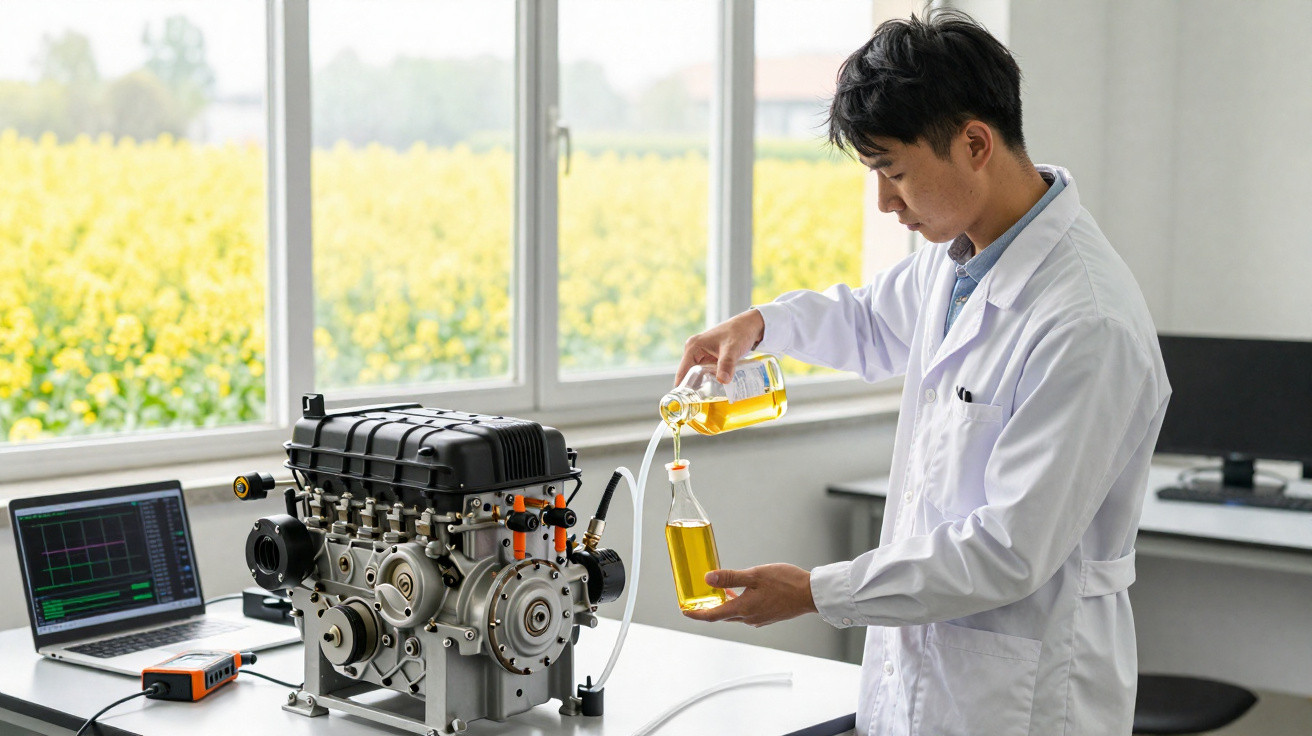
While politicians and industry pour billions into electric cars, engineers have been quietly working on a very different answer. A team at Russia’s RUDN University has modified a conventional diesel engine so that it can run on rapeseed oil rather than fossil diesel – with striking results.
What the researchers have actually achieved
The project is centred not on a futuristic prototype, but on an ordinary diesel engine of the kind used in agricultural machinery and commercial vehicles. The scientists set out to determine whether such an engine could be calibrated precisely enough to operate on vegetable oil with efficiency close to that of conventional diesel.
They selected rapeseed oil, a raw material that is already widely available across Europe. In laboratory tests, the engine was run on two fuels:
- conventional diesel fuel
- rapeseed oil as a biofuel
Both fuels were used in the same engine, with only the settings adjusted in stages. This enabled the researchers to identify exactly where vegetable oil has disadvantages and which parameters can be used to address them.
The decisive breakthrough: With targeted changes to the injection timing and fuel system, the engine runs on rapeseed oil almost as efficiently as on diesel – while producing substantially cleaner exhaust emissions.
Why rapeseed oil presents problems in an engine
Rapeseed oil has very different properties from diesel. It is more viscous, harder to ignite and atomises less effectively in the combustion chamber. These factors are precisely what make its use in conventional diesel engines so difficult.
The technical obstacles in detail
The trial revealed several issues familiar to any farmer who has ever simply poured vegetable oil into a tractor:
- higher viscosity: the thicker oil moves less freely through pipes and injectors
- poorer atomisation: larger droplets do not burn completely
- altered ignition characteristics: the point at which combustion begins shifts
- higher consumption: more fuel is needed to maintain the same output
- marginal exhaust values: particulate emissions and some pollutants rise in particular
These effects have so far held back the widespread use of vegetable oil in standard diesel engines. The RUDN engineers’ approach was fundamentally straightforward, but highly systematic: they examined every weak point and addressed it through technical changes.
The key adjustments: making rapeseed oil practical in diesel engines
Fine-tuning the injection and fuel system
The tests showed that two measures have an especially strong effect:
Changing the injection timing
Rapeseed oil has a different ignition delay from diesel. By advancing the start of injection, the engineers restored combustion to its optimum point. This delivers a clear improvement in both power and efficiency.Optimising the injection nozzle
The geometry of the nozzle opening was modified to atomise the more viscous oil more finely. A finer fuel mist results in more complete combustion and less soot.
The team also examined blends of rapeseed oil with diesel and other biofuels. Well-chosen mixing ratios can reduce the drawbacks of pure vegetable oil without entirely sacrificing its climate benefits.
The result: With adapted technology, the gap between fossil diesel and rapeseed oil narrows considerably – in some load ranges, almost to the limit of measurement.
What this means for the climate and air quality
Rapeseed oil is classified as a first-generation biofuel. Its climate credentials are controversial, particularly because of land use and competition with food production. Even so, the new technology offers tangible benefits, above all in sectors where diesel engines are unlikely to be replaced in the foreseeable future, such as agriculture, construction and heavy transport.
A focus on emissions
Analysis of the tests points to several positive effects:
- reduced dependence on fossil diesel
- lower levels of certain toxic exhaust gases, including carbon monoxide
- potential to cut nitrogen oxide emissions, depending on the settings
- an opportunity to establish regional fuel cycles
Because plants absorb CO₂ from the atmosphere as they grow, using rapeseed oil can significantly reduce net CO₂ emissions – provided production is efficient and does not involve major indirect land-use change.
Does this mean the end of the electric car?
This is where the issue becomes politically sensitive. If diesel units can suddenly operate on more climate-friendly biofuels, the question arises: are the enormous investments in electric cars really still the only logical route?
The honest answer is no: this development does not spell the end of the electric car. However, it puts the wider picture into perspective. Research from Russia suggests that the path to climate-friendly mobility will probably not consist solely of batteries and charging stations.
| Powertrain | Strengths | Weaknesses |
|---|---|---|
| Electric car | zero local emissions, quiet, high efficiency | battery raw materials, charging infrastructure, reduced range in cold weather |
| Diesel with rapeseed oil | uses existing engines, long range, rapid refuelling | land needed for energy crops, technical conversion required |
In areas such as long-distance lorries, tractors and construction vehicles, biofuel solutions like these could provide a realistic bridge – perhaps for decades.
Where this technology could make an impact first
Agriculture, fleets and developing countries
The innovation is likely to be most relevant in applications where diesel still appears indispensable today:
- Agriculture: tractors, combine harvesters and harvesting machinery could run on rapeseed oil produced locally.
- Public and private fleets: buses, municipal vehicles and delivery fleets with existing diesel units could be technically retrofitted.
- Countries with weak electricity infrastructure: nations unable to afford a nationwide rapid-charging network could use biofuels as a practical alternative.
The concept holds particular appeal for farmers: part of their land could directly supply the fuel for their own machinery. This cycle already exists to some extent, but the new engine modifications make it more efficient and lower in emissions.
What still stands in the way
As promising as these findings are, they do not solve every issue at once. Several questions remain unresolved:
- Scaling: the technology must move from the laboratory into near-production applications.
- Long-term durability: rapeseed oil can form deposits in the system and place strain on filters and injectors, so robust long-term testing is needed.
- Competition for land: if too much farmland is used for energy crops, food prices rise and pressure on ecosystems increases.
- Political framework: tax rules, blending quotas and support programmes will determine whether such a solution is economically viable.
The final point is particularly important: without clear signals from Brussels and European capitals, few manufacturers will extensively tune their engine families for rapeseed-oil operation.
What motorists can take from this
For private car drivers in Europe, little will change for now: new cars are becoming increasingly electrified, while diesel is losing market share. The technology demonstrated is aimed more at commercial vehicles and specialist machinery. Yet these account for a substantial share of real-world emissions, particularly in rural areas.
Anyone interested in the future of transport should therefore move away from simplistic black-and-white thinking. Neither “only electric is good” nor “combustion engines will remain forever” accurately reflects reality. Much suggests that the eventual outcome will be a mix of:
- electric cars for urban travel and many private commuters
- optimised diesel engines using biofuels in heavy-duty and agricultural applications
- additional niche solutions such as hydrogen or synthetic fuels
The rapeseed-oil diesel engines from the laboratory demonstrate one thing above all: the internal-combustion engine is not dead yet, but it has to change. That puts pressure on engineers, manufacturers and policymakers, while also creating new scope for more climate-compatible mobility.






Comments
No comments yet. Be the first to comment!
Leave a Comment