
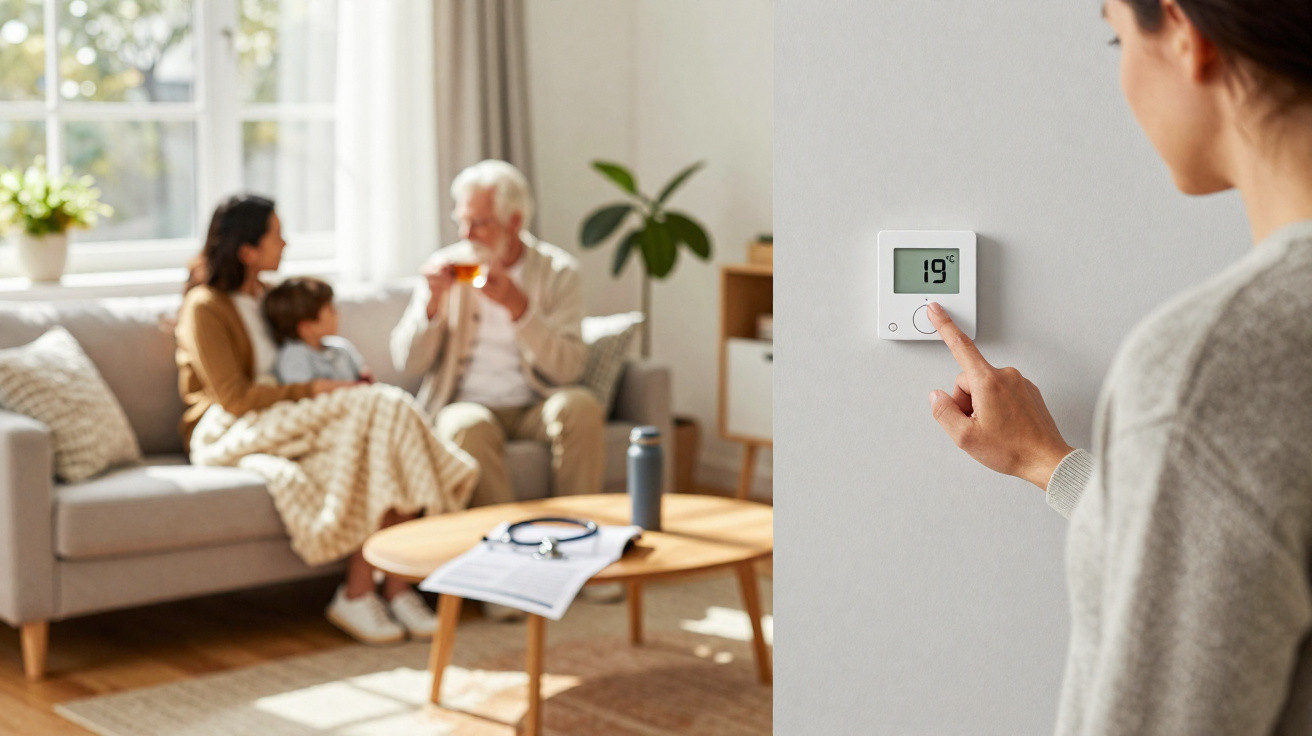
The email landed at 7:42 a.m., as the radiators began their morning clanking. Its subject read: “New winter temperature recommendations – urgent.” In a small Birmingham property management office, three people opened the same PDF and each reacted differently. The landlord saw rising costs and disgruntled tenants. The environmental campaigner imagined retreating glaciers and graphs of air pollution. The occupational doctor thought of children with coughs and older residents shivering in damp homes.
A sentence on page one immediately sparked controversy: specialists were now proposing that the longstanding 19°C benchmark be abandoned in favour of a new “healthy, efficient” indoor temperature range. In an instant, a figure few people had ever challenged became political.
Who has the right to decide how warm we can keep our homes?
The quiet war over a few degrees
This conflict is not playing out through marches in the street. Instead, it appears in frantic WhatsApp chats, tense tenant meetings and boardrooms where spreadsheets collide with public-health data. For years, 19°C was presented as the sensible middle ground by campaigns, energy-saving leaflets and eco-influencers. The number took on an almost moral status: sufficiently warm to avoid cruelty, yet low enough to prevent waste.
A growing group of expert reports is now unsettling that uneasy consensus. Certain medical organisations favour higher minimum temperatures for homes occupied by children, pregnant women or older people, nearer 20–21°C. Climate specialists, meanwhile, caution that every additional degree is both a climate threat and a blow to household budgets. Stuck between them are tenants who simply want to stop having to choose between food and heating.
Consider Leeds in winter 2025. A housing association discreetly revises its advice: “Target indoor temperature: 20–21°C for vulnerable tenants, 19°C for others.” Screenshots and accusations spread across social media within weeks. Environmental campaigners claim the association is “backsliding” on its climate commitments. Doctors respond with images of mould-covered walls and children relying on inhalers. Landlord organisations work out the likely energy costs and begin discussing rent increases. One thermostat setting has become a stand-in for a wider dispute over who bears the cost, who faces the risk and whose comfort matters.
Beneath the emotion is a stark calculation. Heating makes up a substantial share of domestic energy consumption and accounts for roughly a quarter of Europe’s carbon emissions. Raising the thermostat by one degree can mean 7–10% more energy use per additional degree, depending on the property. Leave temperatures too low, however, and the consequences can include respiratory illness, psychological strain, damp and damage to the building itself. Somewhere from 18°C to 21°C sits a precarious compromise between protecting the planet, safeguarding health and warming cold feet.
That is why the latest recommendations refer to “bands” and “zones”, rather than one perfect number. Experts say a modern, properly insulated flat may remain safe and comfortable at 18–19°C in its living rooms, while bedrooms are often better kept cooler. Older homes that are damp and draughty require more heating merely to achieve the same level of safety. Many doctors say the real outrage is not a choice between 18°C and 20°C, but the millions living at 14–15°C while insisting that they are all right.
What should we actually do at home?
Set aside the abstract arguments for a moment. Imagine an ordinary winter evening in a poorly insulated flat. An official “recommended range” will not shield you from draughts at the windows or help if your landlord lives in another city. What you can influence is how you make use of the heat available to you. Specialists repeatedly offer one straightforward piece of advice: warm the room, rather than the air outside it.
In practical terms, this means ensuring radiators are not hidden behind sofas, bleeding them when winter begins, and drawing the curtains as darkness falls to hold in warmth. It means selecting one or two “core rooms” to maintain at 19–20°C instead of unsuccessfully attempting to warm the entire home evenly. It also involves paying attention to your body rather than obsessing over the thermostat reading. Numb fingers, tense shoulders and the slow exhaustion that sets in at 4 p.m. can reveal the truth faster than any app.
Many households quietly play thermostat roulette: they turn the heating up to 23°C, then turn it off and allow the property to become cold again. This up-and-down approach is costly and bad for health. Landlords may complain about mould, but tenants living at 15°C without adequate ventilation do not have many better choices. We’ve all been there, that moment when you stand in the hallway wondering if you should turn the heating on or just put on a third jumper.
Experts’ new emphasis on “comfort bands” encourages a more relaxed approach. Rather than treating 19°C as sacred, people are advised to identify a small personal range in which they feel well and their bills remain manageable. For some, that means 18–19°C alongside thick socks and a sofa blanket. For others, particularly people who are frail or living with long-term illness, keeping the main room at 20–21°C is simply essential. In reality, nobody monitors every room with a thermometer every day.
The public debate rarely captures the untidy reality of a freezing night in January. This is where the three sides of the argument become unmistakably human. An environmentalist working from home wears extra woollen layers and takes pride in holding the thermostat at 18°C. A landlord watches fuel prices and privately hopes no tenant asks for replacement windows. A GP hears another patient describe a “stiff chest” and a “damp smell” in the bedroom, knowing that the guidance is ignored everywhere.
“Below about 18°C, the risk of respiratory and cardiovascular issues rises sharply, especially for older adults,” says one public health doctor I spoke to. “Above 21–22°C, bills jump and so do emissions. The fight should not be about 19 vs 20. It should be about no one living at 14°C for months.”
- For environmentalists: Prioritise insulation initiatives, heat-pump grants and smart controls instead of shaming people who want 20°C when they are ill.
- For doctors: Campaign for legal minimum indoor temperatures in rented homes, particularly for vulnerable residents, and ensure these rules are genuinely enforced.
- For landlords and policymakers: Connect any revised recommendations with funding for improvements, rather than applying moral pressure to people already under financial strain.
A thermostat number, or a reflection of our priorities?
Walk around any city on a cold evening and the entire argument is visible in the lighted windows. Some flats are bright and steamy, with people walking about in T-shirts on heated floors. In others, silhouettes crouch beneath blankets, with breath just visible when the door opens. The heated disagreement about what specialists “should” advise exists between these two realities.
The fading of the old 19°C mantra is not so much a betrayal as an admission: no single temperature ever suited everybody. As the discussion shifts towards bands and zones, a more fundamental issue emerges. Who is entitled to comfort as a guaranteed right, and who is expected to make do “for the planet”? Whose health is considered non-negotiable, and whose cold is dismissed as a personal failure to budget?
The argument will not disappear. Energy costs, climate goals and ageing populations all pull the debate in opposing directions. Every winter, the temperature war will return to kitchens, group chats and parliamentary hearings. The next time you reach for the thermostat, a persistent question may occur to you: am I making the right choice, for myself and for everyone else? Or are we all simply trying to keep warm within a system that has not yet decided what “right” should feel like?
| Key point | Detail | Value for the reader |
|---|---|---|
| Temperature “bands” rather than a magic number | Experts now discuss 18–21°C ranges according to health, building quality and how a room is used | Helps you choose achievable targets rather than fixating on one inflexible figure |
| Health vs climate vs cost | More heating protects vulnerable people but increases bills and emissions, whereas insufficient heat can lead to illness | Makes clear what you are weighing up whenever you adjust the thermostat |
| Practical home strategies | Prioritise core rooms, radiator performance and small habits instead of maintaining high heat constantly | Offers practical ways to feel warmer without sending your energy bill soaring |
FAQ:
- Is 19°C still considered a good indoor temperature? For many healthy adults in a reasonably insulated home, 19°C in living spaces remains a sound reference point. The new recommendations merely introduce more nuance: certain people and properties require a little more warmth, while others can cope with slightly less.
- What temperature do doctors recommend for vulnerable people? Most public-health guidance advises around 20–21°C in living areas for older adults, babies, unwell people and those with respiratory or heart conditions. Bedrooms may be a little cooler where this still feels comfortable.
- Does turning the heating down really save that much energy? Yes. Energy agencies estimate that lowering the thermostat by each degree reduces energy use by roughly 7–10%, provided the temperature is kept steady over time rather than repeatedly raised and lowered.
- My landlord refuses to heat above 18°C. Is that legal? The answer depends on the country and local housing legislation. Some areas impose minimum indoor temperatures for rented homes, while others do not. Tenant unions and housing advice services can explain the rules where you live.
- What if I can’t afford to heat to the recommended level? Seek targeted help, including energy grants, social tariffs, local warm spaces and insulation schemes. Modest measures – blocking draughts, using heavy curtains and heating only core rooms – may help, but lasting progress requires structural support rather than personal determination alone.




Comments
No comments yet. Be the first to comment!
Leave a Comment