
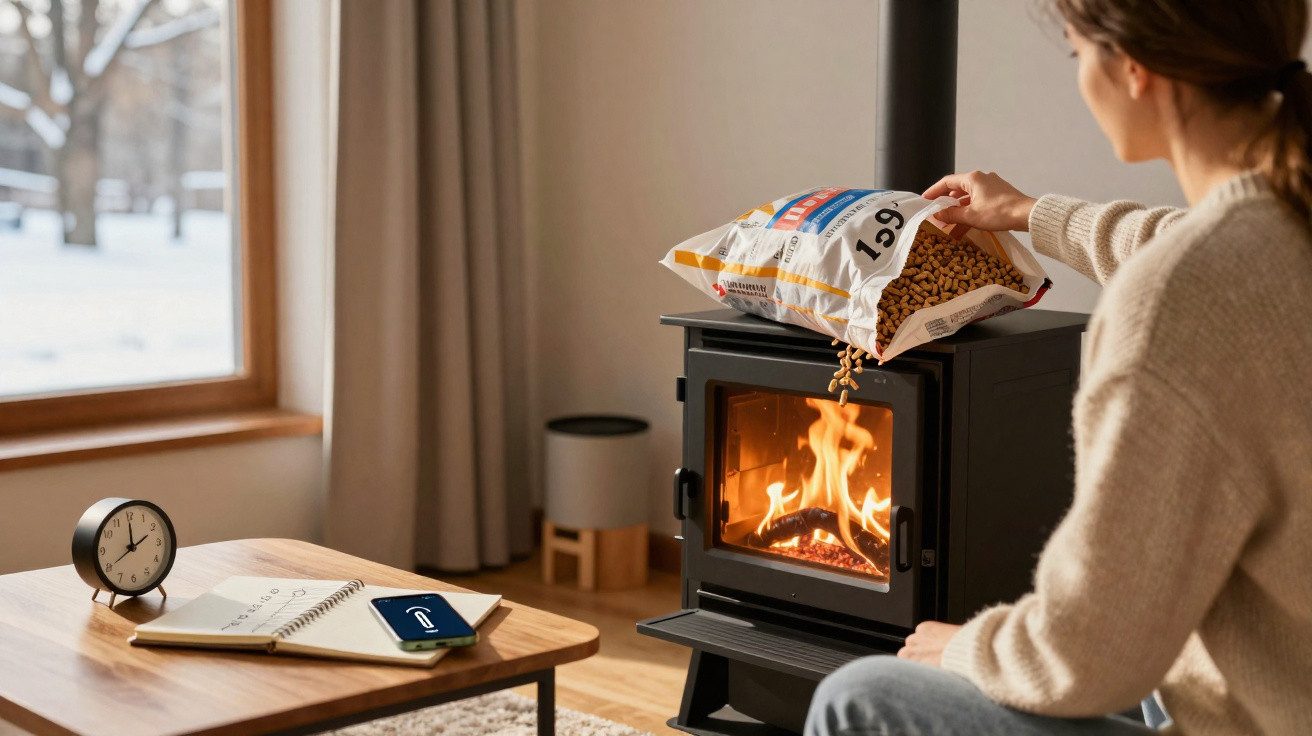
As the cold sets in and the temperature drops, the 15 kg bag of pellets sitting in the corner becomes an increasingly important part of everyday life.
Anyone with a pellet stove or fireplace will recognise the question: will that bag last through an entire night, a full working day or just a few hours? There is no single answer, but realistic estimates are possible by considering the appliance output, the home’s insulation and the way it is used.
Why the same 15 kg bag lasts much longer in one home than another
Although a 15 kg bag of pellets is a standard retail size, its burning time can differ considerably. In many situations, it can last from under 8 hours to nearly 40 hours. The bag itself matters less than the combined effect of the “stove + home + user”.
A modern, properly adjusted stove in an insulated home can make a 15 kg bag last for several days of moderate use.
Recent stoves commonly achieve efficiency levels of between 85% and 95%. In other words, almost all of the energy stored in the pellets becomes useful heat. Older, dirty or incorrectly adjusted models waste more of that potential, so they need additional fuel to provide the same level of warmth.
Pellet stove output: the factor that most affects burning time
Output, expressed in kW, is the starting point for working out the average lifespan of a 15 kg bag.
Pellet stove at maximum output
When the appliance is operating close to its limit - typically around 8 to 10 kW for domestic models - pellet use rises sharply. This is the familiar situation where the stove is turned “up to maximum” to warm a freezing room quickly.
- High output (8 to 10 kW)
- Approximate consumption: 1.5 to 2 kg of pellets per hour
- Lifespan of a 15 kg bag: around 7 to 10 hours
At this setting, a bag is unlikely to last through a full night of severe cold if the appliance remains at maximum continuously.
Stove in economy mode or at low output
If the stove is run in eco mode, usually at between 2 and 3 kW, the pellet feed rate drops substantially.
- Low output (2 to 3 kW)
- Approximate consumption: 0.4 to 0.6 kg of pellets per hour
- Lifespan of a 15 kg bag: between 25 and 40 hours
For anyone keeping the stove on low output, one bag can provide gentle heating for two or three days of limited daily use.
This setting is more suitable for well-insulated homes, where temperatures do not fluctuate greatly during the day.
Insulation: the major invisible cause of consumption
It is not enough to consider the stove alone. The home in which it is installed has a major effect on the calculation. A straightforward rule of thermal engineering used in many designs is that, on average, 1 kW of output heats roughly 10 m² under typical conditions.
| Situation | Output required | Effect on the lifespan of a 15 kg bag |
|---|---|---|
| Well-insulated 100 m² home | 4 to 6 kW for most of the time | Moderate lifespan, with a balanced use of eco and medium output |
| Older 100 m² home without insulation | 8 to 10 kW on cold days | Bag used quickly, lasting 7 to 8 hours at high output |
| Small, insulated flat | Continuous 2 to 3 kW | A bag may approach 30–40 hours of use spread over several days |
Homes built to modern thermal-insulation standards generally place far lower demands on pellets. Thin walls, single-glazed windows and gaps around doors, by contrast, create a constant route for heat to escape.
How to make every 15 kg bag last longer without feeling cold
Some of the answer lies in how the user controls the appliance. Small routine changes can make a genuine difference to pellet consumption.
Stove maintenance and cleaning
A restricted fire bed, built-up ash and partially blocked flues all hinder combustion. The result is more pellets being burnt to achieve the same degree of thermal comfort.
- Clean the fire pot regularly
- Remove ash from internal compartments
- Arrange periodic professional servicing of the stove and chimney
A clean, correctly adjusted stove burns more effectively, produces more heat per kilogram of pellets and requires fewer bag refills.
Fine-tuning temperature and operating times
Using a stove like an electric shower - “turning it on and off at maximum” - is the least efficient approach. It heats the room quickly, but wastes fuel unnecessarily.
Useful settings for keeping spending under control include:
- Maintain a steady target temperature rather than allowing large peaks
- Use eco mode or medium output whenever possible
- Programme the appliance to reduce output overnight
- Avoid leaving the stove at high output when nobody is at home
Real-life scenarios: how long does a bag actually last?
Scenario 1: insulated home, moderate use
Picture a well-insulated 90 m² home in an area with moderately cold weather. The stove runs mostly between 2 and 3 kW, rising to 5 kW at the start of the evening.
- Average consumption: around 0.6 to 0.8 kg/h, allowing for variations
- Daily use: 8 to 10 hours switched on
- Result: a 15 kg bag lasts roughly 2 days of typical use
Scenario 2: older home, harsh winter
In a poorly insulated 100 m² home in an area with a severe winter, the stove operates close to 8 kW for many hours while trying to offset heat losses.
- Average consumption: close to 2 kg/h on very cold days
- Daily use: 10 to 12 hours
- Result: a 15 kg bag does not last beyond one day of intensive use
How many 15 kg bags you need for a cold season
Once the question shifts from “one bag” to “one season”, the figures become much larger. In many homes heated mainly with pellets, annual demand is measured in tonnes rather than individual bags.
- Well-insulated 100 m² home: between 1.5 and 2 tonnes per winter (around 100 to 130 bags of 15 kg)
- A less efficient home or a very cold area: consumption can exceed 3 tonnes (more than 200 bags)
Knowing your home’s average consumption helps you plan stock, negotiate a volume price and avoid last-minute increases during peak season.
Pellet quality: a detail that changes the burning-time calculation
Not every pellet is the same. Certified products with low moisture content - below 10% - and good compaction burn more consistently and offer greater calorific value.
Poor-quality pellets can have:
- More dust and residue in the bag
- Uneven burning with unstable flames
- Excessive ash and deposits
In practical terms, this means less heating time from each bag and more cleaning work. Paying slightly more for reliable pellets usually proves worthwhile in daily use, both for efficiency and comfort.
Terms and details worth understanding before doing the calculation
Two concepts appear frequently in this subject: efficiency and calorific value. Efficiency refers to the stove’s ability to convert the pellet’s energy into useful heat inside the home. Calorific value, meanwhile, is the amount of energy that 1 kg of pellets can release when burned.
When a manufacturer states that an appliance has 90% efficiency, it means that 90% of the energy available in the fuel actually warms the room, while 10% is lost, largely through hot gases in the chimney. The higher the efficiency, the longer the useful heating time provided by each bag.
A quick calculation you can adapt to your own situation
An easy way to estimate burning time is to combine three figures: average output used, hourly consumption and the number of hours used each day. Assume that your stove uses an average of 1 kg of pellets per hour and is left on for 8 hours each day under typical operating conditions.
- Daily consumption: 8 kg
- 15 kg bag: lasts close to 1 and a half days
- 4-month season (120 days): close to 960 kg, or 64 bags
If, over the winter, you lower the reference temperature by 1 or 2 degrees and make greater use of eco mode, consumption is likely to fall. Small behavioural changes can mean dozens fewer bags each season, without giving up basic comfort.


Comments
No comments yet. Be the first to comment!
Leave a Comment