
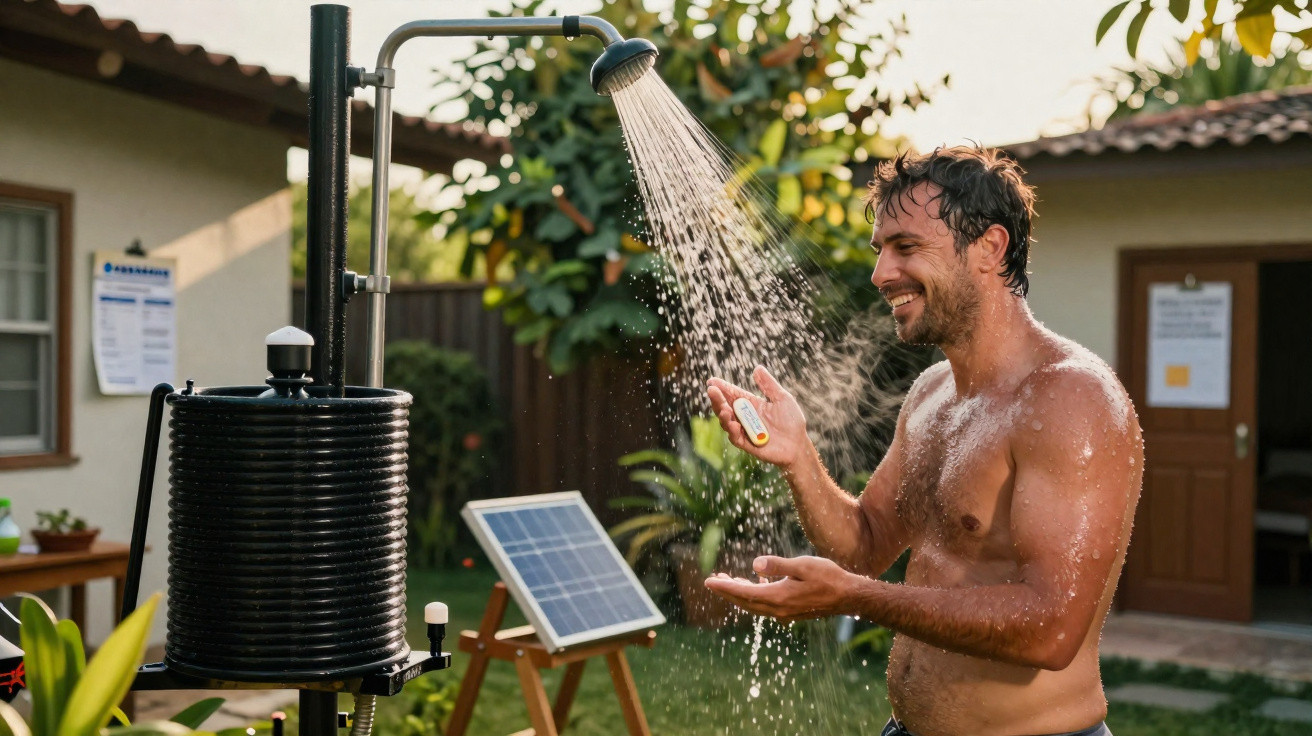
You can learn plenty about someone from their response when the hot water disappears.
Some people curse the boiler, others write off the entire day, while some simply stand beneath a feeble stream of lukewarm disappointment, wondering when life became so reliant on unseen pipework. When UK energy prices surged, that modest everyday comfort suddenly came with an awkward question: what is a hot shower really worth?
That question led me to a muddy field and a contraption that resembled a home-made science experiment: a black barrel, copper piping and an old caravan gas bottle. It was an off-grid hot water system owned by Dan, a quietly self-satisfied sort. At first, it had the look of something you would flick past on TikTok, saying “yeah right” before the algorithm served up another miraculous device. Then Dan showed me his figures, and my view began to change.
The bill that changed everything
We all know the feeling when an energy bill arrives and, briefly, you assume it must be wrong. Mine arrived in early 2023: a PDF displaying a sum that looked more suited to a holiday than three months of gas and electricity. I looked at the total, expecting a digit to vanish when I refreshed the page. It did not. That was when I began paying much closer attention to off-grid ideas.
Until then, “off-grid” had sounded like the preserve of people with vans, beards and improbably photogenic dogs. I live in an ordinary semi-detached house in an ordinary UK town. Heating water without mains gas or an electric boiler humming in the airing cupboard seemed fanciful, like trying to grow an avocado tree in a Croydon flat. A pleasant thought, perhaps, but not everyday reality.
Then I met Dan. In his early 40s and formerly in IT, he lives on the edge of a village in a small house he has gradually transformed into a low-key protest against utility bills. There are solar panels on the roof, a wood burner in the sitting room and, at the back of the property, the feature he was keenest to show me: his off-grid hot water system. He led me down the garden path with the grin of someone unveiling a new car. Instead, he revealed something that looked like a GCSE project taken several stages too far.
The garden-corner contraption
Beside a raised bed of rather sad kale, one corner of the garden contained a collection of items that the council might reasonably label “mixed waste”. There was a 200-litre black plastic barrel, insulated pipes in a jumble, a small pump and a modest solar panel balanced on a home-made frame. Alongside it, protected from the wind by old fence panels, stood a compact gas water heater of the sort usually fitted to the rear of campervans.
Initially, it looked entirely like a gimmick: one of those “I made free hot water using just this one weird trick” arrangements found in YouTube’s more obscure corners. The barrel had been painted matt black, while clear polycarbonate sheets created a miniature greenhouse around it. A sensor cable hung from the top, as though somebody had neglected the final tidy-up. No steam poured from it. It simply sat there, quietly humming with the gentle buzz of a tiny circulation pump.
Dan pressed a switch and took me indoors. He opened the kitchen hot tap. Within seconds, hot water ran out as it would in any conventional house. It was not tepid or reluctant; it was hot. “That’s off-grid,” he said, almost offhandedly. “Well, off-grid most of the time.” He then picked up a battered notebook from the worktop, which was when the visit became more serious.
The modest-looking two-part system
There was no single miracle device behind it, but rather a two-part team. First, sunlight pre-heats the water in the black barrel through what is essentially a DIY solar thermal collector. Cold water from a storage tank runs gradually through coils of pipe inside the barrel, absorbing heat. Even in the UK, on a sunny day Dan can bring that water up to 40–50°C. It is not scalding, but it is certainly “nearly there” for showering or washing up.
When he opens a tap, that pre-warmed water then travels through the small gas heater. Since the water has already been heated part of the way, the heater has very little left to do. That means less gas, less burning time and lower running costs. It is not a flawless, fully solar arrangement - and that is precisely why it feels practical.
What the off-grid hot water figures show
This was where the gimmick impression disappeared. Dan has a faintly intimidating tendency to record everything - temperatures, consumption and bills - in spreadsheets detailed enough to impress most accountants. For the past twelve months, he has tracked the gas used by the water heater and set it against the hot-water costs from his conventional combi boiler in the previous year.
Before installing the system, his gas use for hot water alone - showers, washing up and handwashing, excluding space heating - was around 4,000 kWh per year. At recent UK prices, that came to roughly £280–£320 annually, depending on the tariff. It is not an outrageous amount, but it is hardly insignificant when every other cost-of-living expense is rising. In truth, nobody sits calculating a “price per shower” until circumstances make them do it.
With the hybrid off-grid system, his recorded gas use for hot water fell to just under 1,400 kWh over a year. That is about one third of the previous level. In cash terms, he now spends approximately £95–£115 each year on the gas needed to finish the job the sun has started. The remainder is effectively free, collected from the hazy and unreliable British sunshine we complain about while quietly depending on it.
But does it work through winter?
This was my central question, and probably yours too. It is easy to discuss solar power while imagining July afternoons and the sound of a neighbour mowing the lawn. January in Stoke is something else altogether. Dan’s records reveal the predictable pattern: from late April until early October, the sun handles most of the work. On the strongest summer days, the gas heater scarcely activates because the water leaves the barrel hot enough already.
At the height of winter, the solar barrel does not approach shower temperature. On a bright, cold day, it might lift incoming water from 8°C to 18°C. That is not hot, but it remains useful: instead of heating icy mains water all the way up, the gas heater only needs to take it from 18°C to 45–50°C. During grey, overcast spells, the system simply operates as an ordinary efficient gas-on-demand heater. There are no cold bucket baths or campsite-style sacrifices.
Across an entire year, Dan estimates that the sun provides 65–70% of the energy required to heat his water. The compact gas backup supplies the balance. It is not miraculous; it is simply a reduction in waste, with the sky providing a steady background helping hand.
The price of “free” hot water
By this point, the obvious question is what it cost to construct the arrangement. Dan is straightforward about that. The complete system - barrel, pipes, insulation, inexpensive pump, DIY timber frame, compact gas water heater and the extra solar panel that powers the pump and controls - came to about £650 in total. He and a friend installed it over several weekends. There were no labour charges, but plenty of tea.
Under the old system, hot-water gas cost him about £300 a year. He is now nearer £100, representing savings of roughly £200 annually. On that basis, the payback period is around 3 to 3.5 years. It is neither instant reward nor a Hollywood ending, just a gradual and dependable route to smaller bills.
He has also allowed for maintenance. The pump could require replacement after 5–7 years (£40–£60), and the barrel may eventually deteriorate and need replacing. With appropriate care, the gas heater ought to last a decade. Even after accounting for those replacements over 10 years, he remains hundreds of pounds better off than he would have been by changing nothing. Those numbers don’t go viral on social media, but they quietly change lives.
Safety and regulations
This is the less glamorous side, and the part seldom featured in Instagram posts. The gas heater is correctly flued, fitted in a protected yet ventilated outdoor area, and installed according to the manufacturer’s instructions. Dan asked a Gas Safe engineer to inspect the installation, partly for insurance purposes and partly because he is not foolish. The solar barrel is outdoors and positioned well away from bedrooms, with temperature cut-offs and overpressure valves installed.
Off-grid hot water can become dangerous when people get overconfident. Lukewarm stored water can create a Legionella risk; sealed barrels can cause pressure problems; and poorly installed gas heaters can produce carbon monoxide. Dan’s method is reassuringly dull: keep the water circulating, avoid leaving it hot and stored for days, fit basic safety valves and have the gas components checked. It may not make for triumphant YouTube content, but it stops the setup becoming a story on the six o’clock news.
The subtle emotional change
The figures are one part of it. The way Dan describes living with the system is another. “I don’t panic-shower anymore,” he told me, partly in jest. During the worst price increases, he found himself hurrying through showers and thinking in terms of minutes and pennies. That persistent unease - the feeling that every extra 30 seconds meant another supplier warning email waiting in his inbox - can get beneath your skin.
Now he knows that most of the water for his shower was heated hours before, quietly, by sunlight on black plastic. The gas is an extra boost rather than the entire process. He still does not linger for ages, but that is now a preference rather than an anxiety. He described the peculiar pleasure of hearing the little pump begin buzzing on a bright morning, as if the house were looking after itself in the background while he makes coffee.
There is also a quiet comfort in not being wholly exposed to the next energy-policy announcement. When you stand in his kitchen and run the tap, the water has a story that does not start and finish with the meter in the cupboard. That may sound romantic, until you recall that hot water was once like that for everyone: wood, coal and back boilers. We have simply lost the feeling of knowing how warmth reaches our homes.
Why the “gimmick” is quietly catching on
Dan is not the only one. Variations on this arrangement are appearing across the UK: in allotments, on narrowboats and behind terraced homes with long gardens. Some are more refined, using evacuated-tube solar collectors and polished control systems. Others are rougher, assembled from Facebook Marketplace purchases. All follow the same straightforward principle: do not use full-price fuel for a task the sun is already doing halfway.
These are not people determined to live as pioneers. They are teachers, nurses, delivery drivers and retired couples. Most retain their grid connections, direct debits and smart meters blinking in the hallway. What they want is resilience: a little insulation, not in the walls this time but between their lives and the next jump in wholesale gas prices. A buffer made from a black barrel and a second-hand solar panel.
There is another underlying reality: many of us secretly enjoy the thought of understanding our homes again. Knowing where heat comes from, what it costs and what happens once it arrives. We pretend it is dull adult business, yet people’s faces brighten when the theory connects with a warm tap and a low figure in a spreadsheet.
Could it work in your home?
Off-grid hot water is not a universal solution. Flats without external space, listed properties and rented homes with restrictive conditions are all more difficult cases. Nobody is going to attach a 200-litre barrel to a third-floor balcony in Hackney. Nor does everyone have the time, equipment or patience to spend weekends measuring flow rates with a thermometer and notebook.
There are, however, less demanding versions of the same principle. Straightforward solar thermal panels can feed an existing cylinder. Small point-of-use heaters can be supplied by pre-warmed loft tanks. Even changing when you use an immersion heater during sunny periods can help if you have rooftop solar PV. The central idea does not change: allow “freeish” energy to complete the slow background work, then reserve costly, high-density fuel for short, sharp demands.
If you are considering it, the first task is deeply unglamorous: measure. How much hot water do you truly use? Do your biggest demands happen in the morning, the evening or throughout the day? What is your price per kWh? Without that starting point, every off-grid claim is just vibes. With it, you can look at a black barrel in the garden and think: that is 60% of my showers, sitting in the sun.
When the penny finally drops
As I left Dan’s house, the sky was the washed-out pale grey that counts as an autumn afternoon in Britain. Hardly a solar paradise. He turned on the kitchen tap once more, more from habit than display. Warm water ran. Outside, the pump clicked on for a few seconds, guiding cooler water back towards the barrel. A robin moved along the fence as if it owned the entire garden.
On the train home, while someone’s headphones leaked tinny drill music into the carriage, I kept returning to the figure: a two-thirds reduction in gas use for hot water, achieved for a few hundred pounds and several weekends of tinkering. You might still call it a gimmick; at first, it certainly looks like one. Yet after seeing the figures - and the quiet way they alter the temperature of someone’s life - it feels less like a clever hack and more like a glimpse of how ordinary homes could become a little less vulnerable in the years ahead.



Comments
No comments yet. Be the first to comment!
Leave a Comment