
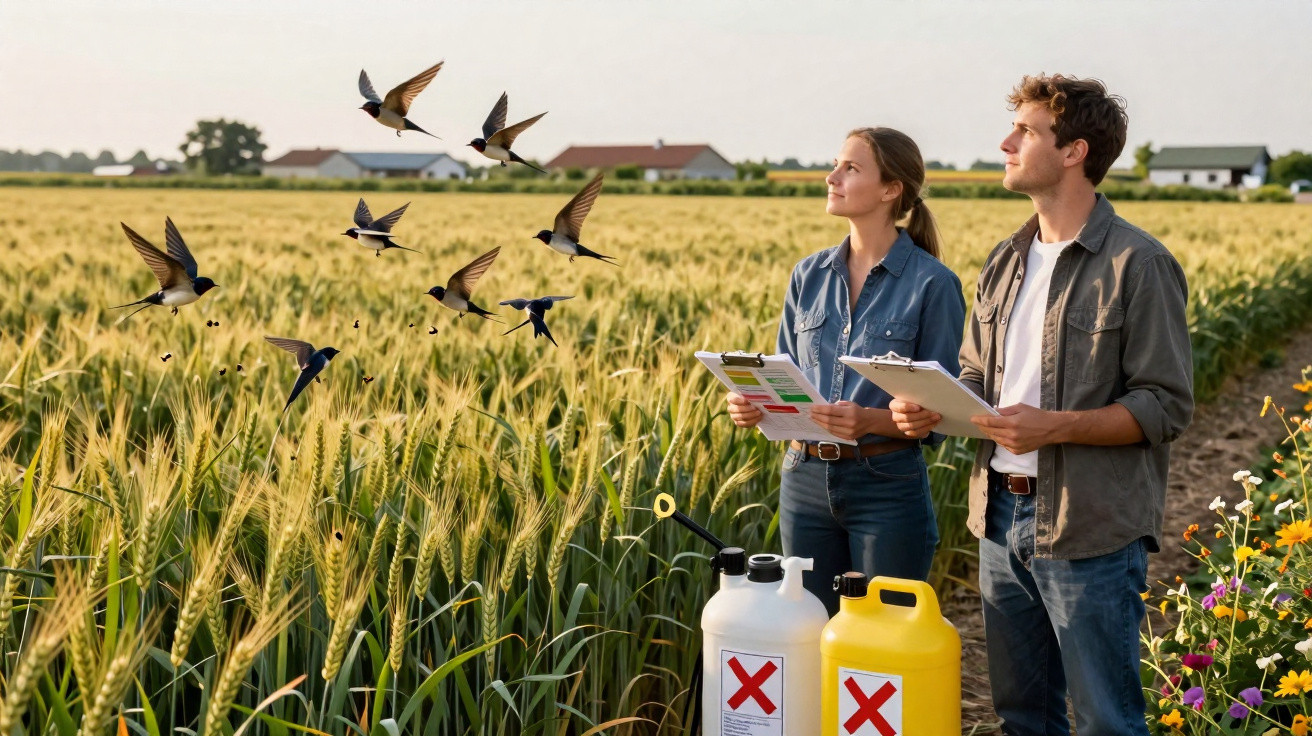
New long-term data from France indicate that populations of insect-eating birds such as swallows and warblers have begun a cautious recovery since certain insecticides were banned. The figures are still far from a happy ending, but they offer a rare glimmer of hope in the otherwise bleak picture of biodiversity loss - and have reignited Europe’s debate on agricultural chemicals and biodiversity.
How an insecticide can deplete entire bird populations
The new research centres on imidacloprid, which for decades was among the most widely used neonicotinoids in Europe. These active substances affect insects’ nervous systems and were primarily intended to target crop pests. In reality, however, they entered soils, streams and earthworms - and ultimately the birds’ food chain.
Thomas Perrot and his team analysed records from almost 2,000 monitoring sites across France, collected between 2013 and 2022. The data revealed a clear pattern: wherever imidacloprid was measurable, populations of insect-eating birds declined markedly.
In areas with higher imidacloprid exposure, insect-eating bird populations fell by more than a tenth on average.
Before the active substance was banned, declines stood at around 12.7 per cent. Even after the ban, the negative effect persisted at roughly nine per cent. This points not only to the chemical’s harmfulness, but also to its persistence in soils and water bodies.
Granivorous species - seed-eaters such as finches - and more adaptable, “omnivorous” bird species showed far weaker responses, or no measurable response at all. Because they rely less heavily on insects, this provides an important clue for interpreting the findings: neonicotinoids affect birds chiefly through their food supply - insects - rather than solely through direct poisoning.
Direct exposure to poison and an empty table
For insect-eating birds, imidacloprid can be devastating in two ways:
- Less prey: insect populations collapse, leaving young birds with scarcely any food.
- Direct effects: residues from treated seed or contaminated water can also damage birds’ own nervous systems.
According to the study, imidacloprid was found not only in arable soils, but also in surface waters, earthworms and even the tissues of small mammals and birds. The active substance therefore moves through the entire agricultural ecosystem.
Neonicotinoid ban since 2018 - and the first signs of recovery
Since 2018, neonicotinoids have not been permitted for use on fields in the EU. At the time, the principal aim was to protect bees and other pollinators. The fact that insect-eating bird numbers are now increasing slightly again at some sites is considered important evidence that such bans can work.
French researchers describe their results as a “cautious but measurable” recovery: the difference in population density between heavily contaminated and less contaminated sites is narrowing. In other words, more insect-eating birds are reappearing on fields that were previously more heavily poisoned.
The trend is not reversing overnight, but it is reversing - a warning signal is becoming a cautious sign of hope.
This recovery is not proceeding unhindered. Imidacloprid is long-lasting: according to current studies, residues can continue to have an effect in soil for years after the last application. There have also been exceptions to the rule. In France, beet growers received special authorisations in 2021 and 2022 to use seed treated with neonicotinoids. As a result, environmental exposure remained high in some regions for longer than the ban on paper might suggest.
Multiple pressures at once
Pesticides are only one of the factors placing farmland birds under pressure. The study therefore places its figures in a wider context:
- Habitat loss: hedgerows are disappearing, grassland is being ploughed up and field margins are being sealed over.
- Climate effects: shifting seasons alter food availability during breeding periods.
- Intensive farming: fewer fallow areas, more monocultures and more frequent fertiliser use.
All these pressures operate together. That makes it difficult to attribute improvements conclusively to a single policy measure. Nevertheless, the pronounced difference between insect-eaters and seed-eaters demonstrates how strong the insecticide’s specific impact is.
Why bird species do not respond in the same way
The researchers examined 57 bird species across 1,983 sites. One key result was that insect-eating birds responded almost linearly: the more imidacloprid in the surrounding area, the lower their population numbers.
The pattern for seed-eating birds was less clear. In some cases, their populations even reached a short-term peak at moderate exposure before declining again. This may reflect indirect effects, such as altered competition or changes in plant availability.
There were also substantial geographical differences. Insect-eating birds remain relatively common in many regions of central, north-western and eastern France. Seed-eaters are more dominant in the south of the country. These patterns are linked to climate, soil types and cropping systems - as well as to farmers’ respective pesticide strategies.
Landscape structure also shapes recovery
The landscape itself is another key factor. Broadly, the study distinguishes between highly intensified regions and areas containing more semi-natural features.
Where hedgerows, flower strips and remnants of grassland are absent, even a ban often leaves behind an ecological emergency.
The researchers found considerably more stable bird populations in regions with extensive or organic farming. Features such as field copses and wide margins provide refuges and nesting places where insects can persist. Even where some land was previously treated with neonicotinoids, nature has a better chance to recover there.
A new tool: how toxic is farmland overall?
A further element of the study is particularly relevant to future agricultural policy: the concept of “Total Applied Toxicity” (TAT). This indicator is intended to measure how toxic the combined use of all pesticides is for different groups of organisms.
It draws attention to an issue that is often overlooked in approval procedures: farmers rarely apply just one active substance. Many fields are treated with cocktails of fungicides, herbicides and insecticides. TAT seeks to reflect this overall burden rather than assessing individual substances alone.
For bird populations, this means that even if neonicotinoids disappear, other products may continue to put pressure on insects and therefore on insect-eating birds. This helps explain why the recovery in populations is measurable but relatively modest.
What this means for farming and policy
The findings from France send a clear message:
- Bans on individual active substances can produce measurable improvements.
- The effects emerge slowly and are held back by other toxic chemicals.
- Without better habitats in farmland, the upward trend remains fragile.
Through its “Farm to Fork” strategy, the EU has set a target of significantly reducing pesticide use. Implementation has proved difficult in many Member States, not least because of resistance from chemical companies and parts of the agricultural sector. The French data now provide an argument that stricter rules are not merely symbolic policy, but can have genuinely measurable effects on biodiversity.
What neonicotinoids are - and why they remain controversial
Neonicotinoids are a class of active substances that act on insects’ nervous systems. They are often used as seed treatments: the seed is treated before sowing, after which the active substance spreads through the growing plant. The aim is for pests to die as soon as they feed on it.
This is problematic for several reasons:
- Pollinators such as bees and bumblebees absorb residues through nectar and pollen.
- Soil organisms such as earthworms face continuous exposure.
- Some of the chemicals enter streams and rivers through drainage and run-off.
For birds, this means fewer insects, more poison in their food and disrupted breeding periods. The French study therefore joins a growing body of international research showing a systematic link between neonicotinoids and declining bird populations.
What now needs to change in practical terms
Perrot’s research team calls for attention to extend beyond chemical bans alone. In their view, several measures are needed in parallel:
- Expanded agroecological farming with fewer pesticides and more diverse crop rotations.
- More mandatory ecological infrastructure, including hedgerows, flower strips and small water bodies in arable landscapes.
- Stronger financial support for farmers moving towards systems with less chemical use.
- Independent long-term research into the combined effects of pesticides, using indicators such as TAT.
For consumers in German-speaking countries, these findings are not simply a look across the border. They also indicate how decisions can have effects closer to home: buying more organic products, supporting regional hedgerow-planting programmes or setting political priorities - much of what influences bird populations in France also matters between the North Sea and the Alps.
The good news is that where policymakers, scientists and farmers work together, swallows, warblers and other insect hunters are becoming more common again. The less encouraging news is that the pace is still nowhere near sufficient to close the gaps left by recent decades quickly. Yet these quiet advances show that the switch can indeed be turned - if rules are not only adopted, but enforced consistently.






Comments
No comments yet. Be the first to comment!
Leave a Comment