
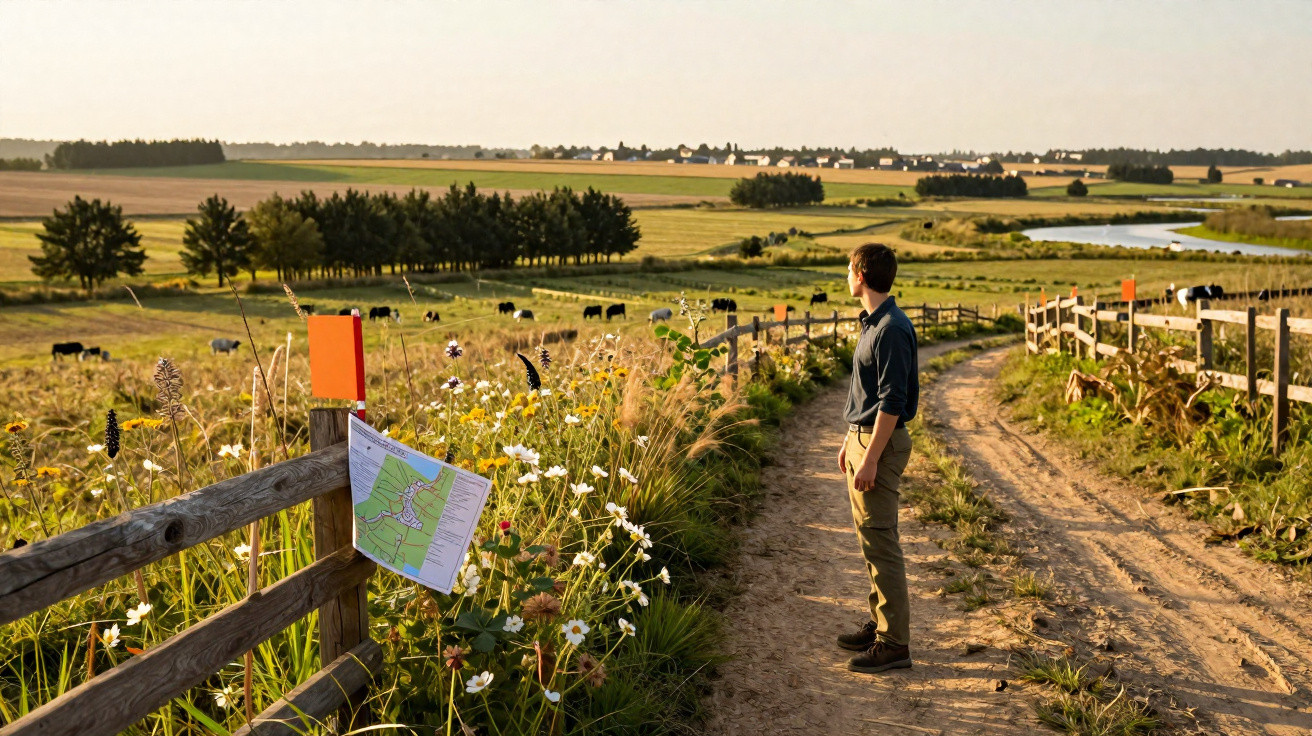
Not traffic or machinery, but the drone of insects, so thick it seems to crackle in the air. A decade ago, this valley was a neat grid of soya and maize, scorched dry each summer and inundated every winter. Now it is a mosaic of ponds, hedgerows, untidy grassland and young woodland, joined together like a place gradually recalling its former self.
A farmer in scuffed boots rests against a gate and watches lapwings wheel above a field newly returned to wetland. Asked what altered, he simply shrugs. “The rules changed,” he says. “So we changed.” Behind him, an excavator is filling a ditch rather than cutting one.
Somewhere between policy documents and this humming field, a prolonged ecological decline has quietly begun to reverse. The unanswered question is how complete that recovery might become.
When land-use rules changed, the landscape changed too
For many years, land-use policies encouraged farmers and foresters to extract more from every acre. Subsidies favoured output, straight boundaries and exposed earth. The result was inevitable: fewer insects and birds, and springs with less sound. People registered the silence, but it was treated as background to “progress”.
A different pressure then emerged: climate commitments, plunging biodiversity charts and soil that became dust during summer storms. Policy began to change direction, though neither swiftly nor smoothly. Funding started to support ponds and hedgerows rather than only ploughing and pesticides. Wetland permits became easier to obtain, while proposals for new golf courses suddenly appeared risky to planning officers.
What seemed like administrative work inside a government department took on another form outdoors. It became room, water, shade and time.
Consider England’s Knepp Estate, now something of a conservation legend. In the early 2000s, this indebted intensive farm sat on heavy clay that resisted attempts to make it “efficient”. Its owners faced a choice: continue battling the soil or use new agri-environment schemes that offered modest payments for allowing land to become wilder.
They took the gamble. Ploughing ceased, and hardy cattle and pigs were introduced as “ecosystem engineers”. The estate embraced revised subsidies that no longer penalised supposedly “unproductive” scrub. Initially, neighbours dismissed it as a mess. Thistles proliferated, fields appeared deserted and the whole project looked like a failure unfolding slowly.
Then came the nightingales, alongside purple emperor butterflies, turtle doves and rare bats. Surveys recorded sharply rising populations of species declining almost everywhere else. Knepp became a practical illustration of what can happen when land policy focuses less on tonnage and is more receptive to ecological recovery. Similar stories are now being heard in former Spanish rice paddies, drained German peatlands and ranches throughout Costa Rica.
The reasoning behind these successes is straightforward: incentives shape land. For years, political signals informed landowners that drainage, tidiness and chemicals represented success. Output increased while ecosystems declined. Once incentives shifted - towards payments for carbon-rich soils, wetland-protection rules and tax relief for conservation easements - behaviour changed as well. Not immediately or everywhere, but sufficiently to make a difference.
Ecology moves more slowly than a budget cycle, yet can respond surprisingly quickly once the pressure lifts. Seed banks beneath the ground revive. Insects recolonise from nearby refuges. As prey populations recover, predators follow. Policy therefore does not “restore nature” itself; it establishes the conditions in which nature can do the work freely.
Reversing decline is not magic. It is what occurs when governments no longer pay for landscapes to remain unhealthy.
How land-use policies alter decisions on the ground
Remove the technical language and the key moment can be remarkably ordinary: a land manager at a table with a pen, considering a new agreement. Older schemes may have paid per hectare of wheat. Redesigned land-use policies can instead fund permanent cover crops, restored riverside buffers or floodplains allowed to flood.
That changes everyday choices. Rather than draining a wet corner “just to tidy it up”, a farmer may retain it and plant trees on higher land. An urban planner may designate riverside land for a park and wet meadow rather than luxury homes because flood-risk regulations now carry real force. Policies do not cultivate land; people do. But people tend towards choices that will not leave them bankrupt.
One influential but overlooked measure is to end subsidies for destruction. As fertiliser subsidies disappear and pesticide regulations tighten, the financial case for monoculture deteriorates. Agroforestry, mixed rotations and grazing systems that store carbon and support wildlife can gain space because they no longer have to compete with artificially cheap “business as usual”.
New rules can create difficulties too, which is where the picture becomes complicated. A forester committed to a 30-year agreement for fast-growing conifers cannot simply convert to native woodland overnight, even where policy has begun to favour it. A smallholder offered five years of hedge-planting payments may hesitate if earlier schemes disappeared after a change of government.
Trust becomes an unseen form of currency. Participation rises where programmes are straightforward, dependable and tailored locally. Where forms are unclear and rules alter after every election, land users sensibly wait and protect their options. Meanwhile, the ecological clock continues to run as paperwork accumulates.
At a human level, land-use policy may seem like a remote chess game run by people who have never had to clear mud from a tractor. That feeling matters. Schemes are adopted more quickly and generate less resentment when farmers and community groups help design them - deciding which habitats take priority, how monitoring is carried out and how disputes are settled.
Most of us know the experience of a top-down rule entering our lives, plainly written by someone who will never have to follow it. Land is no exception. When policy includes listening - through citizen assemblies on zoning or local co-operatives administering rewilding funds - ecological recovery is received as an opportunity rather than an affront.
The turnaround of long-term decline is not merely technical; it is emotional, cultural and, frankly, political.
What changing land-use policy means beyond the fields
Land use may seem, from afar, like a specialist concern for farmers, scientists and finance ministries. In practice, changing rules already affect urban tap water, food costs and the air entering your bedroom window. When wetlands are protected by law rather than drained, flood peaks downstream begin to ease. Insurance premiums in affected towns may fall, while muddy water after heavy rainfall clears more quickly.
Planning policies that support trees, green roofs and pocket parks do more than “help biodiversity”. They lower temperatures in heatwaves, filter traffic particulates and provide children with somewhere to climb that is not a screen. When a city revises its zoning rules to require green corridors beside new roads, land-use policy is being woven directly into the daily commute.
Let us be honest: nobody reads the technical appendices to local development plans every day. Even so, paying some attention to local land debates is worthwhile. A proposed bypass, a “mixed-use” scheme on a former marsh or a plan to restore a river’s natural meanders all contribute to the wider story of decline or recovery.
Many people mistakenly assume that land use is both permanent and distant. It is easy to think forests disappear or return somewhere else, governed by forces beyond our reach. Yet local councils, regional authorities and even neighbourhood committees frequently have considerable influence over what is surfaced, planted or protected.
Policymakers often fall into the trap of pursuing rapid results: isolated “showcase” schemes or polished tree-planting campaigns that overlook soil, water and long-term maintenance. A million saplings planted in the wrong location can quietly perish within a decade. Long-term decline is reversed through less glamorous work: safeguarding existing ancient woodland, financing ecological monitoring and paying land stewards to leave an awkward corner untidy rather than manicured.
There is a subtler psychological obstacle as well. People become attached to familiar scenery, including degraded landscapes. After only one generation, a drained peat field can feel “normal”. Rewetting it may initially appear to mean losing views, access or identity. That conflict calls for empathy, not eye-rolling. Changes to land affect memory and family history as much as they affect soil.
“We didn’t set out to save nature,” a Dutch dairy farmer told me, watching curlews feed in his rewetted pasture. “We just stopped being paid to fight the land, and after a while, we realised we’d been fighting ourselves.”
- Small daily choices - Selecting products with credible “deforestation-free” or regenerative labels moves demand towards improved land use in other places.
- Local planning meetings - Attending even once a year can influence votes on floodplain building proposals or new urban parks.
- Questions for politicians - Asking how land policies affect wildlife, water and soil keeps these issues on their agenda.
- Support for land stewards - Supporting community forests, Indigenous land rights or farmer co-operatives grounds policies in real-world practice.
The quiet force of healing landscapes - and what follows
Spend enough time walking through a place where rules have loosened extraction’s hold, and details emerge that graphs and policy papers overlook. The scent beneath your feet changes, becoming rich with leaf litter rather than fertiliser. Streams remain clearer after storms. Woodpeckers make themselves heard where, ten years earlier, the loudest noise was a sprayer travelling at dawn.
The reversal of long-term decline does not follow a straight path. Droughts strike, fires sweep through young woodland and political priorities shift. Freshly restored wetlands may be drained again under new leadership. Rewilding projects can falter amid local opposition. Still, every clear success - every floodplain or valley that moves from loss towards recovery - makes the next project easier to picture and finance.
The central issue is no longer whether land can recover under better rules. Evidence from dozens of countries and climate zones shows that it can. The issue is how far societies are prepared to go in rewriting the agreements between forests, fields, cities and the people living alongside them. These agreements are no longer abstract: they influence the flavour of drinking water, the cost of food and the weather arriving on your street.
Ultimately, policies are only a framework. Within it is a living collage: farmers taking chances on new crops, communities removing old culverts so rivers can breathe, and investors recognising that healthy soils can be as bankable as concrete. It is an unfinished and somewhat untidy collage, like a field during the first years after the plough has been put aside.
Perhaps that is the most hopeful aspect of this change. Long after the acronyms have altered once more, trees will still be taller, birds louder and soil darker. The rules opened the door; the land is passing through it, one untidy step at a time.
| Key point | Detail | Why it matters to the reader |
|---|---|---|
| Policy can reverse decline | Changes to subsidies, zoning and protection laws are already supporting ecological recovery across several regions. | It demonstrates that environmental harm is not unavoidable and can be reversed within a lifetime. |
| Incentives shape landscapes | Farmers, foresters and planners react to legal and financial signals in highly practical ways. | It helps explain how your taxes, votes and purchases affect distant forests and fields. |
| Local action matters | Council decisions on parks, floodplains and wetlands contribute to the larger story of recovery or decline. | It provides practical ways to help shape the land where you live. |
Frequently asked questions
- How rapidly can ecosystems recover after land-use policies change? Recovery commonly starts within a few years, with plants, insects and birds responding first; complete regeneration of forests and soils can take decades.
- Do these policies damage food production and increase prices? Land-use changes may alter what is grown and where, but mixed regenerative systems can often maintain yields while strengthening resilience to climate shocks.
- Which policy-led recoveries have been successful? Rewilding at Knepp in the UK, German peatland restoration, Costa Rica’s forest recovery and wetland protection in the Netherlands all demonstrate measurable improvements.
- Can individual consumers genuinely influence land use? Yes. They can do so by choosing certified products, supporting local regenerative producers and taking part in local planning decisions.
- What should we look for in future land-use debates? Watch how policies address peatlands, wetlands and ancient woodland, and whether long-term funding is available for the people managing land on the ground.






Comments
No comments yet. Be the first to comment!
Leave a Comment