
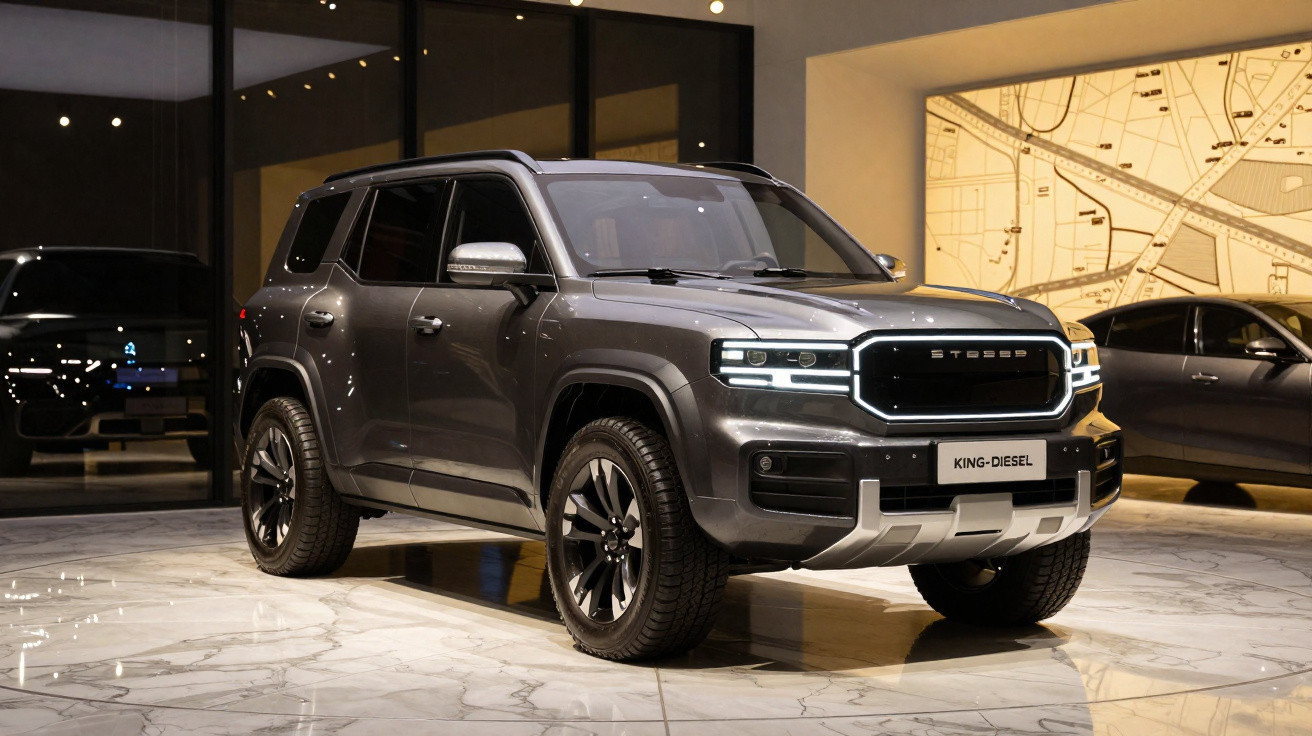
The motorway was still pitch-black when they pulled out of the drive, coffees in hand, battery at 100%, and children half-asleep in the rear seats. Their shiny, silent electric SUV was set to cover 2,500 kilometres through half of Europe. Every detail had been arranged: apps installed, charging points saved, and a hotel with rapid chargers reserved weeks beforehand. It felt less like organising a family driving holiday and more like preparing for a lunar mission.
Two days later, at a blustery motorway service area, they watched a diesel estate fill its tank in five minutes before vanishing towards the horizon. Their own charging session still had 37 minutes to run.
Somewhere between a sigh and a laugh, the blunt verdict arrived.
Diesel is still king on the road.
2,500 kilometres later: a road-trip reality check
In theory, their electric adventure appeared faultless. Its official range covered most legs, public charging networks were growing, and social media was full of victorious EV road-trip posts. The parents appreciated the prospect of cleaner driving, the children enjoyed the silent acceleration, and their budget spreadsheet showed projected fuel savings in green.
Reality intervened shortly after the first 600 kilometres. There were traffic jams, a faulty rapid charger, an app that crashed at precisely the wrong time, and a slow-moving queue behind two vehicles already plugged in. All at once, the “future of mobility” mostly smelled of cold coffee and lukewarm sandwiches.
The first day was meant to be their major push: almost 1,200 kilometres, three rapid-charging stops and arrival by early evening. Stop one went without a hitch. They pulled in with 18% charge, connected the car, stretched their legs and bought snacks. After 28 minutes, they were back on the motorway at 80%, feeling almost smug.
Then they reached the second stop. The advertised 300 kW charger was producing barely 90 kW. The station Wi-Fi had failed, a payment terminal rejected their card, and a software update froze the display just as the car reached 79%. Twenty pointless extra minutes disappeared. That was when the father worked out how much further they would have travelled in his old diesel estate. The result stung.
By the close of day two, they were counting charging sessions rather than kilometres. There had been seven altogether, ranging from ideal to nearly ridiculous. One charger was tucked behind a hotel, another was blocked by a delivery van, and a third only operated via a third-party app that they had to download there and then on weak 4G. The children began groaning whenever anyone said “charger”.
On the motorway, a diesel driver needs only one thought: get to the next pump, spend five minutes there, then carry on. In an EV, long-distance travel quietly becomes a game of mental Tetris. You are balancing range, gradients, temperature, queues and apps. The car drives itself better than the trip organises itself. That is the paradox.
Why diesel still wins when the road gets long
The uncomfortable truth hit them somewhere near kilometre 1,900. For long, straightforward road trips, diesel still makes more sense for most people. An ageing estate may clatter slightly, but it can travel 900 kilometres on one tank. You see a filling station, stop, pay and leave. No charts, apps or kilowatts.
On an extended journey, that kind of uncompromising simplicity is invaluable. When you are exhausted, the children are irritable and you are late for check-in, refuelling as though it were 2005 suddenly feels like a genuine luxury.
Picture the familiar driving day: leaving at dawn and hoping to get the biggest section done before lunch. In a diesel, you can almost ignore the fuel gauge until the middle of the afternoon. The only meaningful limitation is your body telling you it is time for a break.
With the electric car, the vehicle calls the shots. Cold conditions cut range, headwinds drain the battery, and one missed junction can turn a comfortable buffer into a tense countdown. On one occasion, they reached a charging point with 5% remaining because the sat-nav had not allowed for a diversion. The energy graph resembled a horror film. They laughed about it, but the stress was genuine.
There is also an emotional element that brochures rarely mention. Covering distance in a diesel feels routine, even a little dull. You know exactly what is coming, and that predictability is precisely what you need during 12-hour drives.
Electric long-distance travel is the reverse. It combines technological enjoyment with a background hum of low-level anxiety. You celebrate an available free charger, swear at a broken one, and constantly bargain between speed and range. The car is modern, the experience still feels like beta-testing. To be fair, nobody does this every single day. Yet on those occasions when you need to cross a country quickly, diesel is in a different league.
How to survive an electric trip of 2,000+ km and stay sane
If you are taking an EV on a journey of 2,000 or 2,500 kilometres, you can improve the odds in your favour. The essential step is to plan like a control freak, then accept that half the plan may fall apart as soon as you reach the motorway. Map the route with at least two alternative charging points every 200–250 kilometres. That means one failed station will not destroy the day.
Next, arrange your stopping routine around the battery rather than forcing the battery around your schedule. Aim to drive for 2–3 hours, stop for 25–35 minutes, and repeat. It is less heroic, but far more realistic.
One understated but smart approach is never to reach a charger with the battery completely empty. The dramatic screenshots showing a 0% arrival may look impressive online, but on a family journey they create needless pressure. Try to plug in at around 15–20%. You retain a safety margin while still benefiting from respectable charging speeds.
Many EV owners learn another lesson the difficult way: do not fixate on 100%. The final 20% takes painfully long at rapid chargers. It is better to return to the road at 70–80% and stop slightly more often than wait another 25 minutes simply to fill the virtual tank completely.
Then there is the cost. Public rapid charging can quickly undermine the argument that an EV is cheaper, particularly on premium networks. At a crowded charging hub, one driver summed it up while staring at the price per kWh:
“On this kind of trip, I miss my old diesel. Not the smell, not the noise. Just the fact I knew exactly what it would cost and how long it would take.”
A few rules can protect both your sanity and your budget:
- Prioritise hotels and holiday lets offering overnight AC or destination charging.
- Drive a little more slowly on the motorway: 120 km/h rather than 135 can save an entire stop.
- Use a mix of networks and compare prices instead of connecting to the first flashy charger you find.
- Carry one physical RFID card as a backup for occasions when apps fail or freeze.
- Travel outside peak periods where possible: there is less traffic and fewer queues at chargers.
Between two worlds: what this trip really tells us
Their 2,500-kilometre trip did not leave them hating electric cars. Once home, for city driving and short breaks, the EV was plainly better: quiet, clean, enjoyable and inexpensive to run. The more they used it in daily life, the rougher and more dated the diesel seemed.
Still, the phrase remained: diesel is still king on the road. This is not because it is the superior technology, but because long-distance infrastructure and habits have not fully caught up with what EVs promise.
The journey exposed an unusual transition period. For everyday life, the future has already arrived. For major summer getaways, cross-border family journeys and unplanned 900-kilometre dashes, we remain caught between two worlds. One foot is in apps and kilowatts; the other is at old-fashioned fuel pumps that simply… work.
For some people, that is an exciting challenge. For others, it is merely another concern in lives that already feel overfull. The next few years will probably determine whether rapid-charging networks can remove that feeling and unseat diesel for good. Until then, many people will quietly retain both images: the silent EV parked outside the house, and the dependable diesel ready for when the map zooms out and the road runs beyond the horizon.
| Key point | Detail | Value for the reader |
|---|---|---|
| Diesel still dominates long-distance travel | Fewer stops, predictable refuelling, minimal planning | Helps you decide which car suits your type of trips |
| EV road trips demand extra mental load | Apps, backup chargers, speed versus range, pricing differences | Lets you anticipate fatigue and stress before a major journey |
| EVs shine for everyday and medium-distance use | Low running costs, comfort, straightforward home or workplace charging | Shows where an electric car becomes an obvious, practical choice |
FAQ:
Is a 2,500 km trip in an electric car really doable?
Yes, it is possible with current models and networks, but you must accept more stops, some uncertainty and careful planning, particularly when travelling across borders.How many charging stops should I expect on such a journey?
With a modern EV rated for 400–500 km of range, expect 5–8 rapid-charging stops across two long driving days, depending on speed, weather and terrain.Does fast charging cost more than diesel on long trips?
On certain premium networks, yes: the cost per 100 km can come close to or even exceed that of an economical diesel, especially at high motorway speeds; cheaper chargers can help restore the balance.Which is better for holidays: renting a diesel or taking my EV?
If your journey is mainly motorway driving with a tight schedule, hiring a diesel may be less stressful; if you are combining shorter legs, sightseeing and overnight charging, your EV can work very well.Will electric cars soon be as convenient as diesel for long distances?
As charging networks grow, charging speeds rise and payment becomes easier, the gap should narrow; the real issue is when everyday motorists will feel that change on the road, rather than only technology enthusiasts.






Comments
No comments yet. Be the first to comment!
Leave a Comment