
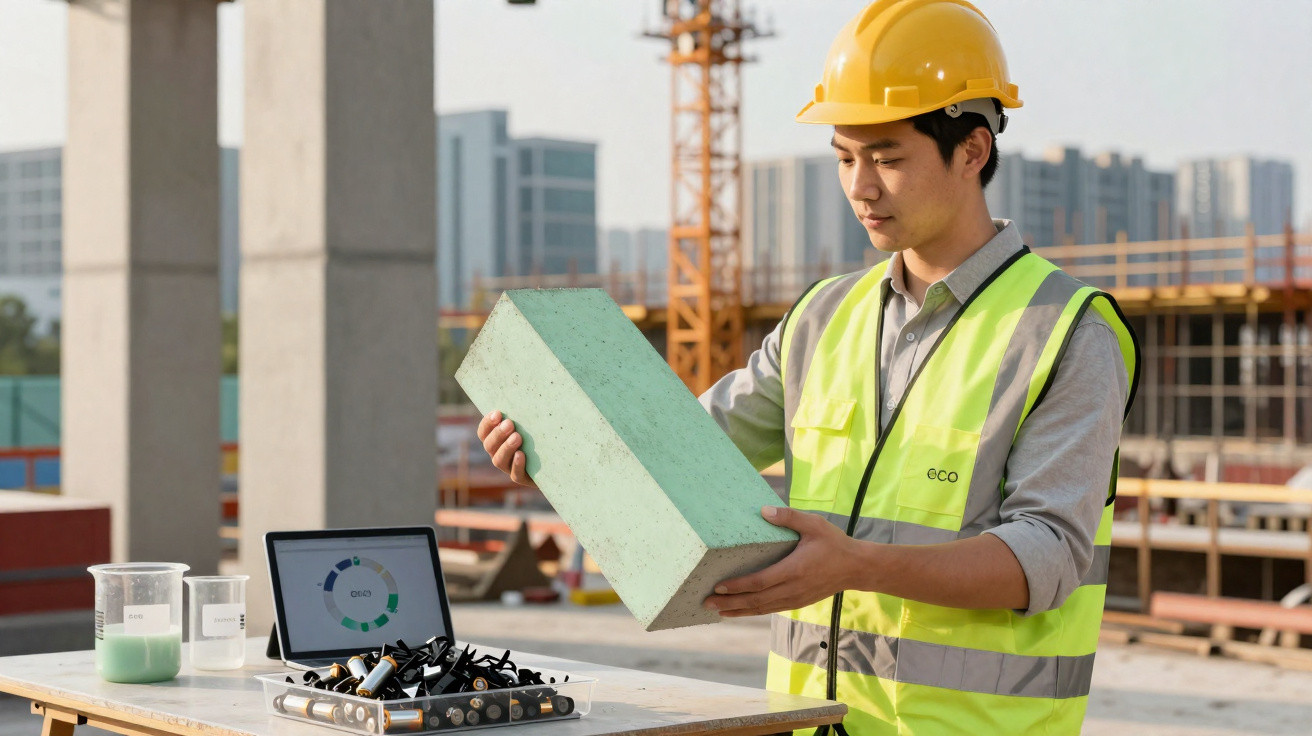
On a planet covered by buildings, flyovers and motorways, one unassuming material accounts for an enormous share of the global climate impact.
Concrete underpins almost everything described as “modern civilisation”, yet it also comes with a substantial environmental cost. Australian researchers now say they have identified an unexpected way to lessen that damage by using waste produced by the worldwide race for lithium batteries.
A sea of concrete and a harsh climate bill
Humanity produces roughly 30 billion tonnes of concrete every year. In practical terms, that is about 952 tonnes leaving factories and plants every second. It is the material used for cities, roads, dams and airports: unobtrusive, grey and seemingly ordinary.
Behind this vast output lies a major cost: Portland-cement-based concrete is responsible for around 8% of global CO₂ emissions, according to recent IPCC reports. On its own, it causes more pollution than commercial aviation.
Concrete is both a symbol of urban progress and of a method of construction that places pressure on the climate, natural resources and air quality.
The main issue is cement, the powder that binds sand, aggregate and water together. Its production requires extremely high-temperature kilns that burn fossil fuels while also releasing CO₂ directly through the breakdown of limestone. These two emission sources are difficult to avoid using conventional technologies.
From battery waste to “green concrete”
What is delithiated β-spodumene?
At the other end of the climate equation is lithium, a crucial metal for batteries in electric cars, mobile phones, laptops and energy-storage systems. Extracting and refining this metal also creates environmental impacts and waste streams. One of these is delithiated β-spodumene, referred to in academic literature as DβS.
DβS is generated as a by-product of lithium refining. It is a solid material, either powdered or in fragments, which would normally end up in tailings facilities, landfill sites or open stockpiles. It takes up space, can create dust, requires environmental monitoring and rarely has a large-scale use.
A team at Flinders University in Australia, led by Professor Aliakbar Gholampour, chose to reverse that approach. Rather than seeing DβS as a problem, the researchers treated it as an ingredient.
Geopolymers: an alternative route to Portland cement
The team tested DβS in a form of concrete that differs from conventional concrete: geopolymer concrete. This system contains no Portland cement. Instead, it relies on a blend of silicon- and aluminium-rich materials, such as ash or industrial slags, activated by alkaline solutions that trigger polymerisation reactions.
When the scientists added DβS to this matrix, they found that the waste could function as an additive and, in part, replace other inputs such as fly ash from thermal power stations. The outcome was noteworthy.
Tests indicated improved mechanical strength and greater durability, with the potential to outperform traditional concretes in certain formulations.
Put simply, waste from the battery industry is beginning to act as structural reinforcement in concrete with a lower carbon footprint.
Less waste and greater circularity
Why this DβS concrete solution deserves attention
The Australian proposal directly links two challenges that are advancing together: rapidly rising demand for lithium and the need to reduce emissions from construction. This connection between mining and concrete could have several direct effects:
- reducing the quantity of lithium-refining waste sent to landfill or industrial containment facilities;
- lowering the use of conventional raw materials associated with major impacts, including coal fly ash and cement clinker;
- creating economic value from waste that currently incurs storage and environmental-control costs;
- putting the circular-economy principle into practice, with a by-product from one industry becoming a valuable input for another.
This type of reuse is becoming increasingly relevant because lithium mining is expected to expand alongside the electrification of transport. Each new megawatt-hour of battery capacity produced also generates waste streams that require safe disposal.
| Challenge | Current risk | Role of DβS in concrete |
|---|---|---|
| Lithium waste | Build-up in stockpiles, potential contamination | Conversion into a construction input |
| Cement emissions | High CO₂ per tonne of clinker | Partial replacement through a geopolymer matrix |
| Demand for infrastructure | Consumption of non-renewable resources | More durable, material-efficient concrete |
How the new concrete performs in practice
Formulations, testing and current limitations
To obtain robust findings, the Australian team adjusted the composition of DβS geopolymers, including the types of alkaline activators, the proportion of waste to other aggregates, and curing conditions at ambient temperature.
Certain combinations stood out, achieving strength levels comparable with - and in some instances greater than - those of standard concrete used in everyday structures. Their performance also matched that of conventional ash-based geopolymers, while offering a clear environmental advantage: less dependence on coal and its by-products.
These materials must still pass further validation stages, including standardising the quality of DβS supplied by different mines, assessing long-term durability, evaluating behaviour through wet, hot and cold cycles, studying the effects of chemical attack, and ensuring compliance with construction standards.
The scientific breakthrough has already taken place in the laboratory; the next challenge is turning this knowledge into a certified product that is competitively priced and scalable.
Potential uses for DβS concrete
In a realistic scenario, DβS concrete is likely to make its debut in controlled, lower-structural-risk applications, expanding as it builds a performance record. Natural candidates include:
- paving for footpaths, car parks and cycle routes;
- blocks for retaining walls, non-load-bearing walls and precast components;
- non-critical infrastructure, such as light industrial sheds and temporary structures;
- pilot projects in social housing developments linked to innovation programmes.
Over time, if durability results are confirmed, bridges, flyovers and multi-storey buildings could also enter the picture.
Other efforts to “decarbonise” concrete
Bacteria, wood and self-repair
The search for cleaner concrete is not new. Research groups around the world are developing alternatives and additions to the conventional Portland-cement route. Among the most widely discussed approaches are:
- powders containing dehydrated bacteria which, when reactivated with water, urea and calcium, begin producing biocement that “binds” sand grains and cracks;
- concrete containing enzyme microcapsules that rupture when cracks emerge, releasing healing agents that mimic bone repair;
- projects that turn wood waste into cementitious additives, partly replacing clinker and reducing carbon intensity per cubic metre.
None of these approaches alone solves the global emissions challenge posed by construction, but collectively they point to a changing sector that is more conscious of material life cycles and opportunities to reuse waste.
Risks, safeguards and the next steps
Reusing industrial waste at scale always raises safety questions. For DβS, regulators and communities will seek clear answers on the potential leaching of chemical elements, effects on groundwater, and air quality during handling and future demolition work.
Toxicological testing, simulations covering decades of use and independent assessments can help establish confidence. One sensitive issue is variability: each lithium mine has its own ore composition. That may require batch classification or standardised processing routes to ensure the final concrete delivers predictable performance and safety.
How this could affect cities and construction projects in Brazil
Brazil remains at an early stage in lithium mining compared with Australia and Chile, but it is beginning to establish itself as a relevant supplier. If the DβS route gains momentum, it could create opportunities for:
- partnerships between mining companies, universities and local precast-concrete producers;
- new industrial hubs focused on regional geopolymer concrete, using waste generated close to construction sites;
- public projects requiring a minimum proportion of recycled content in infrastructure works.
One way to picture the impact is to imagine a major logistics complex built near a lithium extraction area. Rather than lorries transporting waste over long distances, that material flow could be redirected to concrete plants, cutting transport requirements and creating local value.
Terms such as “geopolymer” and “delithiated β-spodumene” may sound remote from everyday life, but they define precisely this boundary between materials chemistry and climate policy. Every percentage point of cement replaced by solutions such as this represents thousands fewer tonnes of CO₂ released over years of construction work.




Comments
No comments yet. Be the first to comment!
Leave a Comment