
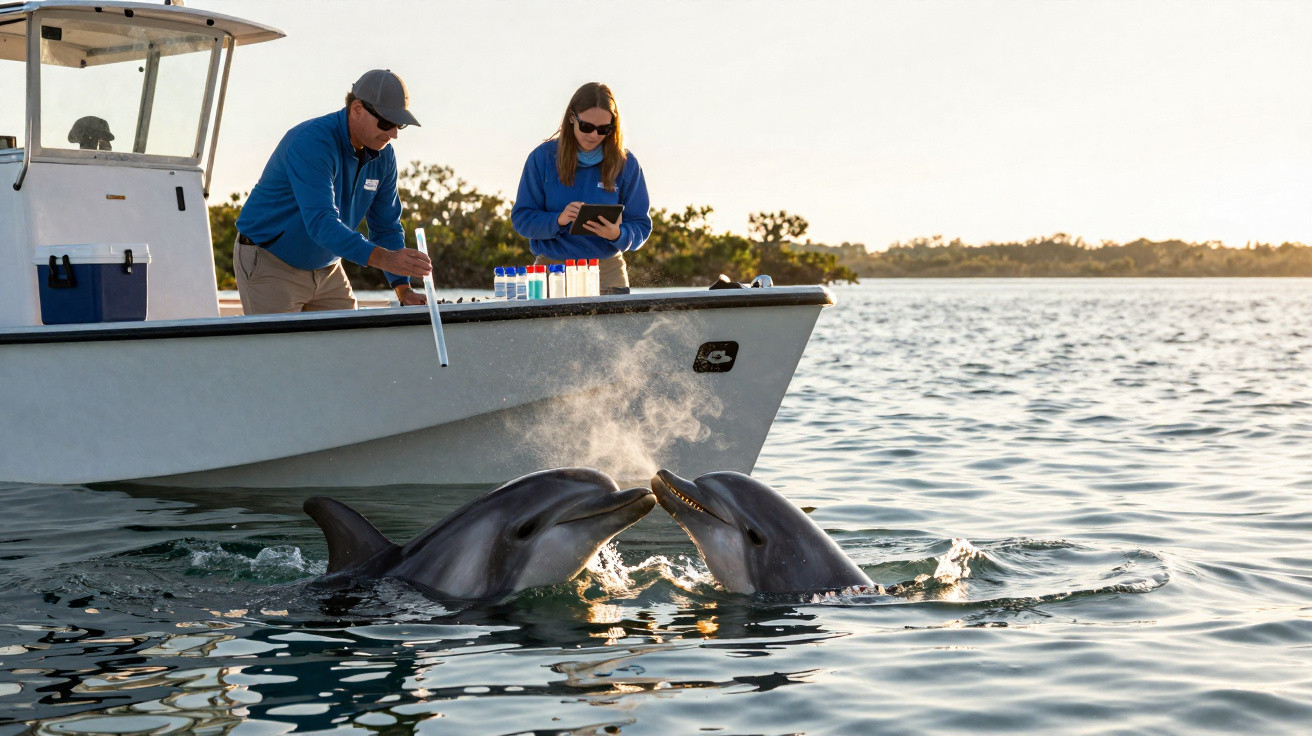
Bottlenose dolphins in Sarasota Bay, Florida, and Barataria Bay, Louisiana, are breathing out microplastic fibres, according to our research, published in the journal PLOS One.
Minute fragments of plastic have now reached every part of the world: land, the air and even clouds.
The oceans alone are thought to contain 170 trillion pieces of microplastic. Studies around the world have shown that humans and wildlife encounter microplastics chiefly through food and drink, as well as by inhaling them.
Our research showed that microplastic particles exhaled by bottlenose dolphins (Tursiops truncatus) have a chemical composition resembling particles found in human lungs. It is not yet clear whether dolphins are exposed to greater levels of these pollutants than people.
Why it matters
In people, breathing in microplastics can trigger lung inflammation. This may result in issues such as tissue damage, excessive mucus, pneumonia, bronchitis, scarring and potentially cancer. As dolphins inhale comparable plastic particles, they could face similar lung health risks.
Evidence also indicates that plastics contain chemicals which can influence human reproduction, cardiovascular health and neurological function. Because dolphins are mammals, microplastics could potentially create these health risks for them as well.
As apex predators that can live for several decades, bottlenose dolphins enable scientists to examine how pollutants affect marine ecosystems and the associated health risks for people who live near the coast. This work matters because more than 41% of the world’s human population lives within 100 km (62 miles) of a coastline.
What is still unknown about microplastics
Scientists estimate that the oceans hold many trillions of plastic particles. These reach the sea through run-off, wastewater and deposition from the atmosphere. Waves can then send the particles back into the air.
Indeed, bubbles bursting as a result of wave energy may emit 100,000 metric tonnes of microplastics into the atmosphere every year. Because dolphins and other marine mammals breathe at the surface of the water, they could be particularly susceptible to this exposure.
More people generally means more plastic. However, that relationship does not always apply to tiny plastic particles suspended in the air. Airborne microplastics are not confined to densely populated places; they also contaminate undeveloped areas.
Our study detected microplastics in the exhaled breath of dolphins from both urban and rural estuaries. However, we do not yet know whether the amounts or types of plastic particles differ substantially between these two environments.
How we conduct our research
For this study, we gathered breath samples from wild bottlenose dolphins during catch-and-release health assessments undertaken with the Brookfield Zoo Chicago, Sarasota Dolphin Research Program, National Marine Mammal Foundation and Fundación Oceanogràfic.
During these short, permitted health examinations, we positioned either a Petri dish or a customised spirometer - an instrument used to measure lung function - over the dolphin’s blowhole to capture its exhaled breath. In our colleague’s laboratory, we used a microscope to look for tiny particles with plastic-like characteristics, including smooth surfaces, bright colours or fibrous forms.
As plastic melts under heat, we used a soldering needle to determine whether the suspected fragments were plastic. Our colleague then confirmed that they were plastic through Raman spectroscopy, a specialised technique that uses a laser to produce a structural fingerprint which can be matched with a particular chemical.
Our findings illustrate both the scale of plastic pollution and the exposure experienced by other living creatures, including dolphins.
Although the effects of inhaling plastic on dolphins’ lungs remain unknown, people can help tackle microplastic pollution by using less plastic and helping stop further plastic contamination of the oceans.
Leslie Hart, Associate Professor of Public Health, College of Charleston and Miranda Dziobak, Instructor in Public Health, College of Charleston
This article is republished from The Conversation under a Creative Commons licence. Read the original article.


Comments
No comments yet. Be the first to comment!
Leave a Comment