
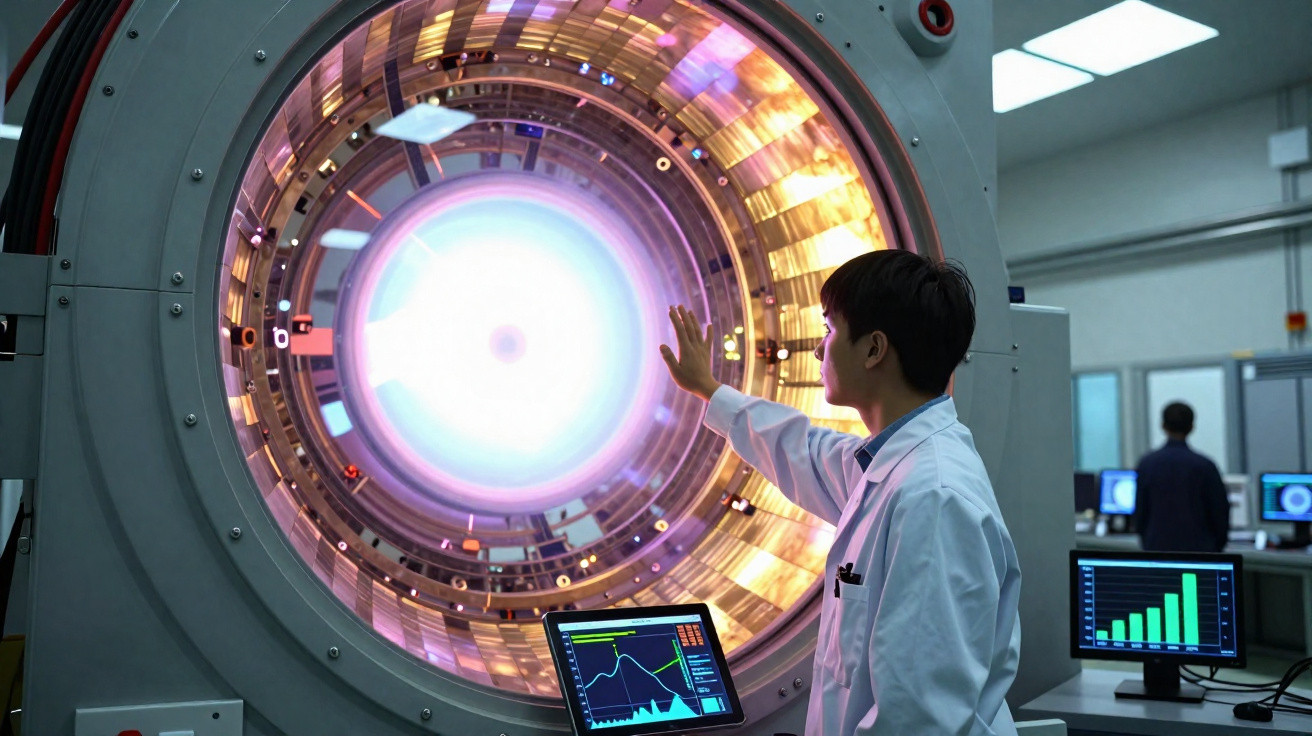
A Chinese fusion experiment has maintained a hot plasma in a stable state while loading it with considerably more fuel than operators would normally attempt, surpassing a long-established density threshold in tokamak reactors.
The research sets out how this obstacle was cleared and why operating at greater plasma density may bring magnetic fusion nearer to continuous energy generation.
Inside the machine
The study details how a fully superconducting Chinese fusion device kept its plasma stable as its density rose beyond previous limits.
By controlling the start-up parameters, Professor Zhu Ping of Huazhong University of Science and Technology (HUST) increased the plasma density without causing it to collapse.
Zhu’s group used the Experimental Advanced Superconducting Tokamak (EAST) to attain between 1.3 and 1.65 times the conventional limit.
Other reactors may be able to adopt this early-stage control approach, although they must still prevent the sudden disruptions capable of damaging equipment.
Why plasma density matters
Adding more fuel to plasma increases its density: the number of particles within a given volume. With greater density, ions collide more frequently, giving every collision another opportunity to fuse and produce energy.
Maintaining sufficiently high fuel temperatures is still difficult, meaning researchers commonly balance density against temperature in order to preserve plasma stability.
If a machine can sustain density without suffering a collapse, heaters gain more time to drive it towards fusion ignition, in which fusion power provides the self-heating.
Most magnetic fusion devices are tokamaks: doughnut-shaped chambers in which magnets confine plasma in a continuous loop.
In many tokamaks, raising density too far cools the plasma edge, potentially causing the plasma to strike the wall abruptly and end the discharge.
Operators frequently rely on the Greenwald density limit, a rule of thumb linked to plasma current, as a warning threshold.
For a long time, crossing this threshold has meant engineers accepting reduced fuel density, slowing the path towards usable fusion energy.
Walls that matter
A more recent theory attributes the density threshold to plasma-wall interactions, in which contact removes atoms from the chamber surface.
Once the walls release these atoms, the plasma can lose energy through radiation in the form of light, making it more difficult to remain hot.
Researchers in France put forward the concept of plasma-wall self-organisation (PWSO) to describe the way plasma and a machine’s internal walls affect one another.
According to this model, changing wall conditions at an early stage can steer the plasma into a state in which the familiar density threshold no longer restricts the amount of fuel it can contain.
An EAST tokamak start-up technique
Rather than waiting for the plasma to become established, the EAST team concentrated on the vulnerable start-up period.
They introduced electron cyclotron resonance heating (ECRH), which uses microwaves to heat electrons rapidly, and left it active throughout start-up.
Elevated initial gas pressure was also important, as the additional neutral fuel at the outset influenced plasma-wall contact before temperatures rose sharply.
Beginning with this combination enabled the discharge to reach a higher density later without requiring emergency interventions once problems emerged.
Cleaner plasma, greater density
The combination of ECRH and extra gas altered the response of the walls, reducing impurities that would normally accumulate as density increased.
With less wall material entering the plasma, less energy was lost through radiation and the core remained hotter for longer.
Temperatures fell near the divertor, the reactor section that manages surplus heat, while the high-density condition stayed stable.
This cooler edge eased the strain on the machine’s internal surfaces, provided operators continued to control the plasma closely.
Tungsten alters behaviour
EAST has tungsten-facing surfaces, and plasma responds differently to this heavy metal when it hits the wall.
Energetic particles striking tungsten can dislodge minute quantities of the metal into the plasma, affecting its cleanliness and stability.
Wall condition was important too: the same settings could sometimes produce different outcomes after previous runs had changed the surface.
This sensitivity indicates that other machines will require thorough, consistent wall preparation to reproduce the result reliably.
Scaling up for future reactors
Achieving greater density through precise start-up control could be applicable to other reactors, as every tokamak has to pass through the same delicate initial phase.
In a burning plasma, where fusion reactions supply most of the heating, increased density can raise energy production without requiring extreme temperature increases.
Rather than adding pellets or other substances to increase the fuel supply, the technique concentrated on controlling wall conditions and applying ECRH during start-up.
Should other reactors achieve the same stable high-density state, designers could move nearer to ignition while retaining strong plasma confinement.
Plasma density and fusion’s future
Trials of the concept under high-confinement operation on EAST will determine whether density-free behaviour persists when the plasma holds more energy.
Greater energy makes disruptions more severe, so the team will need accurate control over gas, ECRH power and wall conditions.
A brief article reported that HUST scientists intend to extend the density-free approach to next-generation devices.
“The findings suggest a practical and scalable pathway for extending density limits in tokamaks and next-generation burning plasma fusion devices,” said Zhu.
By changing start-up conditions and wall behaviour, the EAST findings demonstrate a credible route to increasing density without causing the usual crash.
Demonstrating the method in more demanding operating modes would provide clearer design objectives, though it will continue to require careful control and repeated results.





Comments
No comments yet. Be the first to comment!
Leave a Comment