
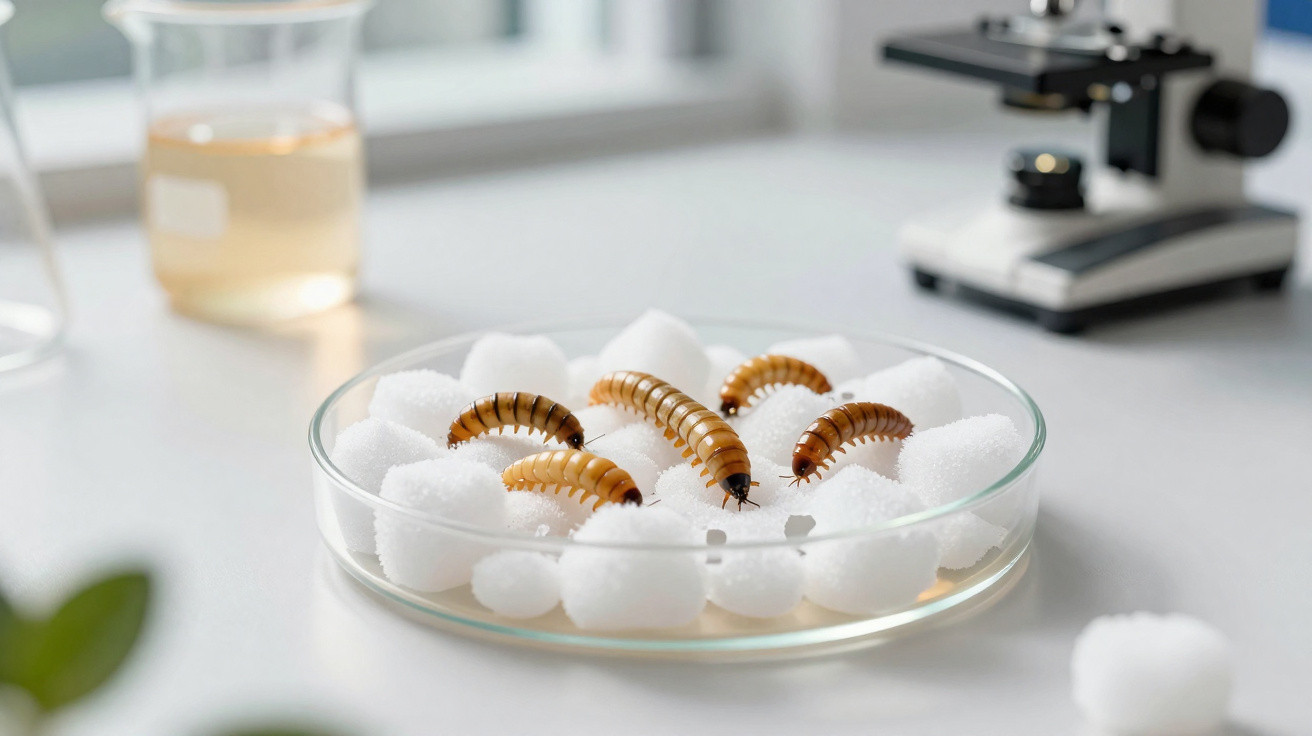
A promising development in the battle against plastic pollution has emerged: mealworm larvae can consume polystyrene.
They are among a limited number of insects known to break down this polluting plastic. However, this is the first discovery of an African-native insect species with this capability.
Polystyrene, often called styrofoam, is widely used for packaging food, electronics and industrial goods. Because it is highly durable, it is also difficult to degrade. Conventional recycling approaches, including chemical and thermal treatment, are costly and may generate pollutants. These limitations prompted us to investigate biological ways of dealing with this persistent waste.
As part of a team of scientists at the International Centre of Insect Physiology and Ecology, I have found that Kenyan lesser mealworm larvae can eat through polystyrene. They also contain gut bacteria that assist in degrading the material.
The lesser mealworm is the larval stage of the Alphitobius darkling beetle. Its larval stage lasts from 8 to 10 weeks. Lesser mealworms are most commonly found in warm poultry houses, where a steady food supply provides ideal conditions for growth and reproduction.
Although lesser mealworms are believed to have originated in Africa, they occur in many countries worldwide. The species identified in our research may, however, be a subspecies within the Alphitobius genus. Further investigations are under way to establish whether this is the case.
We also studied the insect’s gut bacteria to identify the bacterial communities that could contribute to the plastic-degradation process.
Plastic pollution has reached critically high levels in certain African countries. While plastic waste is an environmental problem around the world, Africa faces a particular difficulty because of high imports of plastic products, limited reuse and inadequate recycling.
By investigating these natural “plastic-eaters”, we aim to develop tools that can remove plastic waste more quickly and effectively. Releasing vast numbers of insects at rubbish sites would not be practical. Instead, the microbes and enzymes they produce could be used in factories, landfill sites and clean-up locations. This could make tackling plastic waste more manageable on a large scale.
Key findings
We conducted a trial lasting more than a month. Larvae were given either polystyrene only, bran only, which is a nutrient-rich food, or a mixture of polystyrene and bran.
Mealworms fed polystyrene and bran had higher survival rates than those given polystyrene alone. They also consumed polystyrene more effectively than larvae on the polystyrene-only diet. This underlines the value of maintaining a nutrient-rich food source for the insects.
Although mealworms survived on a diet consisting only of polystyrene, it did not provide sufficient nutrition for them to degrade it efficiently. The result emphasised that a balanced diet is important if the insects are to consume and break down plastic optimally. They may eat polystyrene because it consists mainly of carbon and hydrogen, which could serve as an energy source.
The mealworms receiving the polystyrene-bran diet degraded approximately 11.7 percent of the total polystyrene during the trial.
Gut bacteria
Analysis of the mealworm gut showed substantial diet-related changes in bacterial composition. Examining these changes is vital because it indicates which microbes are actively involved in plastic degradation. It will enable us to isolate the particular bacteria and enzymes that could be used in efforts to break down plastic.
The guts of larvae fed polystyrene contained increased levels of Proteobacteria and Firmicutes. These bacteria can adapt to different environments and degrade a broad range of complex substances.
Kluyvera, Lactococcus, Citrobacter and Klebsiella were also especially abundant. These bacteria are known to produce enzymes able to digest synthetic plastics. When used at scale, they would not harm either the insect or the environment.
Their abundance suggests that the bacteria have a key function in degrading plastic. This could indicate that mealworms do not inherently possess the ability to eat plastic.
Rather, once the insects begin consuming plastic, their gut bacteria may shift in ways that help to degrade it. In other words, the microbes in mealworms’ stomachs can adapt to unusual diets, including plastic.
These results support our hypothesis that the guts of some insects can facilitate plastic degradation. This is probably because their gut bacteria can produce enzymes that break down plastic polymers.
They also point to the potential for isolating these bacteria and their enzymes to develop microbial solutions for plastic waste at a larger scale.
What’s next
Some insect species, including yellow mealworms (Tenebrio molitor) and superworms (Zophobas morio), have already been shown to consume plastics. With help from bacteria in their guts, they can degrade materials such as polystyrene.
Our research differs because it examines insect species native to Africa, which have received relatively little study in relation to plastic degradation.
This regional emphasis matters because African insects and environmental conditions may differ from those elsewhere in the world. They could therefore provide fresh insights and practical approaches to plastic pollution in African contexts.
The Kenyan lesser mealworm’s capacity to consume polystyrene indicates that it may contribute to natural waste reduction, particularly for plastics that resist conventional recycling methods.
Future research may concentrate on isolating and identifying the bacterial strains responsible for polystyrene degradation, as well as studying their enzymes.
We hope to determine whether these enzymes can be produced at scale for waste recycling.
We may also investigate other plastic types to assess how versatile this insect could be for wider waste-management uses.
Scaling up the use of lesser mealworms for plastic degradation would additionally require ways to protect insect health during extended periods of plastic consumption, alongside assessments of whether the resulting insect biomass is safe for animal feed.
Fathiya Khamis, Senior Scientist, International Centre of Insect Physiology and Ecology
This article is republished from The Conversation under a Creative Commons licence. Read the original article.




Comments
No comments yet. Be the first to comment!
Leave a Comment