
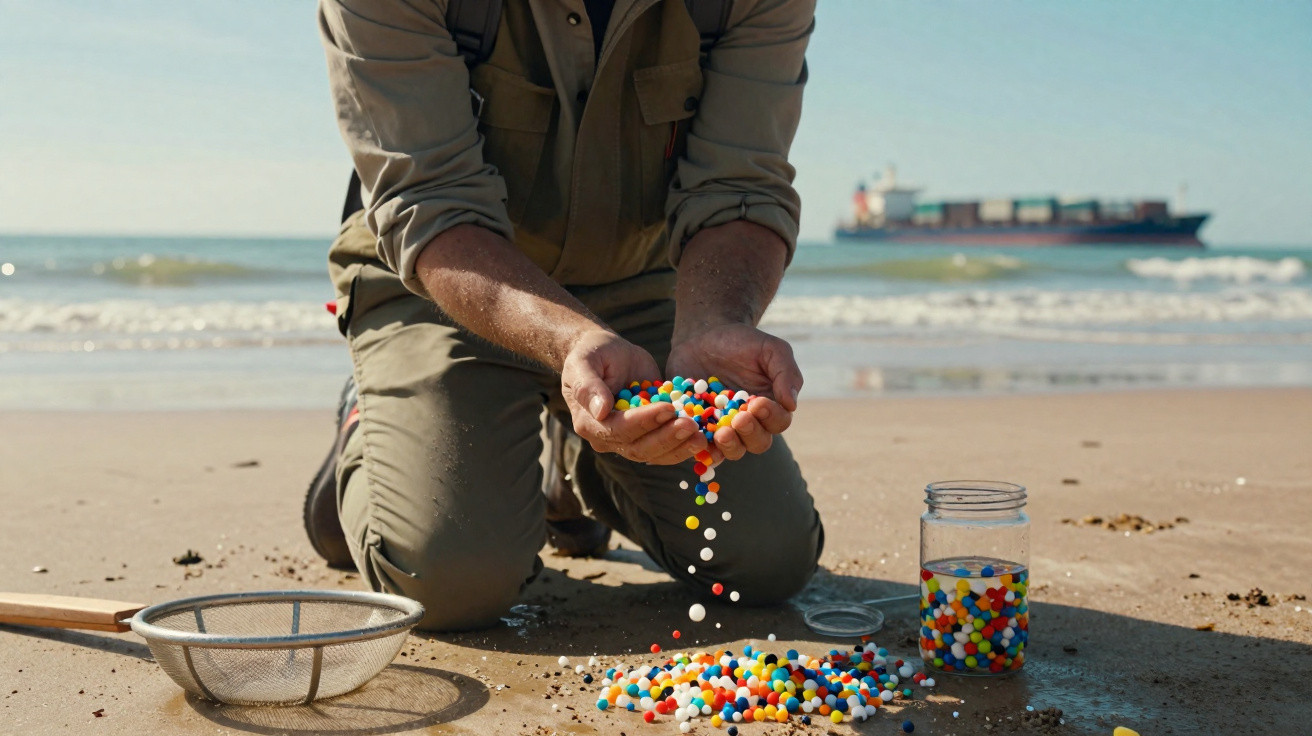
Small enough to rest on a fingertip, plastic pellets can nevertheless inflict disproportionate harm when they reach the ocean.
Following a series of significant spills, an international team of researchers is pressing the International Maritime Organization (IMO) to formally classify plastic pellets – widely known as “nurdles” – as a marine pollution hazard.
They are also seeking stricter requirements to prevent releases and strengthen the response when spills take place.
A scientific commentary newly accepted by Cambridge Prisms: Plastics brings together years of findings from researchers studying pellets both in natural environments and under laboratory conditions.
The group’s research includes field collection, chemical and toxicity assessments, examinations of wildlife exposure, and analyses of major spill incidents.
Their conclusion is unequivocal: existing shipping regulations do not sufficiently safeguard the marine environment from pellet pollution, despite decades of evidence that these pellets routinely enter the sea.
Why plastic pellets keep escaping
Plastic pellets are tiny, lentil-like pieces, generally measuring 2–5 millimetres across. Produced from virgin or recycled plastic, they are transported around the world as feedstock for an enormous range of plastic goods.
Their tendency to spill is the central problem. Pellets may be lost while being stored, loaded or handled on land.
They can also be released during marine transport, a problem recorded since the early 1970s.
After entering the environment, they are exceptionally hard to remove. They disperse over large areas, become mixed with sand and seaweed, and may continue circulating for years.
Scientists therefore contend that pellets must not be regarded as routine, low-risk cargo. Their small size, durability and tendency to escape at numerous stages of the supply chain make them especially prone to environmental leakage.
Enough to “feed” millions of birds
The physical damage they cause is among the most evident concerns. Animals frequently mistake pellets for food and swallow them, particularly seabirds, fish, turtles and other marine wildlife.
“Today the volumes of plastic pellets entering the marine environment are enough to ‘feed’ millions of young seabirds,” noted Jennifer Lavers from Charles Sturt University, who studies pollutants in seabirds.
“In some areas we are already seeing a nearly 100% rate of plastic ingestion, with pellets being particularly problematic for some species.”
“When birds and other wildlife eat these plastics, it can block their digestive system and lead to a wide range of serious health conditions.”
The potential for plastics to “block their digestive system” is far from trivial. Swallowing pellets can suppress appetite, interfere with nutrition and result in injury or death.
Since pellets may accumulate in the environment, the risk is not limited to a single exposure. It can develop into a continual background threat, particularly at hotspots where wind and currents gather floating debris.
Plastic pellets transport chemicals
The commentary also draws attention to chemical hazards. Pellets are not simply inactive pieces of plastic drifting through the water.
They include additives introduced during manufacture, while also absorbing toxic compounds from seawater and potentially releasing them later. As a result, they can serve as miniature carriers of persistent pollutants.
“Plastic pellets are not inert,” said Sinja Rist from DTU Aqua, who works with pelagic pollutants.
“Pellets are persistent, widely dispersed, readily ingested by wildlife, and capable of transporting hazardous chemicals, posing a threat to a wide range of marine organisms.”
This is important because the ocean is not an isolated endpoint. Chemicals may pass through food webs: small organisms can consume pellets, which can then be consumed by predators, allowing contaminants to move upwards through the ecosystem.
The researchers are not claiming that every pellet is a chemical bomb. Instead, they argue that the risk is sufficiently genuine and foreseeable to warrant firmer controls.
Decades of plastic pellet spills
Although pellet spills have occurred for many decades, the commentary identifies one incident that drew worldwide attention in a particularly striking way: the 2021 X-Press Pearl disaster off Sri Lanka.
The container vessel caught fire, releasing its cargo of chemicals and plastic pellets into the sea. The article estimates damages at $6.4 billion, with much of that sum associated with environmental contamination from pellets that burned or spilled.
For affected scientists and local communities, this was not merely a theoretical issue. Beaches, fisheries and coastal ecosystems suffered rapid and highly visible impacts.
“After studying the aftermath of the X-Press Pearl disaster, it is impossible to argue that plastic pellets are harmless cargo,” said Hemantha Withanage, a chairperson at the Center for Environmental Justice in Sri Lanka.
“The impacts in Sri Lanka were immediate, widespread, and long-lasting. Stronger international regulation is essential to prevent this from happening again.”
The significance of this case is not just that pellets can be damaging. One shipping accident can release enormous quantities in a single event, producing a persistent contamination and clean-up challenge extending well beyond the original incident.
Shipping rules leave gaps
MARPOL – the International Convention for the Prevention of Pollution from Ships – prohibits the deliberate discharge of plastics.
However, the study maintains that these rules are inadequate for accidental spills, lost containers and shipping emergencies.
Put simply, the system prohibits dumping plastic but does not do enough to prevent vast releases when accidents occur.
The researchers highlight that the European Union has recently introduced measures intended to prevent pellet losses throughout the entire supply chain.
Meanwhile, the IMO committed in 2021 to tackling pellet pollution from shipping as part of its broader work to reduce marine plastic litter.
Several options have since been considered, including assigning environmentally hazardous pellets a dedicated UN number. This would formally acknowledge their potential hazard and activate obligations concerning packaging, labelling and notification.
The experts argue that the scientific evidence already warrants this action, and that classifying pellets as hazardous in shipping practice would automatically make prevention and response more rigorous.
Global regulations are urgently needed
The authors’ request is clear: acknowledge the danger and regulate plastic pellets accordingly. This would involve stronger measures to keep pellets from escaping in the first place, alongside more explicit rules for dealing with spills.
“There are decades of studies highlighting threats from plastic pellets released into the oceans, including threats to marine animals and the food chain,” said lead author Therese Karlsson, a science advisor for IPEN.
“Plastics are made with thousands of chemicals, including many known to cause harm to the environment and our health. It is past time for global regulations to protect the oceans from spills of hazardous plastic pellets.”
The urgency comes from the combination of their scale and their familiarity. Pellets are present throughout the plastics economy, while spills have long been treated as “normal”. The scientists behind the commentary are effectively arguing that normality does not make the situation acceptable.
If pellets persist, spread widely, are readily eaten by animals and are associated with serious physical and chemical damage, regulations should recognise them as the hazard they represent – rather than harmless grains that happen to float.
A preprint of the study is available here.




Comments
No comments yet. Be the first to comment!
Leave a Comment