
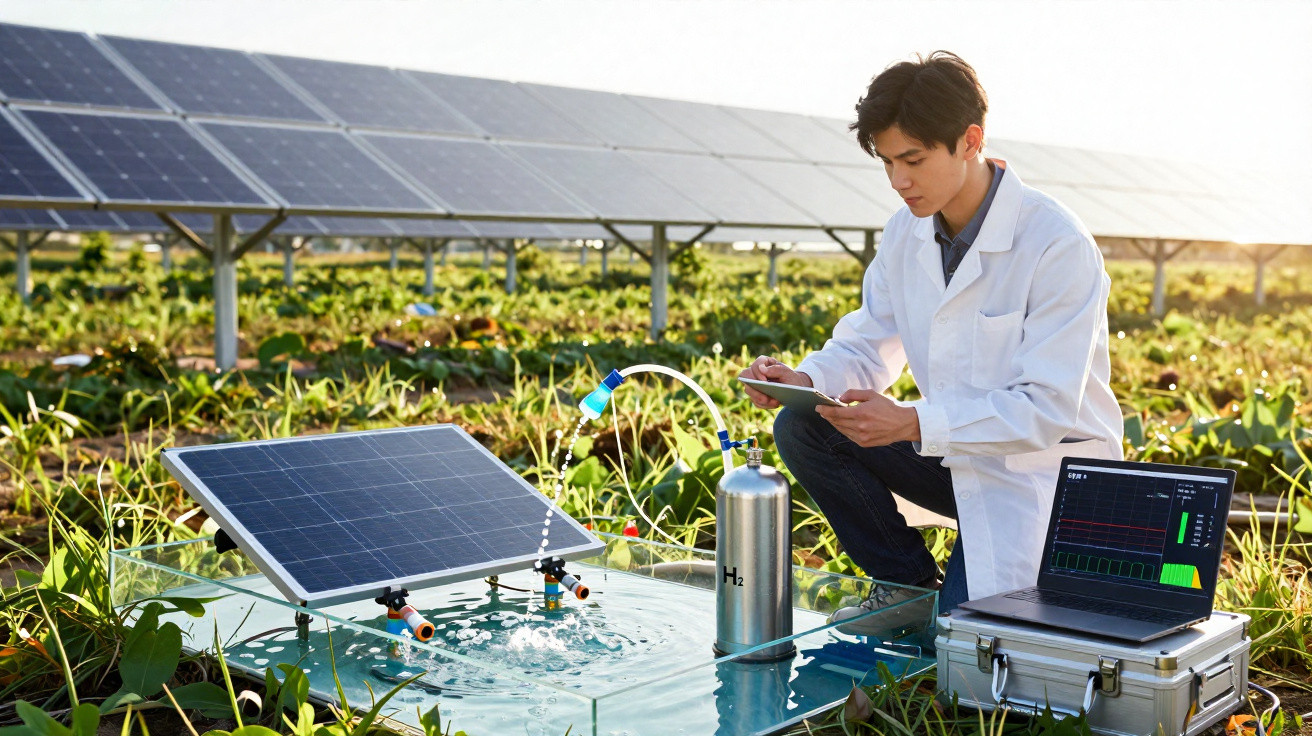
Scientists in Germany have created a compact device that, in outdoor trials, turned as much as 31.3 percent of incoming sunlight into chemical energy held in hydrogen. In other words, it converted almost a third of the sunshine that reached it.
According to the researchers, this is the highest solar-to-hydrogen efficiency yet reported in genuine outdoor conditions. It could be a significant advance, although the apparatus remains a small-scale demonstration rather than a commercial hydrogen facility.
The advance relies on shortening electricity’s route. Rather than passing solar electricity through power-conversion electronics before feeding an electrolyser, the system links high-performance solar cells straight to the water-splitting hardware.
That means fewer stages and lower energy losses. Questions over cost, longevity and large-scale deployment remain unresolved, however.
How the system produces hydrogen
The apparatus uses Fresnel lenses: thin lenses with ridges that operate rather like the magnifying glasses many people used in childhood.
These lenses concentrate direct sunlight onto four-junction solar cells built from III-V semiconductors. The layered materials are able to absorb different portions of the solar spectrum.
Such high-output cells are also used for space applications. They offer substantial power from a small area, but they are expensive.
Electricity from the cells passes to two proton exchange membrane electrolyser cells arranged in series. PEM electrolysis uses electrical power to split water into hydrogen and oxygen.
A polymer membrane transports charged hydrogen particles through the equipment. Put simply, sunlight enters and a fuel that can be stored emerges. The principle sounds straightforward, but the engineering is not.
Project leader Juan F. Martínez said the arrangement uses “concentrating photovoltaics”, while Tom Smolinka called the electrical combination a “perfect match”. Jens Ohlmann oversaw the research, which Frank Dimroth devised at the Fraunhofer Institute for Solar Energy Systems ISE in Freiburg, Germany.
Why the electrical match matters
Solar cells achieve their strongest output at a particular voltage-current balance, while an electrolyser also operates best within a defined range.
If those operating points do not correspond, potentially useful power can be lost.
The team connected four solar cells in parallel with two electrolyser cells in series. This arrangement kept each side near its optimum operating point without requiring additional conversion electronics.
At its best, the solar component achieved 34.7 percent efficiency, while the electrolyser stack reached 91.1 percent. Combined, they delivered the 31.3 percent solar-to-hydrogen figure.
The result was calculated using hydrogen’s higher heating value. In everyday language, this includes all the chemical energy released when hydrogen reacts with oxygen and the water produced then cools.
A record with important caveats
The lens array covered just about 65 cm² and was mounted on a two-axis tracker that followed the sun. It was a very small setup producing a very large figure.
Testing ran for more than 107 operating hours over 13 summer days. In one representative hour, efficiency stayed above 31 percent despite changing sunlight levels.
Temperature was important too. The prototype’s integrated thermal connection increased the water temperature by only around 2°C.
The researchers therefore used an external heater, bringing the incoming water to nearly 60°C for the high-efficiency tests.
Energy consumed by the heater was excluded from the 31.3 percent calculation. While the team expects a later design to recover waste heat from the solar cells, the present prototype did not demonstrate this capability.
No drop in performance was observed during the brief trial, which is encouraging. Yet 107 hours cannot establish how the equipment would perform after years exposed to dust, heat, cloud cover and daily temperature variation.
Conditions outside the test environment are more demanding. That is where the next challenge begins.
Where green hydrogen could help
Hydrogen cannot, and should not, replace electricity in every application. It may nevertheless prove useful where direct connection to clean electricity is difficult.
Potential applications include steel production, chemical manufacturing, shipping fuels and remote power systems. It could also provide long-duration storage for excess solar power.
It is rather like storing sunshine in a bottle for future use. Useful as that may be, every conversion stage still adds cost and sacrifices some energy.
The broader market is still limited. The International Energy Agency reports that low-emissions hydrogen output was close to 1.0 million tonnes in 2025, and forecasts that it will account for only slightly more than 1 percent of worldwide hydrogen production in 2026.
Improved efficiency is important because renewable hydrogen generally remains more costly than hydrogen produced from fossil fuels. Ultimately, the technology must compete on price, not simply on a laboratory performance result.
Concentrating photovoltaics have constraints as well. They perform most effectively under intense, direct sunlight.
Unlike conventional flat solar panels, they cannot use diffuse light from overcast skies as effectively. Location is therefore highly important.
What has to happen next
The team now needs to demonstrate that the concept can extend beyond a collector of roughly 65 cm². Its goal is a robust module that can be made at industrial scale, representing a major step up.
Engineers must reduce costs and enhance heat transfer. They will also have to show that the lenses, tracker, solar cells, membranes and catalysts can continue operating for years.
The group is looking for investors for a proposed spin-off, Clearsun Energy. Funding could help take the technology towards a larger pilot project, but no commercial launch date has been announced. It will not reduce household electricity bills tomorrow.
Could this method ultimately lower the cost of solar hydrogen? Possibly. At present, though, the evidence points to a more measured conclusion.
Directly matched concentrator solar cells and PEM electrolysis can exceed 30 percent efficiency outdoors. The difficult task now is achieving this at a practical scale and at a cost buyers can afford.
The complete study appeared in Communications Engineering on 27 April 2026.



Comments
No comments yet. Be the first to comment!
Leave a Comment