
The world’s transport networks are on the verge of one of the largest construction expansions ever seen.
Rising populations and economic growth will create a need for enormous new networks of roads, railways, bridges and airports.
Satisfying this demand may require hundreds of billions of tonnes of concrete, steel and asphalt by 2060.
A new study suggests that the largest chance to reduce the resulting emissions does not lie in cleaner construction methods. Nor does it come from a wholesale move to rail.
Instead, the greatest climate benefits result from planning cities so that people require less infrastructure to begin with.
A world built around roads
André Baumgart, a doctoral researcher at the University of Natural Resources and Life Sciences, Vienna (BOKU), headed the research.
His team used crowd-sourced information to map global road and rail systems, at sufficient resolution to identify individual streets.
They then linked each section of network with the concrete, steel, asphalt and gravel contained within it. In 2024, this added up to around 355 billion tonnes of material.
Roads make up the overwhelming share. Lower-standard local and rural roads represent about half of the mass, while higher-standard roads account for most of what remains. Almost three-quarters of the total consists of sand and gravel alone.
Railways comprise only a small portion, at roughly 6 percent. However, they contain more than two-thirds of the steel, as tracks and stations rely heavily on the metal.
These materials are distributed very unevenly. In densely inhabited, lower-income areas including Sub-Saharan Africa and South Asia, infrastructure stocks are below 5 tonnes per person.
In more spacious and affluent places such as North America, they may surpass 500 tonnes per person.
Infrastructure is set to expand rapidly
Demand for mobility is expected to rise by approximately 80 percent by 2060, in line with population and income growth.
Meeting that need using today’s construction approach would double the material held in mobility infrastructure, reaching about 720 billion tonnes.
Bringing wealthier and poorer regions closer together in provision would raise that figure further. If every nation attained a reasonable minimum level of access, material stocks would treble to more than a trillion tonnes.
Most of this expansion would take place in the Global South, where poorer regions are urbanising quickly. By 2060, stocks in South Asia would increase eightfold and those in Sub-Saharan Africa sevenfold as the regions build infrastructure to catch up.
This also prompts a question about how much infrastructure is actually necessary.
An assessment covering well over a hundred countries found that mobility benefits plateau at a moderate material stock. Beyond that threshold, additional roads make little difference to people’s lives.
The reference pathway would also cover around 518,000 square kilometres of new land, while breaking up habitats in the process. Development at this scale is not merely theoretical.
Over three decades, China more than trebled its road and rail stocks. This illustrates how swiftly construction can accelerate when a country’s economy expands.
Rail’s hidden carbon cost
The seemingly obvious answer is to construct railways rather than roads. Trains carry more passengers using less land and consume substantially less fuel per journey. However, the study identifies an easily overlooked complication.
Building railway lines requires exceptionally large quantities of material. Rails, sleepers, bridges and stations consume vast amounts of concrete and steel. Producing those materials generates carbon emissions long before the first train operates.
Researchers describe this initial carbon burden as embodied emissions – carbon incorporated in the construction of something rather than its operation. Diverting global road expansion towards rail would more than treble those emissions by 2060.
Under the model, embodied emissions would rise to about 37 billion tonnes of CO₂, compared with 11 billion tonnes under the current pathway. Concrete and steel account for almost the entire increase.
This does not mean rail is the wrong option. Trains still reduce the emissions associated with everyday journeys, and over time those savings may exceed the additional emissions from concrete.
Rather, the finding shows that a cleaner transport system may involve a larger carbon cost at the point it is built – one that can be missed when assessments count tailpipe emissions alone.
The biggest lever is less travel
Because additional rail can increase embodied carbon, the more effective lever is elsewhere. The study’s strongest climate message is that the amount of infrastructure needed should be reduced in the first place.
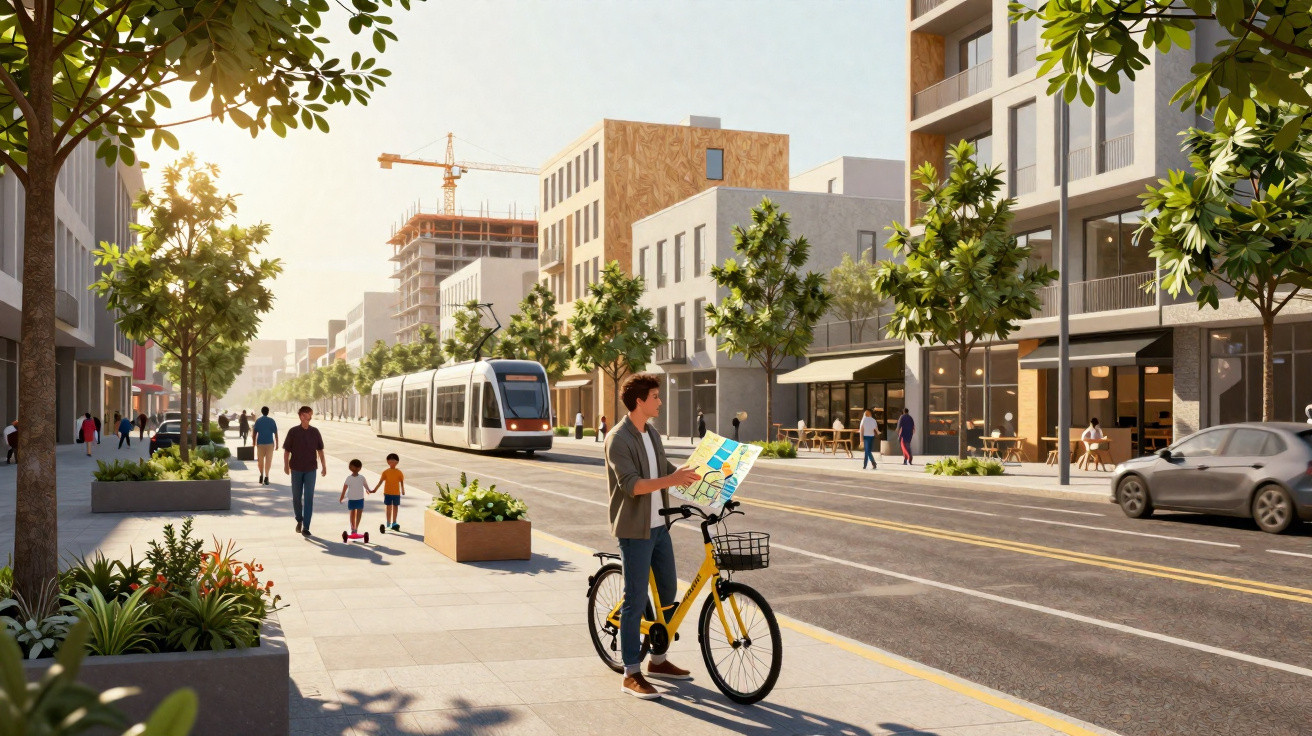
This largely depends on urban form – the way cities are arranged. Compact, mixed neighbourhoods place homes, shops and workplaces nearer one another, cutting journey lengths and reducing the need for roads.
Urban sprawl has the reverse effect, demanding much more asphalt per person to provide the same level of access.
Reducing travel demand cuts infrastructure’s embodied emissions by around 44 percent by 2060, to approximately 6 billion tonnes of CO₂. More compact cities deliver most of this reduction.
Two widely discussed measures make very little difference. Halving the number of cars through sharing, or replacing every car with an electric model, changes little because both chiefly affect vehicles and parking – which represent a small proportion of the concrete and asphalt involved.
The advantages of denser development extend beyond climate concerns.
“Compact, transit-oriented, and walking- and cycling-friendly cities can deliver access to mobility with far less material and carbon than car-centric sprawl,” said Baumgart.
Cleaner materials still matter
Demand is only one side of the issue. The other is the way that the concrete, steel and asphalt still required are produced.
Lower-emission manufacturing, increased recycling, alternative materials and carbon capture can each reduce the emissions embedded in new construction.
By themselves, these measures achieve only modest reductions, cutting the total by just 4 to 8 percent. They require a broader effort to decarbonise the heavy industries that supply them.
A separate worldwide study came to a similar conclusion for buildings and cars. It found that recycling and efficient design save the most carbon when combined with clean energy.
The best way to cut emissions
When both approaches are combined – lower travel demand alongside cleaner, recycled materials – their benefits build on one another.
Together, they could reduce the climate impact of future infrastructure by cutting embodied emissions 63 percent, while still ensuring every region has a reasonable level of access.
The significance is clear in the carbon budget – the CO₂ the world can still release while keeping warming under control. Continuing to build as at present would use up a few percent of it.
A major shift to rail would be more damaging. Its concrete requirements alone could commit close to a quarter of the budget for the more stringent 1.5°C (2.7°F) target.
The researchers regard this as a way to reconcile objectives, rather than a trade-off.
Study co-author Volker Krey is a climate researcher at the International Institute for Applied Systems Analysis (IIASA).
“Meeting the world’s growing mobility needs and achieving climate goals can appear to be competing objectives, but integrated planning can help reconcile them,” said Krey.
Less travel beats cleaner construction
Climate models have seldom followed the full link between growing mobility demand, the physical roads and railways it creates, and the carbon cost of that construction.
For the first time, this research sets out that sequence. It follows the path from the distances people travel, to tonnes of concrete, to tonnes of CO₂.
Its main conclusion is that the greatest savings arise from needing less infrastructure, rather than simply constructing it more cleanly. Lowering travel demand achieves more than any technological substitution. The largest reductions result from doing both.
The authors contend that decisions about what is built, and where it is built, matter more than the sheer quantity of construction. Once established, a city’s layout influences how residents travel for generations.
Cities built for the future
For that reason, the opportunity is now, particularly in places where cities are growing rapidly.
“Choices made now in rapidly urbanizing regions will lock in mobility patterns for decades due to the long service lives of infrastructure,” said Baumgart.
For planners in fast-expanding cities, the research turns a limitation into a decision.
More compact neighbourhoods, safe routes for walking and cycling, and rail where it replaces car journeys can provide the access people need with a fraction of the carbon impact.
Infrastructure constructed this decade will remain in place in 2060, and much of its climate cost is being determined today.





Comments
No comments yet. Be the first to comment!
Leave a Comment