
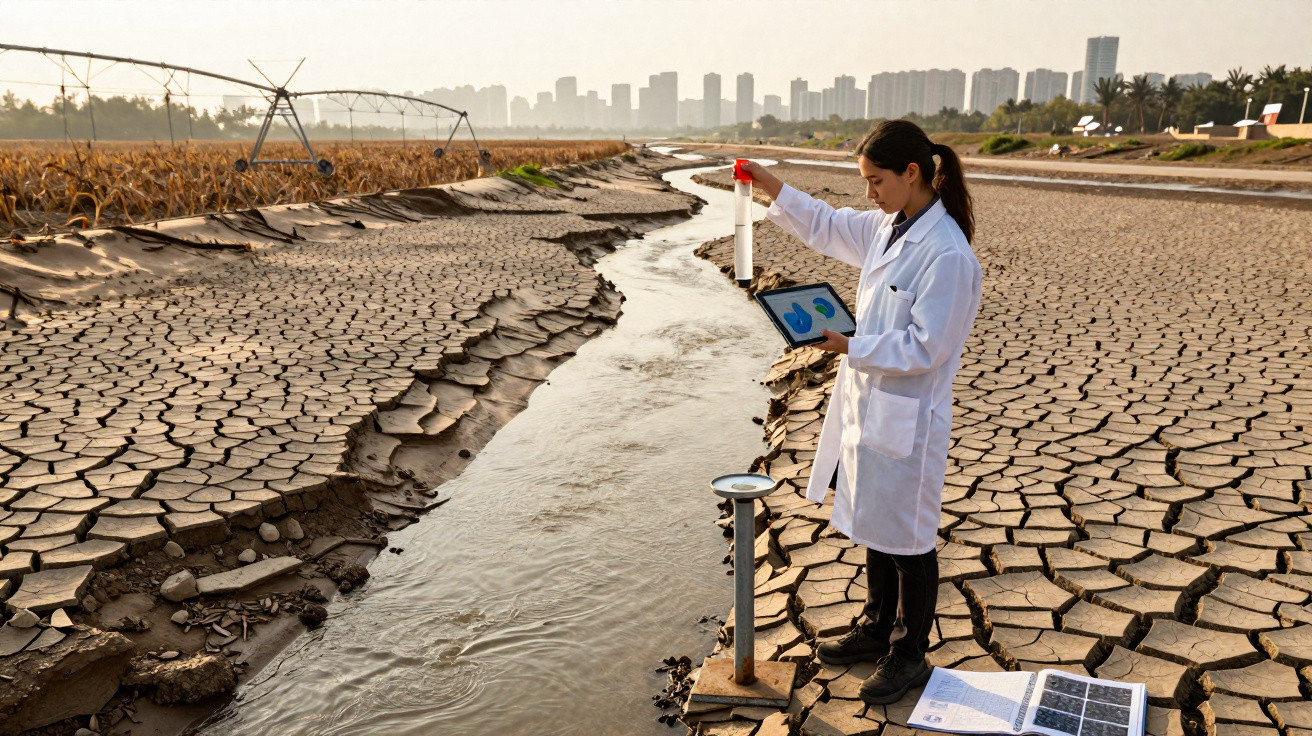
A new United Nations report warns that humanity has moved into what researchers describe as an era of “water bankruptcy.” Across many parts of the world, annual rainfall and river flows no longer cover demand.
Countries are therefore drawing ever more heavily on groundwater reserves, which may need centuries or even millennia to replenish.
The scale is already apparent. The report calculates that three out of four people live in countries affected by water shortages, pollution or drought, while around four billion people face water scarcity for at least one month a year.
It further concludes that about 70 percent of major aquifers are declining, prompting fears that certain losses could be hard – or even impossible – to restore.
What water bankruptcy really means
Kaveh Madani, the report’s author from the UN University Institute for Water, Environment and Health (INWEH), uses a financial comparison to explain the issue in tangible terms.
Madani said the world’s “checking account” – surface water such as rivers, lakes and seasonal runoff – is effectively being run down.
He said that humanity’s inherited “savings” – groundwater, glaciers and other long-term reserves – are also being depleted.
The increasingly visible crises worldwide, including worsening water shortages, resemble the familiar warning signals of bankruptcy, he said.
The comparison is important because it illustrates the risk of treating groundwater as a contingency reserve. Living on savings to pay monthly bills can work temporarily, but it quietly takes you towards collapse.
Water shortages are increasing worldwide
The report identifies two recurring forces behind the crisis in different regions. The first is the spread of farming and urban development into dry areas.
The second is global warming, which is drying already arid places further, increasing evaporation and making rainfall more unpredictable.
It offers stark examples of the effects on the ground. In Turkey, groundwater extraction has been associated with the formation of nearly 700 sinkholes. In Beijing, dust storms linked to desertification have killed hundreds.
These are not “future risks.” They are current signs that land and water systems are being forced beyond their limits.
When water shortages intensify
The report connects water stress with broader social instability, describing water scarcity as a factor that can drive migration, conflict and unrest.
Madani, formerly deputy head of Iran’s Department of Environment, said water shortages helped produce the circumstances behind recent violent protests in Iran.
His argument was that, when water systems break down, employment and everyday life break down alongside them, making political stability far more difficult to sustain.
Iran also serves as an example of how several pressures can accumulate. The country experienced its driest autumn in 50 years.
At the same time, the expansion of dams and wells for farming has almost dried out Lake Urmia, formerly the Middle East’s largest lake, while draining much of Iran’s groundwater.
The article says the government has even considered evacuating Tehran and has used cloud seeding in an effort to bring rainfall.
Lessons from the Colorado River
The report also examines the western United States, where the Colorado River provides water for a vast area.
Its flow has dropped by an estimated 20 percent over two decades, largely because of reduced precipitation and increased evaporation.
The study also stresses that human decisions compound the problem, especially extensive diversions for agriculture. This includes producing feed for beef and dairy cattle.
Meanwhile, large cities including Los Angeles rely on the same river for drinking water. As with an increasing number of rivers worldwide, the Colorado is progressively failing to reach the sea.
Its two principal reservoirs are now about 30 percent full. Bradley Udall of Colorado State University warned that the system could enter “dead pool” – when water levels become too low to pass through dams – should reservoir levels decline to around 10 to 15 percent.
Udall said this could occur as early as 2027. Researchers say negotiations on water reductions between states collapsed last year.
The situation demonstrates how challenging leaders find it to agree cuts when several economies depend on one diminishing resource.
Efficiency alone can have the opposite effect
One surprising argument in the article is that greater agricultural efficiency does not necessarily lower water consumption. In certain circumstances, it may raise it.
Udall said that when growers move to drip or sprinkler irrigation, plants absorb more water rather than allowing it to run off.
Although this appears beneficial, it can reduce the water returning to rivers and available to downstream users. Efficiency improvements therefore help only when accompanied by genuine reductions in overall water use.
Udall also said effective solutions must focus on farming, as agriculture consumes the overwhelming majority of the world’s freshwater.
The difficult reality is that reducing agricultural water use will be essential, and that this is a global issue rather than only a US one.
Reducing farm water use is complicated
The article makes no claim that this will be straightforward. Around half of global food production takes place in areas with falling water storage. Farming is also the source of income for more than 1 billion people, many in lower-income countries.
Those countries frequently export food to wealthier nations whose economies are based on services. As a result, calls to “just use less water in farming” often overlook the human impact.
Madani said water is closely connected to employment and economic stability. He argued that losing water-dependent livelihoods can create immediate and explosive social consequences.
Pollution is widening the crisis
Even nations that appear rich in water are under pressure. The article notes rising water consumption by data centres, alongside pollution from industry, sewage, fertilisers and manure that renders water unusable.
Wetlands are another key concern. According to the article, wetlands covering roughly the same area as the European Union have disappeared, chiefly after being converted for agriculture.
This destruction comes with a huge cost: an estimated $5.1 trillion in ecosystem services, including flood protection, food production and carbon storage.
Researchers point to Bangladesh as a place where water is present but safe water is not. Rising sea levels and saltwater intrusion have contaminated roughly half the country’s well water with arsenic.
In Dhaka, the article describes both tap water and a “dead river” contaminated by chemicals associated with fast-fashion manufacturing for export markets.
Sonia Hoque of the University of Oxford said people in Bangladesh know the source of much of the river pollution. However, she said tougher regulation is politically sensitive because of concerns that it might deter international buyers.
Count water before attempting to manage it
The report’s message is not “panic.” It is closer to “grow up.”
Madani argues that humanity must learn to use less water, and that better management can make this possible. Yet, he says, many countries are still failing at the most fundamental task: calculating what water they possess and what they consume.
Accordingly, pursuing eye-catching measures such as cloud seeding makes little sense when there is not even a clear water-shortage balance sheet.
Madani said widespread measurement – through water meters in homes, wells and diversion canals – must come first, as it is impossible to manage what is not monitored.
His central argument is straightforward: before the world can stop overdrawing its water account, it must understand the figures.
Only then will governments be able to make practical plans, rather than stumbling from drought to emergency to protest in the hope that the next rainy season rescues them.





Comments
No comments yet. Be the first to comment!
Leave a Comment