
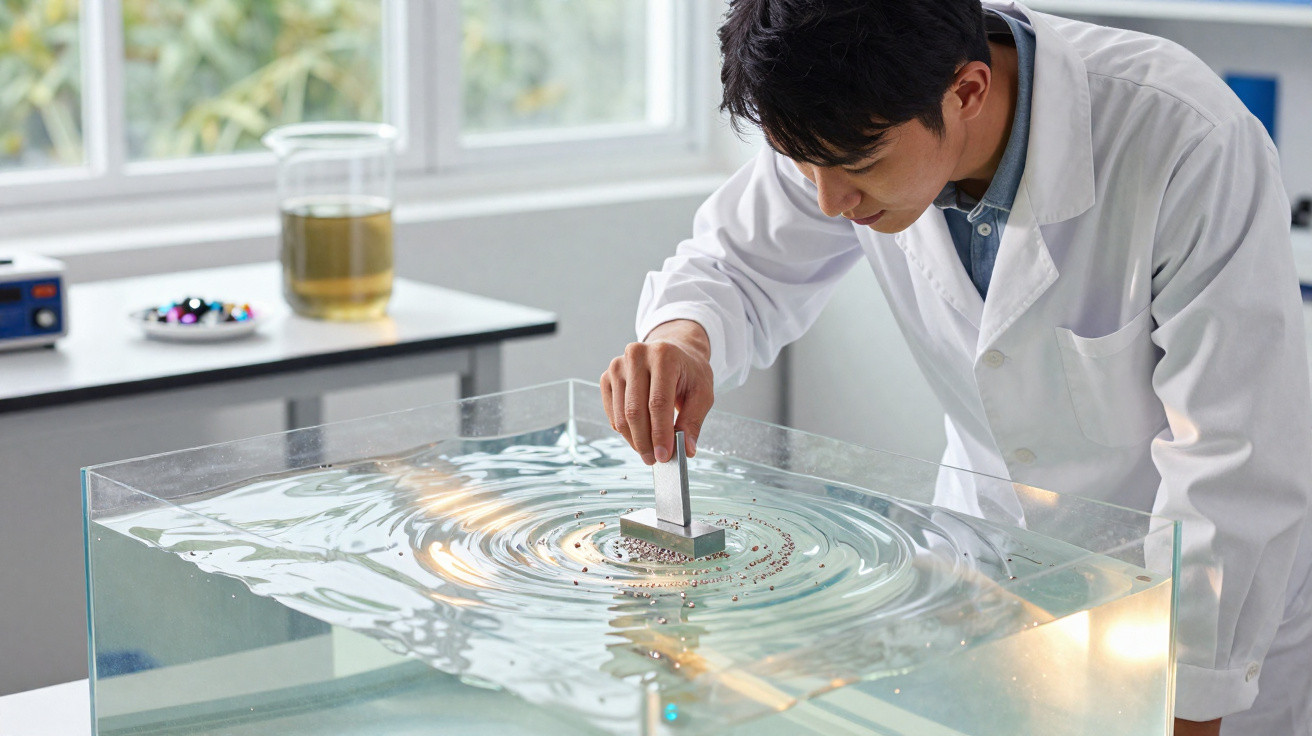
Common solid magnets made from iron-based alloys may concentrate rare earth elements in underwater settings, allowing them to build up and crystallise.
The research offers a potentially cleaner, groundbreaking route for recovering materials needed by modern technologies.
Metals in motion
Within a liquid cell positioned next to a magnet, rare earth ions collect in concentrated bands instead of staying uniformly dispersed.
At the Pacific Northwest National Laboratory (PNNL), Giovanna Ricchiuti observed these bands forming and demonstrated that magnetic gradients alone may drive the separation.
Rather than simply drawing ions nearer to the magnet, the effect produced defined areas in which the metals became much more concentrated than in the surrounding liquid.
This initial sorting stage matters greatly when attempting to separate metals that are almost identical.
Rare earths power modern technology
Rare earth elements are essential to phones, turbines, batteries and defence hardware, as their distinctive properties allow compact, high-performance components to function.
“There is an urgent demand for rare earth elements due to recent technological advancements and supply chain disruptions,” said Ricchiuti.
Separating many lanthanides, a tightly related group of rare earth metals, is difficult because they act almost as chemical twins in solution.
Because of this near-identical composition, valuable material remains caught in waste streams that are still not easily or cheaply recovered.
Hidden metals in industrial waste
Coal ash, mine tailings and produced water - the salty wastewater generated by oil and gas wells - may all contain trace quantities of rare earths.
Existing facilities generally use liquid solvents or specialist resins, alongside repeated chemical stages, to separate closely related metals.
“Traditional separation methods use large amounts of organic solvents,” said Ivani Jayalath, a doctoral student at the University of Mississippi.
Every additional stage increased costs, consumed energy and created further liquid waste before the metal could reach a factory.
A narrow but useful advantage
The new method takes advantage of magnetic susceptibility, which measures the extent to which a substance responds to a magnetic field.
Heavier ions, including dysprosium - a rare earth metal used in high-performance magnets - experienced a stronger attraction than lighter ions such as lanthanum in the same liquid.
A magnetic field varying across space could draw one group towards the magnet while another trailed behind or moved away.
This slight difference in magnetic behaviour gave engineers another means of sorting the metals. Previously, chemistry alone provided very limited separation capability.
Waves expose concealed movement
The PNNL team employed Mach-Zehnder interferometry, a laser-based technique that monitors minute changes in liquid density.
As the ions travelled, the instrument detected enriched regions near the magnet and depleted areas where the liquid had lost those ions.
Ricchiuti explained that the magnetic field produces shifting waves in ion concentration, forming regions in which ions gather.
Other ions are driven away by the interplay of magnetic movement, diffusion and electric forces created inside the liquid.
The wave-like patterns demonstrated that the magnet was continually redistributing ions over time, rather than merely holding them in place.
Feedback controls the flow
Magnetic attraction formed only one part of the process, since the redistributed ions also generated electrochemical potentials - local, voltage-like differences within the liquid.
As charge distribution became uneven, self-generated electric fields counteracted diffusion and helped arrange the migrating ions.
The model in the paper showed how even a weak permanent magnet could generate long-range movement without an external power supply.
This electrical feedback transformed a basic magnet from an inert object beside a beaker into an active separation device.
Crystals signal the transition
After a common chemical known as oxalate was introduced, the concentrated metal ions began to form a solid compound directly on the magnet’s surface, making collection easier.
Crystallisation was useful because a solid can be separated more readily than the same metal when it is dissolved throughout a large volume of liquid.
Concentrations close to the magnet reached three to four times those in the bulk solution, sufficient to move the system towards the solid phase.
The finding indicated that magnets could help transfer metal from its dissolved form into a collectable solid.
Less energy and fewer chemicals
“Using magnets offers a simple and potentially more sustainable way to assist separation processes,” said Jayalath.
As permanent magnets require no continuous electricity supply, the technique suggested lower operating energy use than systems driven by voltage.
Initial techno-economic estimates indicate that this could lower chemical costs compared with current standard methods for magnet-responsive rare earths.
Although provisional, these savings help explain why a laboratory finding has already drawn significant industrial interest.
Scaling brings added complexity
This was an early study, with the researchers using simplified solutions instead of the complex chemistry present in industrial waste.
Actual waste streams may include competing ions, suspended particles and changing acidity, all of which could complicate the magnetic effect.
Industrial-scale systems would also require careful planning to ensure that magnets, flow routes and crystal-collection stages continue to operate at larger volumes.
These constraints define the future scaling agenda rather than undermining the ability of passive magnetic gradients to produce useful transport.
Towards cleaner sourcing
A low-cost magnet, placed in the appropriate geometry, can shift scarce metals, alter the liquid around them and begin turning them into recoverable solids.
Should future testing succeed with real waste streams, the method could support domestic supply chains while using far fewer chemicals.






Comments
No comments yet. Be the first to comment!
Leave a Comment