
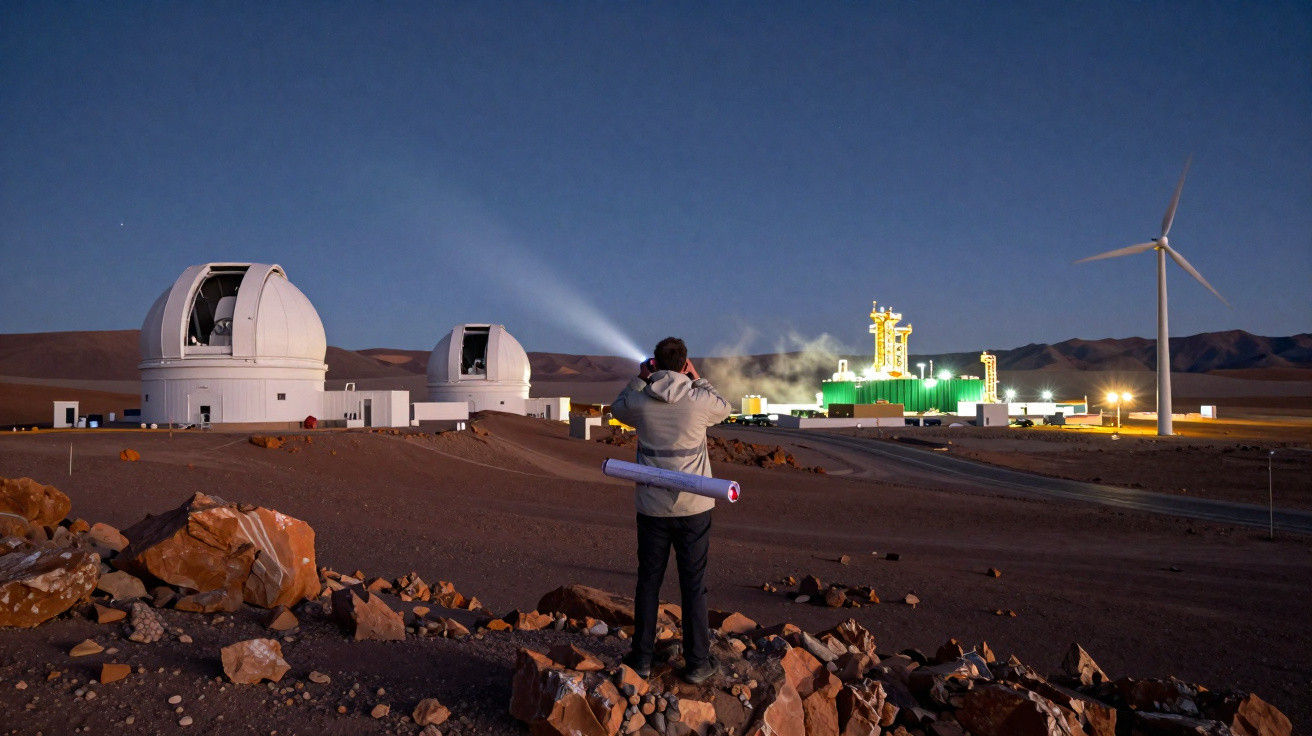
A fresh analysis has found that a proposed green hydrogen and green ammonia complex in northern Chile would have introduced extra light, vibration and dust to one of Earth’s darkest astronomical sites.
These effects would have impaired the ability of the major observatories in the area to spot faint targets and produce crisp images, limiting potential astronomical discoveries.
Paranal under pressure
Paranal’s observing platform, on a desert ridge in northern Chile, lies roughly 26 kilometres (16 miles) from the proposed INNA industrial energy complex, a major development intended to produce green hydrogen and green ammonia.
At this short distance, the European Southern Observatory (ESO) assessed how the project’s lighting, wind turbines and dust could affect the surrounding telescopes.
In March 2025, ESO determined that the developers would not be able to sufficiently reduce the combined effects at the planned site.
Once additional light, vibration or dust reaches an observatory, it cannot be removed afterwards by the telescopes, making prevention essential.
How dark sky works
The report’s assessment of 28 leading observatories found that just six experienced less than 1% artificial brightening. While natural illumination from the Moon and upper atmosphere establishes the baseline, light pollution increases it.
At 1% contamination, one in every 100 photons from the sky originates in urban areas, and a telescope cannot distinguish those photons from natural light.
Much of the comparison used the V-band, astronomy’s standard green filter, since artificial brightness is particularly evident in that band.
The cumulative light effect
ESO modelling indicated that, by 2024, artificial sky brightness had already risen by between three and almost four times its 2012 level.
Scattered photons from light sources as far as 50 to 100 kilometres (31 to 62 miles) away still reached the sky above the desert.
Even with ideal lighting fittings, INNA would have increased artificial brightness by a further 5% to 55%, rising to as much as 269% if the lights became five times brighter.
For the thin cirrus cloud conditions that occur during around 13% of observing time, the report forecast that INNA’s lighting could appear 1.5 to 2.8 times brighter.
INNA wind turbines and precision
ESO identified ground vibration from 70 wind turbines as a threat to high-precision observations at both Paranal and the nearby Armazones peak.
This vibration is especially important for an interferometer, which combines light from separate telescopes, as timing inaccuracies blur fine detail.
In the report’s wind-farm scenario, the turbines were likely to surpass vibration thresholds for the Very Large Telescope Interferometer and the 39-metre (128-foot) Extremely Large Telescope.
As the system merges optical beams in real time, later processing cannot compensate for unstable foundations, meaning fewer nights would be suitable for the highest-resolution work.
Wakes roughen the air
The effects of wind farms extend beyond their boundaries: turbine wakes have been observed 55 to 100 kilometres (34 to 62 miles) downwind.
This disturbed air can degrade seeing-the blurring measured by astronomers in starlight-by spreading stellar images across detectors.
In favourable conditions, predicted turbulence increased by 17% at 0.5 arcseconds and by 43% at 0.3, shifting typical events towards 0.4 to 0.6.
Additional turbulence could result from heat above INNA’s solar panels, as air around three degrees Celsius (five degrees Fahrenheit) warmer is more likely to rise and mix.
Dust hits the optics
ESO estimated that INNA’s construction would increase airborne particle concentrations by around 75% for larger dust particles and 73% for finer ones.
Dust damages telescope performance when particles adhere to mirrors, reducing reflectivity-the proportion of light a surface reflects.
At Paranal, the report associated this effect with a loss of roughly 2.5% in light throughput and 2% additional downtime for cleaning.
The Cherenkov Telescope Array Observatory South site was expected to suffer the greatest effect, as its mirrors do not have fully enclosed protection from dust.
Proximity defines impact
Minor alterations to the design could not resolve the fundamental issue, because INNA was located too near the observatory ridges.
Distance is crucial: light disperses through the atmosphere and vibration moves through rock, with both diminishing only when their sources are farther away.
ESO also stated that modest changes to lighting near Armazones could return contamination to close to 1% for the Extremely Large Telescope.
The report concluded that, without moving the project, the residual effects would remain significant, making site selection a matter of policy.
A project gets dropped
An ESO announcement in February 2026 said that AES Andes would withdraw from INNA and concentrate on its renewable portfolio.
Chile’s environmental assessment service still needed to complete the administrative process, although ESO expected the imminent withdrawal to formalise the cancellation.
“When the cancellation is confirmed, we’ll be relieved that the INNA industrial complex will not be built near Paranal,” said Xavier Barcons, Director General of ESO.
Stopping the project offered the telescopes their strongest opportunity to preserve present conditions, despite regional development continuing to add light.
Rules for shared deserts
INNA also demonstrated how rapidly an exceptional site can lose its worth when darkness and quiet are regarded by planners as resources available at no cost.
Safeguarding observatories requires managing exterior lighting, reducing dust and locating large turbines sufficiently far away for their wakes to dissipate.
Barcons said that green-energy projects and observatories could coexist if planners maintained adequate separation between industrial developments and telescopes.
Clear safeguards would prevent future energy schemes from creating the same conflict, particularly as Chile increases its renewable capacity.
Keeping skies clear
The INNA assessment attached firm figures to risks that can seem theoretical, connecting each of them to reduced observing capability.
Future assessments could apply the same thresholds to establish buffer distances at an early stage, before infrastructure is installed and difficult decisions arise.






Comments
No comments yet. Be the first to comment!
Leave a Comment