
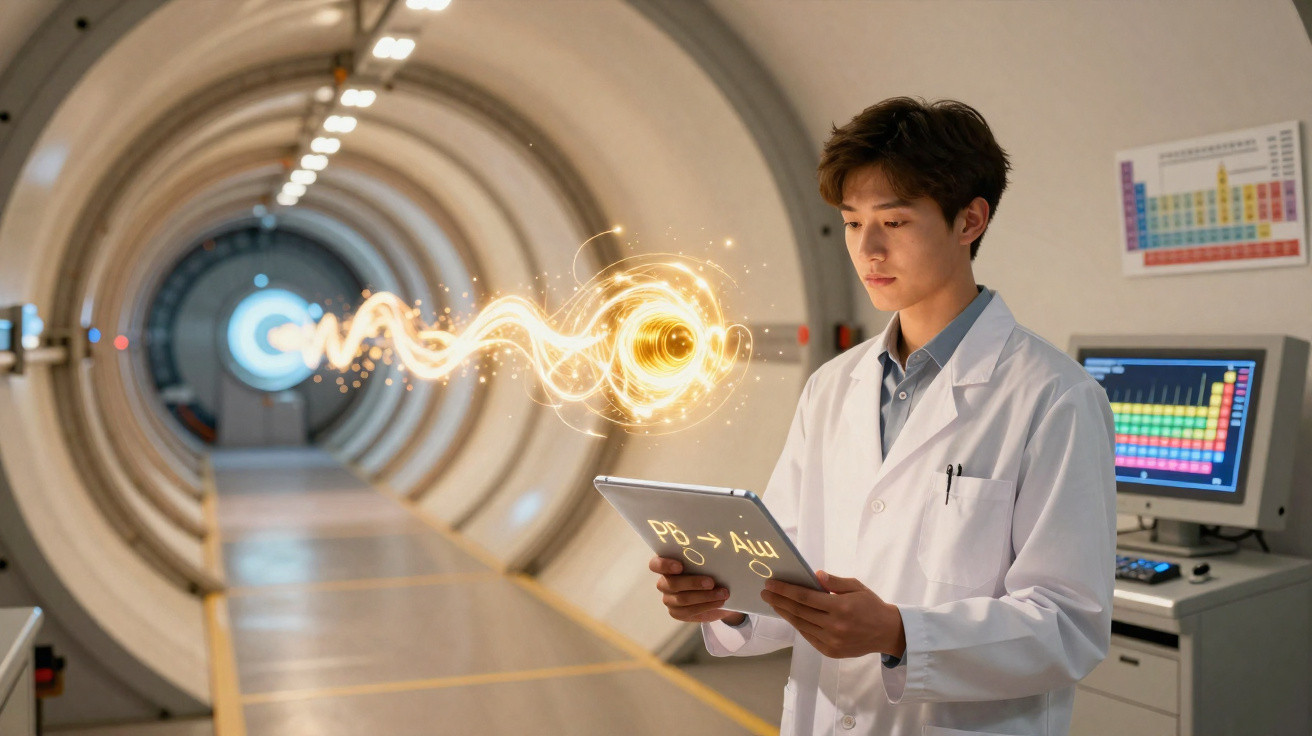
The 27-kilometre Large Hadron Collider (LHC), which runs beneath the France–Switzerland border, routinely accelerates heavy ions into near-light-speed encounters. Yet on 30 July 2025, researchers announced an observation that once sounded like legend: lead ions briefly turned into gold before decaying into more commonplace matter.
The study found that one lead run can generate gold nuclei at a cross section similar to the overall hadronic collision rate. As a result, this form of “modern alchemy” occurs in the tunnel much more often than had been anticipated.
“Usually in collider experiments, we make the particles crash into each other to produce lots of debris,” said Daniel Tapia Takaki, professor of physics at the University of Kansas and leader of the group on the ALICE experiment.
His group created a technique to detect what occurs when ions only skim past one another. The interaction is so uncluttered that the detectors see little beyond a burst of light and a modified nucleus.
Gold from lead, briefly
Ultraperipheral collisions occur when two atomic nuclei pass each other at close range without making contact, while their intense electromagnetic fields nevertheless interact.
Rather than breaking apart in a direct impact, each ion sends the other a pulse of high-energy photons, as described by the Weizsäcker–Williams method. Photons from one nucleus can therefore investigate, or even alter, its counterpart. This photon bombardment may eject one, two or three protons.
When three protons are removed, a lead-208 nucleus briefly becomes gold-205 – realising the alchemist’s ambition, albeit for only about 10⁻²³ seconds. That interval is sufficient for it to register in the forward calorimeters.
Earlier ALICE data had suggested that these exceptionally clean events were present, although the detector had been designed for untidy head-on collisions. Tapia Takaki’s team adjusted the readout settings, introduced vetoes and improved a two-step fit to distinguish neutron and proton peaks.
What near-miss collisions reveal
As photons have no net charge, photon–photon and photon–nucleus interactions avoid the flood of hadronic debris associated with central collisions. This clean setting lets physicists examine nuclear structure and test QED at energy scales that were previously inaccessible.
The Kansas-led study measured a gold-production cross section of 6.8 barns, just 12 percent below the 7.67 barn total inelastic rate for standard lead–lead interactions at the same energy.
In practical terms, for each hadronic ion collision delivered by the LHC, there is approximately one additional nearby event in which a lead ion quietly changes into gold before breaking up.
The same data set measured the 0-proton channel at 157.5 barns, the 1-proton channel at 40.4 barns and the 2-proton channel at 16.8 barns. Within 25 percent, the findings equalled or surpassed theoretical estimates from the RELDIS photonuclear model.
The differences indicate that current models do not fully represent pre-equilibrium emission and nucleon coalescence in single-proton channels.
Tracking LHC alchemy at light speed
The ALICE collaboration uses zero-degree calorimeters positioned 112.5 metres downstream from the interaction point to detect neutral and charged fragments.
The KU team selected events in which proton energy lay within two standard deviations of the beam energy, with at least one neutron striking the adjacent neutron calorimeter. This produced a sample of only two million events from 2.05 million triggers.
The researchers then accounted for acceptance, efficiency and the limited possibility that a peripheral hadronic collision might mimic an electromagnetic interaction.
Monte Carlo investigations with RELDIS and the AAMCC-MST transport code found that hadronic lookalikes make up less than one percent of the single-proton sample, meaning the photon-driven signal is effectively pure.
The final fit showed wide 1-proton and 2-proton peaks, each roughly twice the width of the matching neutron peaks. Relativistic protons can lose energy at the edges of the calorimeter or through interactions with beam-line material, causing this broadening.
A revised Gaussian model, in which width scales with proton number, compensated for the smearing and has now been taken up by other heavy-ion groups.
Why the flash matters for future colliders
Taking away three protons changes lead into gold, but the removal of just one proton produces thallium, an ion that follows a different path through the LHC magnets.
If secondary particle beams are not adequately managed, they can strike cold components, disable superconducting magnets or activate safety systems. Such problems may restrict the capabilities of planned 27 TeV upgrades and the proposed 100-kilometre Future Circular Collider.
Through measurements across the full range of 0- to 3-proton channels, the ALICE team supplies vital information for loss maps, which machine engineers use when designing collimators and shielding.
These measurements also support simulations for the US Electron Ion Collider (EIC), where knowledge of photon-induced nuclear break-up is essential for rejecting background in precision experiments.
More than just gold
Near-miss collisions can create not only gold but also mercury, thallium and platinum isotopes, all with distinct decay routes and scientific implications.
Knowing precisely how frequently and how cleanly these channels arise also supports light-by-light scattering, searches for axion-like particles and research into nuclear excitation.
Tapia Takaki said the work could be important for planning the next generation of machines, since every beam ion lost can mean days of accelerator time and substantial operating costs.
Put simply, observing a fleeting flash of gold is not about becoming wealthy; it is about helping billion-dollar facilities operate safely and efficiently.
Next steps for gold physics
When Run 3 data become available, the team intends to expand the study to four- and five-proton emissions, extending sensitivity to nuclei close to hafnium and tantalum.
They are also collaborating with theorists to improve photonuclear models, so that neutron-to-proton ratios align more closely with the observations.
A dedicated ultraperipheral-collision trigger is being developed. It will combine current calorimeter logic with real-time machine-learning filters, enabling rare events to be captured without overloading the data-acquisition system.
If it works, physicists may be able to observe modern alchemy almost as it occurs, potentially even detecting long-lived isomers before they decay in flight.




Comments
No comments yet. Be the first to comment!
Leave a Comment