
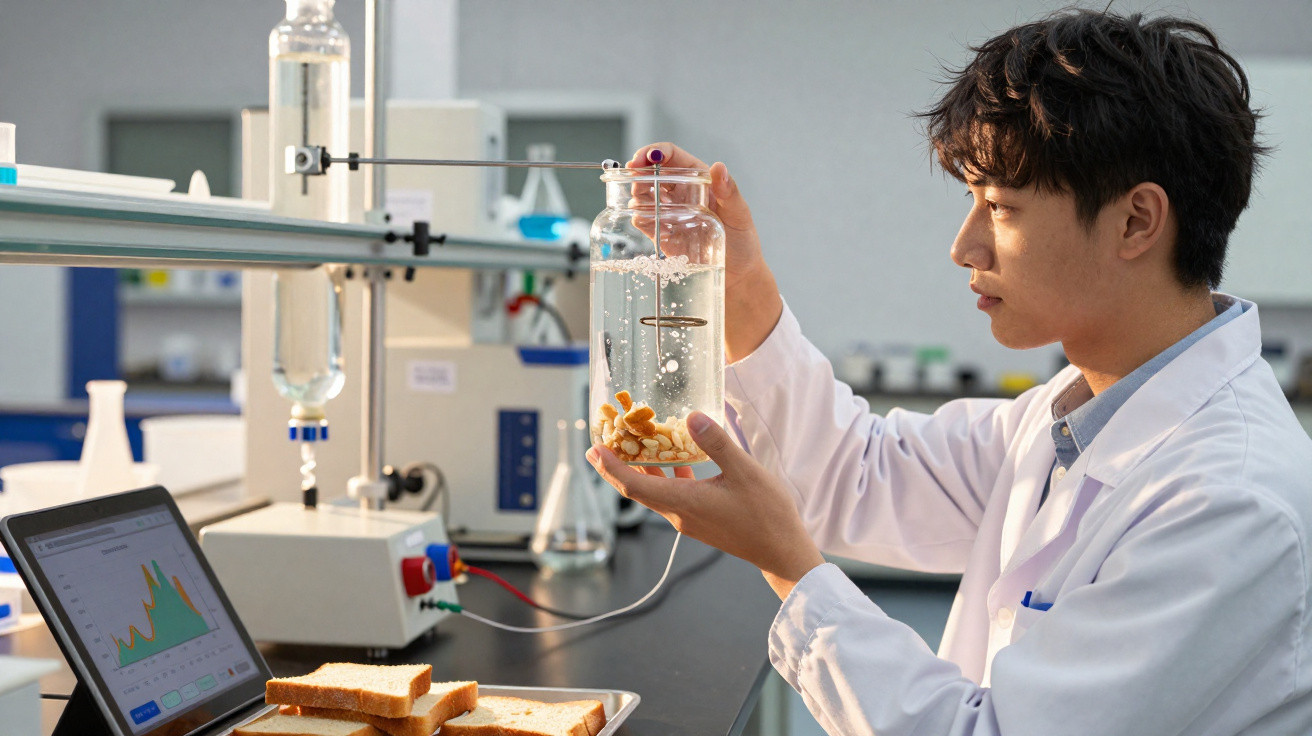
Living bacteria have taken the place of fossil-fuel-derived hydrogen in one of the chemical industry’s most common reactions, producing the gas directly from unwanted bread.
The development could make a fundamental manufacturing process less energy-intensive, allowing it to operate without an external supply of hydrogen gas.
Bread-powered hydrogen reaction
In one sealed flask, bacteria consumed sugars recovered from discarded bread and gave off hydrogen while growing in oxygen-free conditions.
Professor Stephen Wallace of the University of Edinburgh showed that the hydrogen generated within the living cells could power hydrogenation in that very same vessel.
Instead of bringing in compressed hydrogen from fossil-fuel-based facilities, the reaction took place close to room temperature as the microbes generated the gas continuously.
This self-contained arrangement eliminates the need to transport hydrogen at high pressure, although it also prompts questions over how living systems could be incorporated into industrial-scale reactors.
Hydrogen’s industrial role
Hydrogenation, which adds hydrogen to stabilise reactive compounds, is used throughout manufacturing to convert oils, pharmaceutical ingredients and plastics into useful products.
When hydrogen gas reaches metal catalysts, it splits into atoms that bond with double bonds, altering a substance’s melting point and chemical behaviour.
“Hydrogenation underpins huge parts of modern manufacturing, but it still relies almost entirely on hydrogen made from fossil fuels,” said Wallace.
Fossil hydrogen bottleneck
A recent International Energy Agency assessment found that worldwide hydrogen production released roughly one billion tonnes of carbon dioxide in 2023.
Most production plants extract hydrogen from natural gas or coal, emitting carbon dioxide before a factory begins the hydrogenation process.
Transporting compressed hydrogen and operating high-pressure reactors increase energy costs, while leaks present fire hazards that must be controlled by operators.
Generating microbial gas inside the reactor could replace that fossil-fuel stream and remove upstream stages, although large facilities would still require close supervision.
Microbes make hydrogen
Some microbes shift to fermentation when oxygen is absent, obtaining energy from sugar without air and releasing hydrogen as a by-product.
For the Edinburgh trials, a conventional Escherichia coli strain was grown on sugars from bread and generated hydrogen in a sealed vessel.
Removing air during cell growth encouraged the bacteria to expel hydrogen, which the researchers retained within the same container.
Since the hydrogen was produced as required, the chemical stage could proceed near room temperature rather than at the elevated temperatures generally used in industry.
Palladium meets cells
During the reaction, a small quantity of palladium - a metal that helps hydrogen bond to molecules - rested on the bacteria’s surface.
The metal split hydrogen molecules, allowing the released atoms to move into nearby chemical targets suspended in water.
Microscopy showed the catalyst closely surrounding the cell membrane, indicating that the surface served as a working area for the conversion.
The bacteria continued to grow despite this contact, an important point if the chemistry is eventually combined with large fermenters.
Products from crumbs
After establishing the system, the researchers used it to alter a range of chemicals that would ordinarily need externally transported hydrogen gas.
Certain targets originated outside the cells, whereas others were first produced by the bacteria before the catalyst completed the transformation.
One experiment made raspberry ketone for use in flavourings, while another produced a chemical used in nylon manufacturing, showing that the reaction may be suitable for both specialist and bulk materials.
Although these demonstrations remained at flask scale, they suggested that living cells could provide industry with hydrogen without relying on fossil sources.
Bread waste feedstock
As bread waste accumulates quickly, the team used it as a feedstock rather than treating it as rubbish destined for landfill or incineration.
Enzymes converted stale bread into simple sugars that the bacteria could consume without requiring specialised processing equipment.
Around one million tonnes of bread are thrown away annually in the United Kingdom, creating a substantial potential supply of raw material for the approach.
Using waste instead of freshly grown crops also avoids trade-offs involving land and fertiliser, though gathering clean waste streams at scale remains challenging.
Counting carbon costs
A formal life cycle assessment - a complete calculation of emissions from beginning to end - compared this method with standard hydrogenation.
The assessment found that replacing fossil-derived hydrogen with waste bread could make the process carbon-negative, meaning it removes more greenhouse gases than it produces.
The outcome was helped both by avoiding landfill or incineration and by bypassing energy-intensive hydrogen production, which is normally carried out at very large scale.
However, these gains rely on local waste-management arrangements and energy sources, meaning carbon-negative outcomes will differ between regions and processes.
Scaling without fossil fuel
Moving this chemistry beyond laboratory glassware will need more than a larger setup, as industry requires continuous reactors, dependable feedstocks and consistent yields.
Further experiments will examine different microbes and operating conditions, with the aim of eliminating the palladium catalyst and making the reactions entirely biological.
The University of Edinburgh’s public Zero by 2040 strategy has encouraged researchers to pursue manufacturing stages with lower carbon emissions.
“Being able to run these reactions using microbial hydrogen opens up new possibilities for sustainable manufacturing at scale,” said Wallace.
What comes next
Converting bread waste into hydrogen suitable for reactions demonstrated that chemistry and biology can operate in one vessel, reducing both energy use and emissions.
Future expansion will depend on dependable waste supplies and safer catalysts, but the central concept already offers an alternative to fossil-fuel-fed manufacturing.




Comments
No comments yet. Be the first to comment!
Leave a Comment