
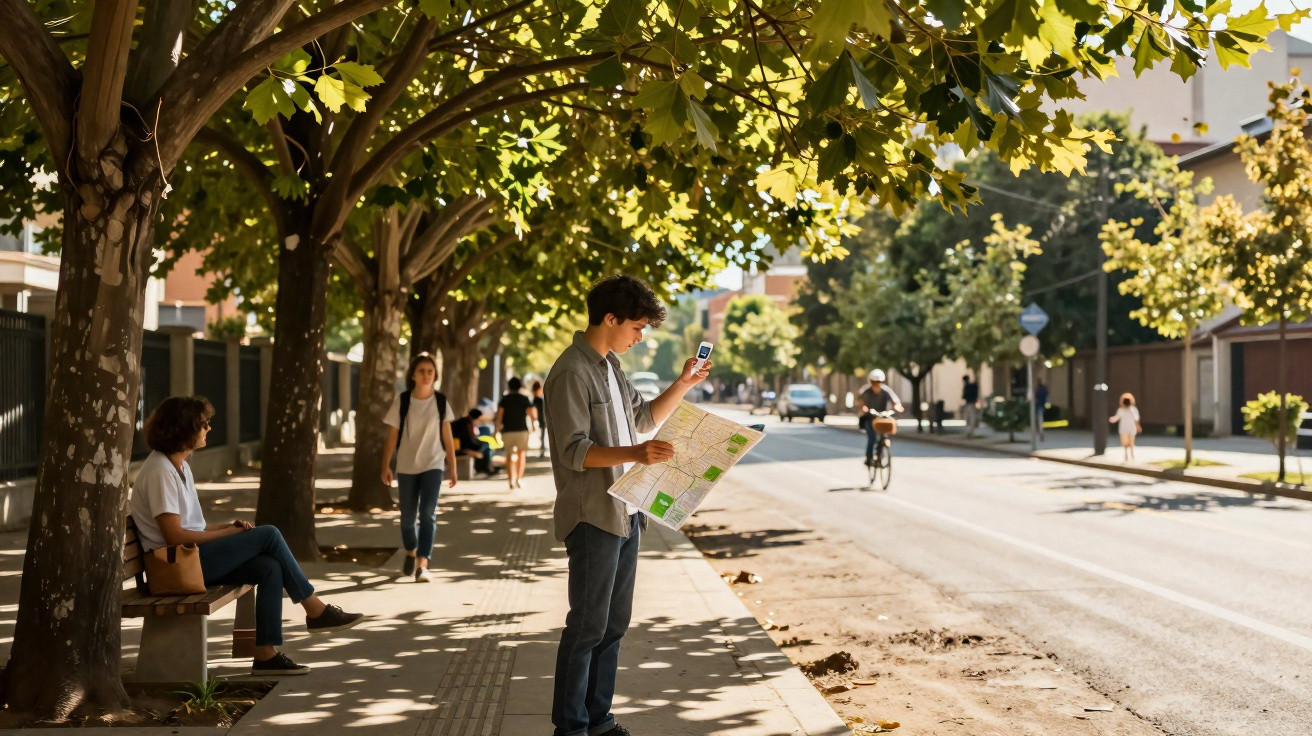
Can you spot three trees from your home, school or workplace? Does tree canopy cover provide shade across at least 30% of the local neighbourhood? Is there a park within 300 metres of the building?
Together, these three straightforward questions underpin the "3+30+300 rule" for cities that are greener, healthier and more resilient to heat.
First developed in Europe and now attracting interest worldwide, this straightforward metric sets out the minimum needed for people to gain nature’s health benefits in urban areas.
We tested the rule in eight cities worldwide: Melbourne, Sydney, New York, Denver, Seattle, Buenos Aires, Amsterdam and Singapore.
The majority of buildings in these cities did not satisfy the 3+30+300 rule. Tree canopy was severely lacking, including in some of the world’s wealthiest and most recognisable cities. Improved canopy cover is urgently required to cool cities as climate change intensifies.
Explore each of the three interactive maps: zoom in or out, search for an address or location, and press the "i" button for further information. Source: Cobra Groeninzicht
Shady trees support health and wellbeing
Depression, anxiety, obesity and heatstroke are more common among people living in areas with fewer trees or poor access to parks. But how much "green infrastructure" is necessary to keep us healthy and content?
Dutch urban forestry specialist Professor Cecil Konijnendijk established the benchmark with the introduction of the 3+30+300 rule in 2022. It draws on his extensive assessment of evidence connecting urban nature with human health and wellbeing.
Although the rule remains fairly new in Australia, it is building international support.
Cities across Europe, the United States and Canada are adopting the measure, either formally or informally, in urban forestry strategies and plans. They include Haarlem in the Netherlands, Malmö in Sweden, Saanich in Canada and Zürich in Switzerland.
Testing the 3+30+300 rule
We used the 3+30+300 rule with a global database of city trees, which brings together open-source data supplied by local authorities.
For the research, we chose cities with the most comprehensive data and sought to include at least one city from each continent. Regrettably, we could not find suitable data for cities in Africa, mainland Asia or the Middle East.
Our final group of eight includes several cities widely considered leaders in urban forestry and green-space development. The City of Melbourne is well known for its ambitious Urban Forest Strategy.
New York has delivered successful initiatives including MillionTreesNYC and The Highline. Singapore is recognised for its abundant tropical vegetation, with notable places including Gardens by the Bay and Bishan-Ang Mo Kio Park.
Data limitations meant our Melbourne and Sydney assessments were confined to central areas, whereas the remaining six assessments covered entire cities.
Across the eight cities, most buildings met the requirement for three trees but failed the canopy-cover test. By comparison, three in four (75%) buildings in Singapore met the 30% canopy target, as did almost one in two (45%) in Seattle.
Only 3% of buildings in Melbourne had sufficient canopy cover in their neighbourhood, even though 44% could see at least three trees.
Central Sydney performed more strongly, but just 17% of city buildings had enough shade, despite 84% having a view of at least three trees.
Park access was uneven as well. Singapore and Amsterdam performed strongly for parks, whereas Buenos Aires and New York City performed poorly.
After finishing this study, we worked with Dutch geospatial company Cobra Groeninzicht to map a further ten cities across Europe, the US and Canada. Those cities produced comparable findings.
Trees are too small and too widely spaced
We were surprised that so many buildings worldwide could see at least three trees while lacking sufficient neighbourhood canopy cover. It appeared to be a contradiction: were there enough trees, or were there not?
The same question has emerged in other research. Nice in France, for instance, recently reported that 92% of residents can see three trees, yet only 45% had adequate neighbourhood canopy.
Our investigation showed that these three visible trees are often too small to provide worthwhile shade.
Planting density was also a problem. Where cities did contain large trees, they were generally planted far apart.
To meet the 3+30+300 rule, cities therefore need larger, healthier trees that live longer and are planted more closely together.
Explore each of the three interactive maps: zoom in or out, search for an address or location, and press the "i" button for further information. Source: Cobra Groeninzicht
Urban life is hard on trees
Many roads and pavements are built on compacted crushed-rock foundations, then covered with impermeable asphalt or paving.
Consequently, very little water reaches tree roots and roots have limited room to develop. Street trees therefore grow slowly, die early and are more vulnerable to pests, disease and heat stress.
Trees also encounter additional pressures above ground. Power companies have legal authority to require pruning that can sometimes be excessive. Residents and developers also regularly seek the removal of trees, often with success.
This combination of high removal rates, severe pruning and difficult growing conditions makes large, healthy canopy trees uncommon.
Even planting replacement trees can be unexpectedly challenging. Engineering standards can work against planting by demanding substantial distances from driveways, underground pipes and even parking spaces.
Rather than resolving potential conflicts, planners often simply remove trees from streetscape designs. The outcome is sparse planting.
Solutions for nurturing tree canopy
Fortunately, every one of these problems has a solution.
Legal changes that place trees on an equal footing with other infrastructure would be an excellent starting point. Trees bring risks alongside their benefits, but those risks should be managed instead of accepting hot, barren streets.
Improved planting standards will also matter. Technology is already available to provide greater soil volumes beneath pavements and roads. Innovative asphalt-like surfaces, often known as "permeable paving", enable rainwater to soak into the soil.
While these methods cost more, they are highly effective. They can potentially double tree growth rates, reduce flood risk, and limit problems such as roots obstructing drains or creating uneven pavements.
Our research clearly calls on cities to enlarge, maintain and safeguard their urban forests and parks in readiness for climate change.
With another record-breaking summer forecast, following the world’s hottest year, the need to grow tree canopy has never been more pressing.
We need to advance these reforms and make sure urban populations have all the green infrastructure required to protect them in the future.
Thami Croeser, Research Fellow, Centre for Urban Research, RMIT University
This article is republished from The Conversation under a Creative Commons license. Read the original article.



Comments
No comments yet. Be the first to comment!
Leave a Comment