
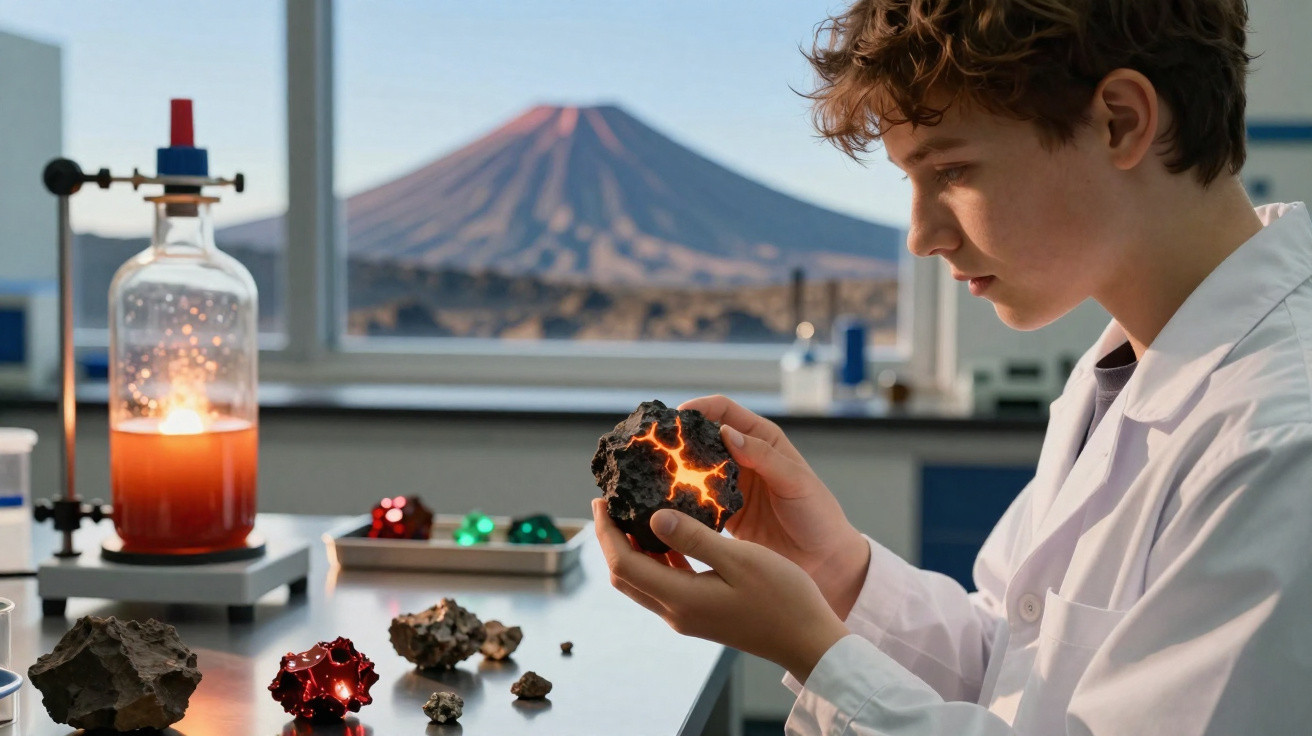
Extinct volcanoes are difficult to investigate because we cannot observe them erupting. By applying a distinctive experimental method, we recreated one type of extinct volcano in the laboratory and gained fresh insight into the magma it generates.
We discovered that several uncommon magma types are remarkably effective at concentrating rare earth elements. These metals are vital to a range of high-tech sectors, including the production of magnets for electric vehicles and wind turbines.
Demand for rare earths is rising sharply as society shifts away from fossil fuels and electrifies power generation and transport. Despite their name, rare earths are not especially scarce. The principal difficulty is identifying rocks where these metals are concentrated sufficiently to make extraction economically worthwhile.
Our research, published in the journal Geochemical Perspectives Letters, indicates that certain extinct volcanoes are highly promising places to search.
Iron-rich magma in extinct volcanoes
One puzzling form of magma contains exceptionally high quantities of iron. It is so uncommon that no eruptions involving this magma have been recorded in human history.
Instead, evidence of it comes solely from extinct volcanoes that erupted many millions of years ago.
The best-known example is El Laco in Chile. Kiruna in Sweden is another important case and has been mined for iron ore for several decades. Last year, LKAB, the company operating the mine, announced that Kiruna contains Europe's largest rare earths resource.
Kiruna's discovery prompted us, along with many others, to ask why a volcanic iron mine would also host a rare earth resource. Numerous other rock types are already known to contain rare earths, yet none resembles Kiruna or other extinct volcanoes rich in iron.
Was this merely geological serendipity, or do iron-rich magmas possess an inherent tendency to also be rich in rare earths? After all, many extinct iron-rich volcanoes are known, but nobody had previously investigated whether they contain a rare earth resource.
Iron-rich rocks are also frequently straightforward to locate, despite their scarcity, because they produce a strong magnetic signal. Should rare earth explorers include them among their targets?
Recreating volcanism in a bottle
To examine this idea, we used an apparatus known as a piston cylinder. We placed synthetic materials resembling volcanic rocks and magmas in small capsules, or "bottles", made from noble metals including platinum.
Next, we subjected the capsules to pressures comparable with those at a depth of 15 kilometres within Earth's crust, then heated them to 1,100°C until they melted into liquid.
Under these extreme conditions, we observed that iron-rich magma forms bubbles within a more widespread magma type found in almost every modern active volcano. The iron-rich magma draws rare earths out of the surrounding liquid.
Because these iron-rich bubbles have different density and viscosity from their iron-poor surroundings, they separate from them, much as a mixture of water and oil eventually divides into distinct layers.
Iron-rich magmas take up rare earths so efficiently that their rare earth content is almost 200 times higher than that of the ordinary magmas around them.
Consequently, the finding at Kiruna was not accidental. It is a feature we can expect in most, and perhaps all, iron-rich volcanoes.
Why do we need more rare earth deposits?
Rare earth element production is concentrated in only a small number of countries: chiefly China, as well as the United States, Myanmar and Australia.
Rare earths are therefore designated "critical minerals": they serve important purposes, but their supply chains face geopolitical risk.
Growing demand for rare earths has driven major investment in research and exploration to identify further deposits. The greater the number of known deposits, the more readily industry can select those capable of supplying rare earths at the lowest financial, environmental and societal cost.
Extinct volcanoes rich in iron are commonly mined for iron ore. Our findings suggest that mines already operating at these sites could potentially be adapted to recover rare earths too.
That would offer a beneficial result, as an existing mining operation could gain extra value. In certain cases, mining waste could be processed again to recover these critical metals.
As a result, entirely new rare earth element mines might not be needed, avoiding unnecessary disturbance to natural environments.
Michael Anenburg, Research Fellow in Earth Sciences, Australian National University
This article is republished from The Conversation under a Creative Commons license. Read the original article.






Comments
No comments yet. Be the first to comment!
Leave a Comment