
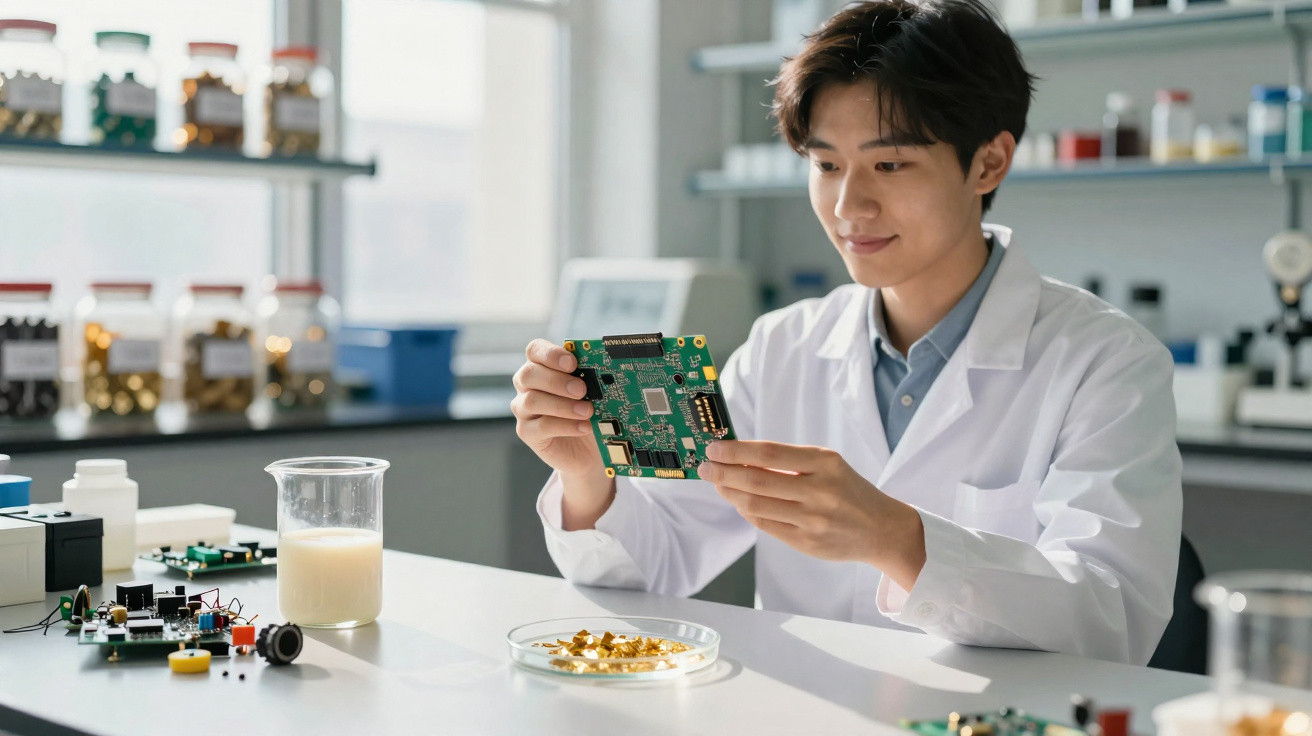
Discarding an old mobile phone or broken laptop may seem like getting rid of nothing more than electronic waste. In reality, valuable metals are being thrown away with it - above all gold, and in quantities that can make some conventional mines look modest. A new Swiss method now demonstrates how this gold can be recovered remarkably cleanly and efficiently.
Gold in electronic waste: why our technology is a hidden mine
Electronic waste is one of the world’s fastest-growing waste streams. Every year, millions of smartphones, computers, routers, servers and other devices are added to it. Many end up in boxes or cellars, or enter poorly regulated disposal channels.
These devices contain an entire reserve of metals:
- copper in cables and circuit tracks
- silver in contacts
- nickel and palladium in components
- and gold in particularly sensitive areas
Gold in particular surprises many people. Concentrations in sorted electronic waste can be considerably higher than in certain gold mines: estimates indicate up to 400 grams per tonne of processed circuit boards. In mining, even just a few grams per tonne of rock can already be worthwhile.
A pile of old motherboards is not a worthless heap of rubbish - it comes surprisingly close to a small gold deposit that has already been mined.
This changes the way we view these devices. A broken smartphone is no longer simply electronic waste, but a secondary source of raw materials that has already been extracted, transported and processed. The question is no longer, “Throw it away or keep it?”, but rather, “How can we recover its value?”
Why our devices contain gold in the first place
Gold is used in electronics not for reasons of luxury, but wherever complete reliability is essential. The metal conducts electricity extremely well and barely reacts with oxygen or moisture. Corrosion, which damages other metals, has little chance here.
Gold is commonly found in:
- plugs and connectors in smartphones, laptops and servers
- contact surfaces on motherboards
- fine connections in high-frequency and specialist components
The quantity in each device is small, but across millions of devices it adds up to a substantial metal reserve - and this is exactly where the new research begins.
The dirty reality: how electronic waste is often recycled today
In many parts of the world, electronic waste is still recycled using crude and highly dangerous methods. Circuit boards are burned to access the metals they contain. Alternatively, they are dissolved in acids and toxic chemicals, often without protective clothing, filtration or oversight.
The consequences are severe:
- toxic fumes harm workers’ health
- soils and waterways absorb heavy metals and chemicals
- entire regions face long-term environmental damage
The real issue is therefore not that electronics contain gold, but how that gold is forced out of the scrap. This is where an unexpected innovation comes in - from cheese production of all places.
Swiss researchers use cheese waste to recover gold
A team at ETH Zurich has developed a process that sounds like an environmental fairy tale: recovering gold with a by-product from cheese-making. It is based on whey, the liquid left over during cheese production.
The researchers use proteins from this whey to create tiny fibrous structures known as protein fibrils. These fibrils can selectively bind metal ions. Broadly, the method involves four stages:
- Selected electronic components, such as motherboards, are carefully brought into solution.
- The protein fibrils are added and draw gold ions out of the liquid like a filter.
- The gold-loaded material is heated, burning away the organic elements.
- What remains is a small piece of highly pure gold.
From around 20 old motherboards, this method recovered roughly 450 milligrams of gold with a fineness of 22 carats.
The abstract idea of “gold in electronic waste” suddenly becomes very tangible: a clearly visible small gold bead, obtained without huge lorries, blasting or open pits.
Two waste streams, one smart solution
What makes the process especially interesting is that it brings together two previously underestimated waste streams. On one side are discarded electronic devices; on the other is an agricultural surplus material from food production. Both were long treated as inconvenient by-products - together, they become a resource.
This approach fits the principle of a circular economy: materials that once sat at the margins are brought to the centre and given a new purpose.
From laboratory concept to real industry: what is still needed
For now, the process is still being developed. The researchers have shown that the method works technically and produces pure gold. Turning it into an industrial system, however, will require more than laboratory chemistry.
Several obstacles remain:
- widespread collection of old devices
- clean separation of the relevant circuit boards and components
- facilities capable of processing large volumes safely and economically
- clear rules governing the trade, export and recycling of electronic waste
Many households keep old phones, routers or hard drives in drawers for years. Companies stockpile retired servers and network equipment, often because they are uncertain about sensitive data. Unless these devices reach recycling facilities, even the most advanced process will have no effect.
What consumers can do in practice
Private households have more influence than many realise. Anyone who hands in unwanted devices through the right channels supports these new material cycles. Practical steps include:
- taking mobile phones, laptops and tablets to local authority collection points
- using take-back schemes offered by electronics retailers or manufacturers
- not placing devices in general household waste
- ensuring old business technology is professionally erased and recycled by certified providers
The cleaner and more concentrated the streams of discarded devices are, the more profitable technologies such as ETH Zurich’s protein process become.
Putting gold, carats and concentrations into context
The description “22 carats” refers to the purity of the recovered gold. Pure gold is 24 carats. Gold of 22 carats therefore contains just under 92 per cent precious metal - a very high level. Such purity is of interest to both the electronics industry and jewellery production.
At first glance, obtaining around 450 milligrams of gold from 20 motherboards may not sound like much. At industrial scale, though, the calculation changes: thousands of circuit boards from a single data centre or several major repair operations can already provide substantially larger quantities. Added to this are the millions of smartphones, laptops and other devices discarded across the EU each year.
Compared with conventional mining, this offers a major advantage: the “ore”, in the form of electronic waste, has already been extracted, transported and concentrated into relatively small volumes. The most demanding stages of raw-material extraction have therefore already been completed - we simply do not yet make consistent use of them.
What risks remain - and where the opportunities lie
Bio-based processes are generally considered far gentler, but they are not automatically without problems. They require energy, chemicals and carefully controlled operations. If pressure grows to produce as cheaply as possible, there is a risk that shortcuts will again be taken somewhere along the chain. Strict quality and environmental standards therefore remain essential.
On the other hand, the concept offers considerable opportunities for regions that have no mining industry of their own but use large amounts of technology: cities, data centres and industrial businesses. They could recover some of the metals they need from their own discarded equipment, becoming less dependent on imports from crisis regions.
An old motherboard may appear unremarkable to an individual. In large volumes, however, it becomes a serious stream of raw materials - and, with processes such as that developed by ETH Zurich, potentially a new chapter in gold recovery that needs fewer excavators and more ingenuity.




Comments
No comments yet. Be the first to comment!
Leave a Comment