
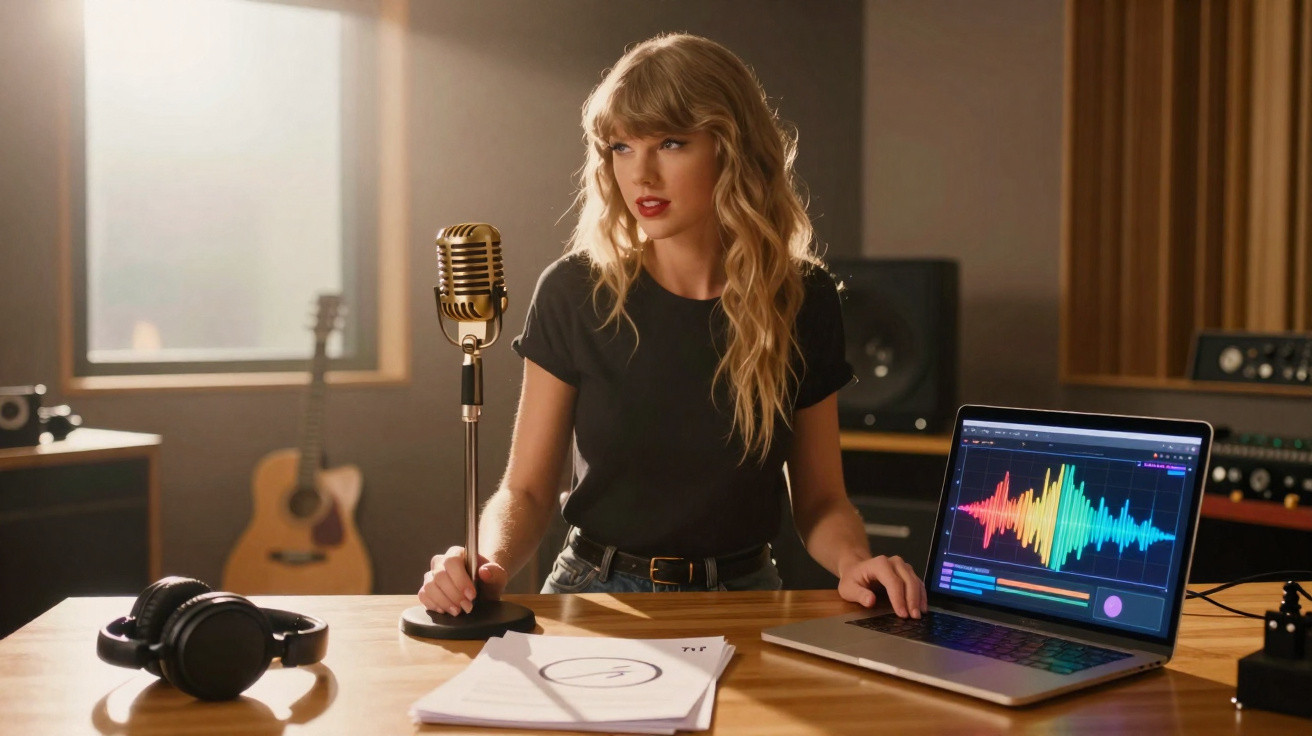
Taylor Swift is using trade marks to safeguard her voice against imitations generated by artificial intelligence. The move could allow her to challenge copies that are likely to cause confusion.
Some AI models have become so capable that they can reproduce a real person’s voice convincingly enough to deceive most people. As the technology continues to advance, American singer Taylor Swift has taken a decisive step to protect her own voice. According to an Associated Press report, she has formally filed applications with the US Patent & Trademark Office to protect both her voice and her appearance.
One application contains an audio recording of the artist saying “Hey, it’s Taylor Swift”. Another includes a recording of “Hey, it’s Taylor”. To protect her appearance, Taylor Swift has also submitted an application featuring an image described as “a photograph of Taylor Swift holding a pink guitar with a black strap, wearing an iridescent multicoloured bodysuit and silver boots. She is standing on a pink stage in front of a multicoloured microphone, with purple lights in the background.” According to AP, all three filings have been approved and are being processed.
How could Taylor Swift’s trade mark filings provide protection?
In a blog post, US intellectual-property lawyer Josh Gerben explains that protecting sound marks is not a new concept. Netflix, for instance, uses this approach to protect its well-known “tu-dum” from imitation. What is new in this case, however, is the use of sound-mark protection to safeguard a voice. The lawyer notes that although artists already receive automatic legal protection, including through copyright, filing applications with the US Patent & Trademark Office provides additional protection if they are validated.
Taylor Swift could therefore bring legal action against identical reproductions of the protected recordings, or even against imitations that are “likely to cause confusion”. The same principle applies to her image, as the artist’s lawyers could challenge AI-generated images that resemble the protected one too closely. “Swift’s trade mark applications suggest a broader shift in how celebrities use trade mark law to fight AI,” the lawyer writes in his post. He also points out that another celebrity, actor David McConaughey, has submitted similar applications.
AI voice cloning can also create commercial opportunities
For others, however, AI systems capable of reproducing their voices represent a fresh way to make money. ElevenLabs, an AI laboratory specialising in voice, offers a type of platform through which users can request rights to imitate the voices of living or deceased celebrities using its products.
Our view on AI-generated voices
As AI can now generate highly realistic voices, some of which may cause confusion, other artists and celebrities may follow the example set by Taylor Swift and David McConaughey, making this type of measure more widespread.
It is also worth noting that Google has already developed a “likeness detection technology” for the entertainment industry on YouTube. “Likeness detection helps creators find content on YouTube where their face appears to have been altered or generated by AI,” the Mountain View company explains on the support page for the feature. There is not yet, however, an automated equivalent for voices.

Comments
No comments yet. Be the first to comment!
Leave a Comment