
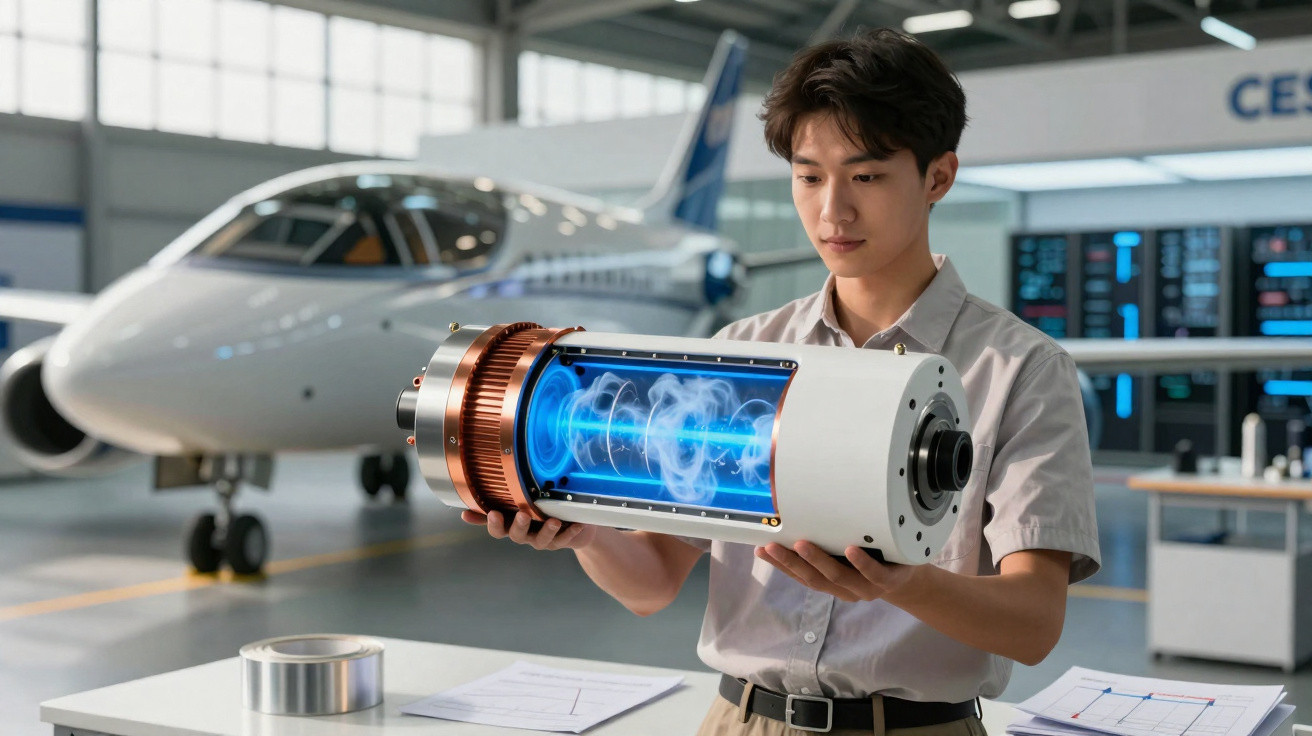
The unit neither lit up, roared nor sprouted wings. But within its glossy casing, a young US company says it has solved one of advanced electrification’s most difficult challenges: making superconducting motors viable for real aircraft and energy-intensive infrastructure.
The point at which superconductivity moves beyond the laboratory
To engineers, superconductivity can sound like respectable science fiction. Send electricity through a specialist material and cool it to well below freezing, and its electrical resistance drops to zero. That means no ohmic losses, virtually no wasted heat, and magnetic fields powerful enough to produce substantial torque from compact motors.
In theory, this is ideally suited to aviation’s problems. Aircraft demand exceptionally high power density, while every kilogram added in motors, cables or cooling equipment reduces range, payload, or both. Conventional electric machines have advanced steadily, yet they still turn a meaningful share of their energy into heat and need substantial cooling arrangements.
Superconducting machines address these limits directly, offering:
- Far greater torque density than conventional motors.
- Reduced electrical losses, particularly at high power.
- The prospect of smaller and lighter propulsion systems at the same output.
- More efficient performance during extended cruise periods.
For decades, however, one issue has prevented their practical adoption: cooling.
Traditional superconducting systems resembled chemistry experiments more than aircraft components. They relied on external cryogenic skids, liquid helium or nitrogen reservoirs, pipework, valves and fluid-management software. Such equipment works well in a physics institute, but not when it must be fitted beneath a wing or inside a confined fuselage.
Aviation has waited years for superconducting tech that comes as a single, self-contained unit rather than a lab experiment bolted onto a motor.
Hinetics’ sealed superconducting motor contains its own cooling system
At CES 2026, Chicago startup Hinetics presented what the industry has long sought: a superconducting motor with its own built-in refrigerator.
Rather than first developing a motor and then considering how to attach cooling equipment, the team took the opposite approach. It began with an integrated cryocooler, then designed the machine around it as one industrial assembly.
Within the casing, a compact cryorefrigerator runs axially through the rotor. Its “cold finger” removes heat from the superconducting coils and transfers it towards the external environment. The motor’s active elements are housed in a vacuum, held by Kevlar cords with minimal heat conduction and protected by aluminised mylar insulation.
In effect, the result is a highly precise thermos built into a rotating machine. The cold area remains cold, ambient heat finds it difficult to enter, and the entire system is enclosed in a single sealed unit. From outside, it appears unremarkable: there are no condensation-covered pipes or external cryogenic equipment.
This level of integration is important because it broadens the technology’s potential users. A self-contained system could be installed in an engine nacelle, wing root or datacentre mechanical room without requiring a new facility or a dedicated team of cryogenics experts.
By hiding the cryogenics inside a standard-looking machine, superconductivity shifts from science project to installable hardware.
Why 99.5% efficiency has major consequences
Small fractions of a percentage that alter aircraft design
The demonstrator that Hinetics brought to Las Vegas produces only a few kilowatts. Its notable feature is its performance figure: approximately 99.5% electrical efficiency under load. That may appear to be little more than a laboratory achievement, but the implications change at the scale of the future 6-megawatt aviation motor the company intends to pursue.
At 6 MW, every half-percent of loss represents 30 kilowatts of heat. Eliminating that heat allows the cooling system to become smaller. Ducting, heat exchangers, fluid pumps and structural supports can all be reduced in size. The weight spiral normally associated with high-power systems can then begin to reverse.
Hinetics also says the stronger magnetic fields within its superconducting rotor increase torque density by around a factor of ten compared with many conventional machines. This gives designers more freedom to balance diameter, length and rotational speed.
For electric or hybrid aircraft, that flexibility can bring tangible benefits:
- Smaller nacelles, reducing drag.
- Shorter shafts and lighter gearboxes, or potentially direct-drive fans.
- Additional wing space for batteries, hydrogen tanks or fuel.
- Larger operating margins in hot conditions, when cooling is most challenging.
Lower waste heat also reduces thermal stress on insulation, bearings and power electronics. This could support longer maintenance intervals and more predictable ageing, both vital considerations for airlines cautious about complex new propulsion systems.
Aviation in view, AI datacentres alongside it
Electric aircraft are the showcase rather than the sole market
Hinetics presents aviation as its most visible application. Its focus is on high-power motors operating at roughly 1,800 rpm for regional aircraft, hybrid propulsion systems and VTOL aircraft using several propulsors along the wing.
However, the founders also identify another, arguably more unusual, opportunity: AI datacentres.
Training large neural networks and operating real-time inference systems create sharp bursts in power demand. Racks activate, GPUs suddenly draw current, and facility managers must work to level the load. Conventional generators and grid infrastructure do not respond well to such spikes. To manage them, operators add batteries, flywheels and complex control systems to otherwise standard equipment.
Superconducting machines respond differently because of their extremely low inductance and fast magnetic behaviour. They can respond almost immediately to changing loads, taking in or supplying short-duration power fluctuations through the mechanical shaft rather than electronic buffers.
A single superconducting machine could act as both motor and shock absorber for the brutal power surges of AI computing farms.
In this role, a superconducting motor could be positioned between the grid and a rotating mass or turbine, reducing peaks and covering troughs in consumption without requiring an additional bank of battery cabinets.
Three years of development within a scale model
“Baby Yoda” and the journey to CES
The CES machine is not intended to set power records. Instead, it serves as a concentrated proof of concept at 1:20 scale compared with a 3 MW motor that Hinetics is currently assembling.
The demonstrator includes every major feature required by the full-size motor: the vacuum enclosure, Kevlar support system, internal cryorefrigerator, high-temperature superconducting coils and the control methods required to keep the rotating cold mass stable.
The programme reached an important milestone in May 2025 with an earlier prototype called “Baby Yoda”. This small test rig showed that commercially available Stirling cryocoolers could lower the rotor’s superconducting material to around −224 °C and maintain that temperature reliably.
Achieving this temperature with standard industrial equipment altered the project’s risk profile. Hinetics no longer required exotic cryogenic plants or custom refrigeration technology. From then on, the key challenge was intelligent packaging rather than theoretical physics.
The programme receives financial and technical support through ARPA‑E, the US Department of Energy’s advanced projects agency. ARPA‑E concentrates on early-stage, high-risk technologies that could disrupt established energy systems if they prove viable in the real world.
The persistent issue: superconducting tape costs
Materials economics remains the main constraint
At present, the largest obstacle to commercialisation is not cooling equipment or mechanical engineering. It is the price of the superconducting tape itself.
Often made from rare-earth barium copper oxides or comparable compounds, these tapes can carry enormous currents without resistance when adequately cooled. Their manufacture is also complicated, involving the deposition of multiple layers, precise crystal-structure alignment and stringent quality control. These requirements keep their cost far above that of standard copper conductors.
Hinetics and other organisations in the sector are nevertheless monitoring a notably rapid decline in prices. Average costs have fallen by a factor of two over roughly three years. The company anticipates another halving over the next three years if manufacturing volumes increase and new production lines begin operating.
This type of cost curve resembles the one experienced by photovoltaics and lithium-ion batteries a decade ago. Both began as expensive, specialised technologies before entering mainstream markets as production scale and process optimisation improved.
| Factor | Conventional motor | Superconducting motor (target) |
|---|---|---|
| Electrical efficiency | 95–97% | ≈99.5% |
| Torque density | Baseline | Up to 10× higher |
| Cooling system | Air/liquid, external radiators | Integrated cryocooler, vacuum enclosure |
| Materials cost | Standard copper, steel | High-temperature superconducting tape |
When the cost of superconducting tape falls below a certain point, aircraft designers may be able to justify spending more per kilogram of conductor in return for a more compact, lighter and more efficient powertrain. The same rationale may apply to ships, grid-stabilisation systems and premium industrial drives, where downtime is more costly than capital expenditure.
Implications for climate targets and electricity grids
Should integrated superconducting motors achieve commercial maturity in the megawatt class, their effects could extend beyond specialist electric aircraft. Aviation regulators are strengthening CO₂ targets, while grid operators face increasing renewable generation and rapidly growing AI-related demand.
Lighter, more efficient propulsion could make hybrid-electric regional services practical on routes where today’s batteries remain marginal. Airlines could operate smaller fuel-burning cores supported by superconducting generators and motors, reducing emissions without committing entire fleets to fully battery-electric aircraft.
On land, grid planners could deploy these machines as flexible assets. They could be paired with wind or solar farms to smooth output, or installed within industrial sites constrained by grid-connection limits. Superconducting machines can provide a striking amount of controllable power in a compact footprint, which is particularly valuable in large cities and space-constrained locations.
There are less apparent risks and compromises as well. Superconducting systems depend on rare materials and precision manufacturing, so supply disruptions could slow deployment. Maintenance teams will require training to work with vacuum enclosures, cryogenic seals and unfamiliar failure modes. Regulators will also need to determine how to certify equipment that does not fit existing motor or turbine standards.
Even so, the Las Vegas demonstrator points to a change. For the first time, visitors could stand only a few inches from a complete superconducting aircraft motor-not a diagram or a laboratory coil-and picture it driving a propeller. The challenges still ahead appear economic and industrial rather than impossible. That helps explain why aviation executives and datacentre planners alike paid close attention to what initially looked like another polished cylinder on a CES stand.




Comments
No comments yet. Be the first to comment!
Leave a Comment