
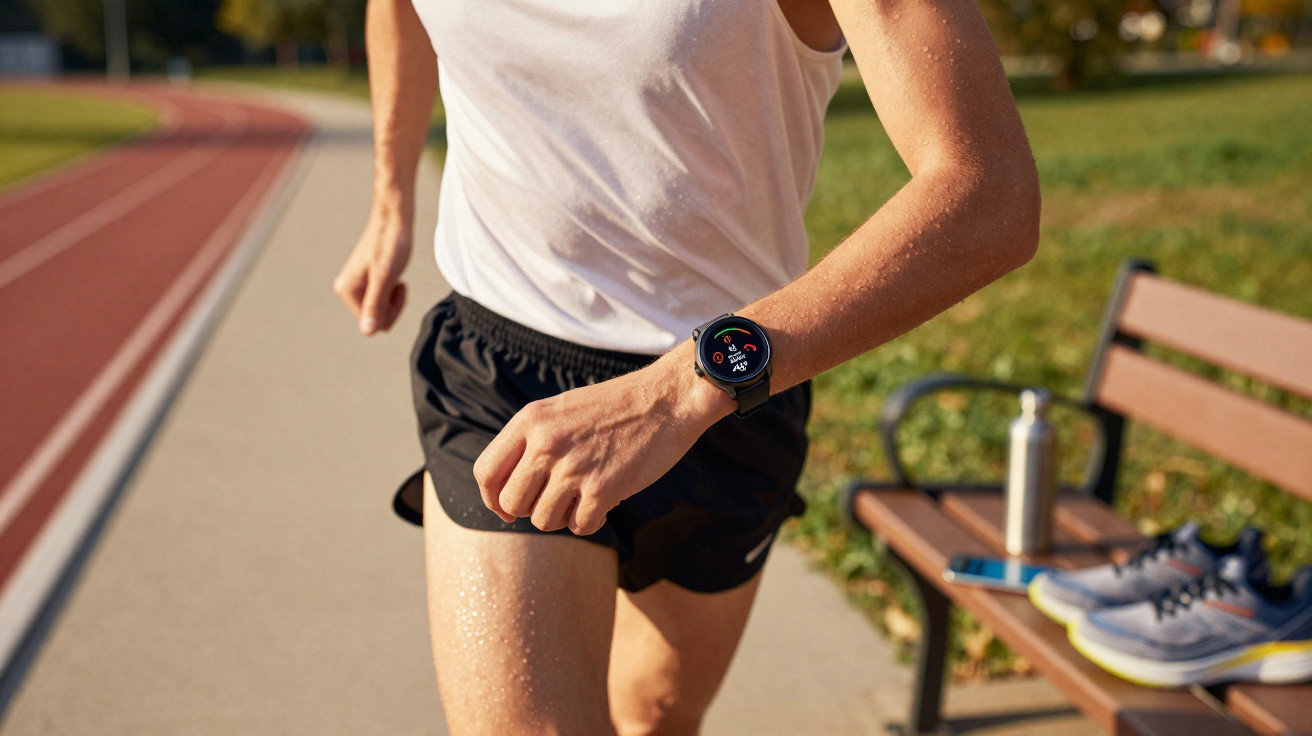
Coros, Garmin’s major rival in the sports watch market, has unveiled its new ultra-light model for runners, cyclists and swimmers. It significantly outperforms the Pace 3, puts the Pace Pro’s future in doubt, and introduces an AMOLED display, a microphone and a more understated design.
Coros quietly revealed it on Eliud Kipchoge’s wrist. In New York, as the marathon runner collected the final race bib needed to complete his set of the world’s six most prestigious marathons, the new Pace 4 lit up with its AMOLED screen. Coros’s final new release of 2025 belongs to the Pace range, and it is a particularly important one: this is the model behind the brand’s success and its ability to gain ground on Garmin in the entry-level, ultra-light sports watch category, an area the leading American manufacturer has failed to defend.
Sports watch: Coros replaces the Pace 3 with the Pace 4
The Coros Pace 4 succeeds the Pace 3, which launched in August 2023. Its price rises only slightly, from €249 to €269, yet the list of upgrades is extensive. The sports watch retains the same mission: delivering accurate tracking in an ultra-light case with excellent battery life. Looking at the specifications of this new Pace 4, the Pace 3’s figures almost seem modest. With an AMOLED display now included, the watch has been modernised and no longer needs to envy the Pace Pro. Indeed, the latter may disappear, as it no longer appears to have enough arguments to remain on the market.
The display and battery life are not the new Coros Pace 4’s only strengths. The brand is continuing with its plan to add a microphone to all its new GPS sports watches. We will return to this addition later in the article, as it brings a new feature that should appeal to athletes following training plans on their watch and wishing to keep notes about each session. However, the Pace 4 will not offer mapping, a cellular version for making calls, or a torch, as found on an increasing number of Garmin watches.
Nor will the Pace 4 sports watch gain extra functions or equipment for everyday life. There is one small disappointment: Coros has not decided to introduce a contactless payment service, as Garmin does with Garmin Pay and an NFC chip in its watches. That is unfortunate, as this simple feature makes it possible to leave a phone or bank card behind while still being able to pay during an outing.
Coros Pace 4 design and display
The Coros Pace 4 keeps dimensions close to those of the Pace 3: a 43.4 x 43.4 mm case, 11.8 mm thick, compared with 11.7 mm for the Pace 3, and a weight of 32 g with the nylon strap, rising to 40 g with the silicone strap. Its display measures 1.2 inches. The design changes echo those of the Coros Pace Pro, with the screen blending more smoothly into the bezel. The construction remains plastic, with two different tones between the bezel and the side section of the sports watch, which also houses the buttons. Speaking of controls, a new button has appeared on the left-hand side of the watch. We will cover it in the software section of the Coros Pace 4.
The Pace 4 therefore moves to an AMOLED display, leaving behind Coros’s transflective technology, which helped reduce the watch’s price and power consumption. First introduced on the Coros Pace Pro, AMOLED provides a broader colour range, stronger contrast, with truly black blacks as no LED is illuminated, and improved readability. According to Coros, the Pace 4’s display resolution is 164% higher than that of the Pace 3. More precisely, it offers 390 x 390 pixels and a peak brightness of 1500 nits-the same as the Pace Pro. Coros remains conservative with the Pace range’s protective glass, using mineral glass to prioritise cost and low weight, as it did with the Pace 3.
Coros Pace 4 battery life and endurance
Coros surprised many people when it launched the Pace Pro: contrary to expectations, AMOLED did not cause battery consumption to soar. More accurately, Coros handled the arrival of the new display effectively by improving the sports watch’s efficiency. The outcome was excellent-until the Pace 4 arrived. This model lasts even longer than the Pace Pro, with 41 hours of GPS use with all systems enabled, versus 31 hours for the Pace Pro and 25 hours for the Pace 3. In dual-frequency GPS mode, it is rated for 31 hours, compared with 15 hours on the Pace 3. In daily-use mode, without GPS activities, battery life reaches 19 days, versus 15 days on the Pace 3.
Battery life falls when the Always-on mode, which keeps the screen permanently active, is enabled. Users can choose to activate Always-on only during an activity or at all times, including outside activities. The impact is 10 hours, reducing battery life to 31 hours in GPS mode with all systems enabled. With dual-frequency GPS, the Pace 4 delivers 24 hours in Always-on mode, matching the endurance of a Pace Pro. The figures cannot be compared with the Pace 3, because it does not have an AMOLED screen or an Always-on mode: its display stays on all the time, although brightness increases only when the watch is raised towards the user or a button is pressed.
To promote the Pace 4, Coros highlights these comparisons: 16 additional hours over the Pace 3 with all systems GPS, and 4 extra days of daily use. Against the Pace Pro, it offers 3 more hours in all-systems GPS mode. Coros told Presse-citron that the Pace 4’s better battery life than the Pace Pro comes from a combination of battery capacity and its smaller display, at 1.2 inches rather than 1.3 inches.
The Coros Pace 4 action button and microphone
The Coros Pace 4’s other new additions are a new action button on the sports watch case and an integrated microphone. Starting with the button, it essentially adds a control that makes navigation around the sports watch quicker. Until now, Coros’s interface allowed users to scroll through menus and data horizontally. With this third button, it is now possible to scroll from left to right to move between menus or open media controls, navigation, or the watch’s general settings.
Coros wanted to spend time discussing the microphone with Presse-citron. The brand does not intend it to be used for calls, but rather to make note-taking after a session easier. It believes that comments about how a session felt are essential for remembering sensations and training periods, although most people do not want to spend time writing a few lines after finishing a workout. The microphone is therefore designed to record us and transcribe our impressions, adding them as text, alongside an audio file, to the session history in the app.
Coros Pace 4 price and release date
Two years after the Pace 3, the new Pace 4 goes on sale for €269, an increase of €20. It has been available to buy in France since 10 November and will arrive in shops at the beginning of December, including Decathlon, for example. At launch, only the black and white versions are available, and both come solely with the silicone strap. This is regrettable, as it is less comfortable and heavier than the nylon option. Coros says it experienced difficulties receiving the nylon straps in time for the Pace 4 launch. Nevertheless, we recommend the nylon version for its low weight, comfort, and quick, precise adjustment to fit the wrist.
Another important detail is that Coros will reduce the prices of the Pace 3 and Pace Pro from 14 November. The Pace 3 will be €20 cheaper at €229, while the Pace Pro will lose €50, falling to €349. The brand’s teams told Presse-citron that both older models will remain on sale until stock is depleted, suggesting that the Pace Pro will also be retired. That would be understandable: although it has mapping and an electrical heart-rate sensor unavailable on the Pace 4, it no longer stands apart enough. Heavier and more expensive, it now competes with the trail-focused range, which offers longer battery life and a more robust case.
It remains to be seen what Coros has in store for 2026 after this new Pace 4.



Comments
No comments yet. Be the first to comment!
Leave a Comment