
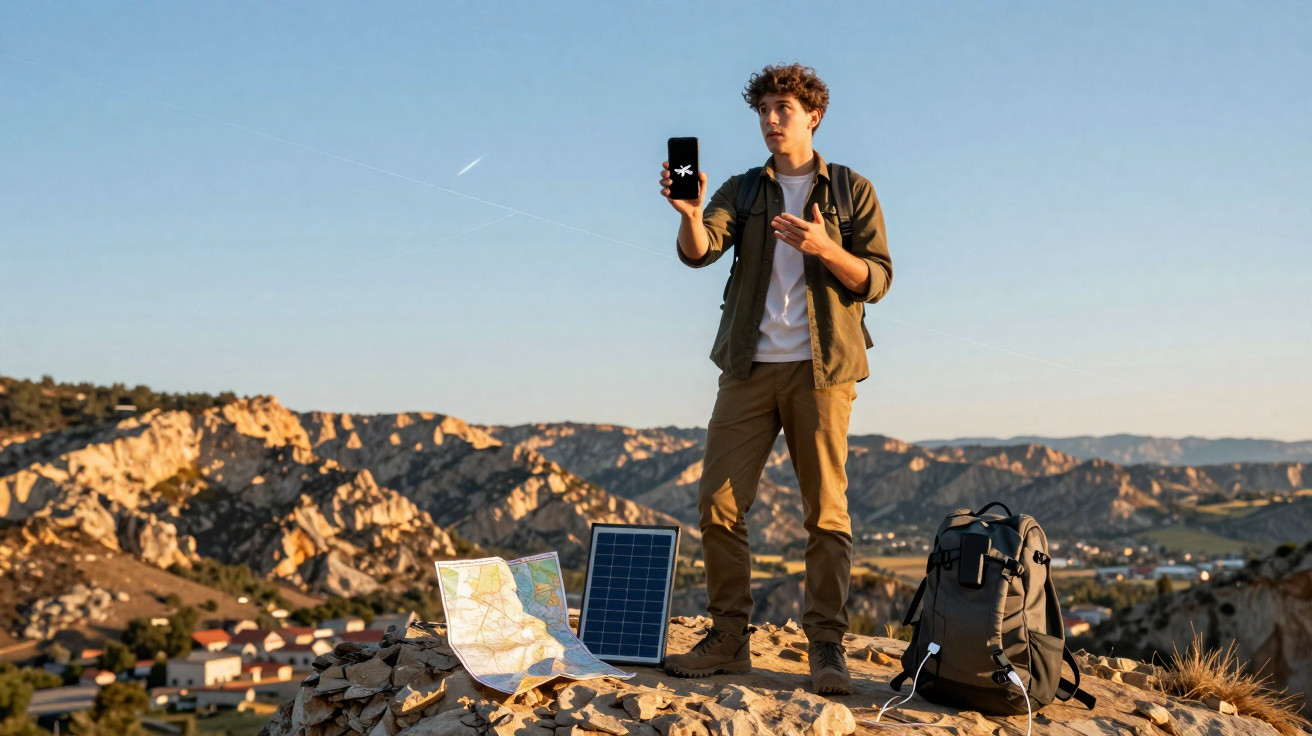
The alert arrived at 2:17 a.m., while a storm swept across the Atlantic. An Icelandic hiker was stuck on a ridge, with 120 km/h winds howling around him, 7% battery remaining and hands too unsteady to type properly. There were no bars and no signal: only the familiar dread of seeing “No Service” appear as the world silently drops away.
But on this occasion, it did not.
His old, basic Android handset suddenly displayed an unfamiliar network name connected to a satellite passing overhead. His rescue request was sent, including his location, condition and coordinates. A helicopter pilot later said: “Without that connection, we’d likely have found a body.”
That is the promise behind global Starlink coverage on any phone.
It is also why many people find the prospect unsettling.
Starlink everywhere: from dead zones to full bars
Anyone who has watched a handset fall from 4G to a solitary “E” on the way out of town will understand the appeal of this technology. Enter a tunnel or lift, or travel by train through rural countryside, and your digital world can close like a book. No maps, messages, payments or anything else.
SpaceX wants to remove that experience.
Its proposal is a sky packed with low-orbit satellites that function as mobile masts in space, communicating directly with standard phones. There is no large roof-mounted dish and no need for a specialist handset: just you, your phone and a sky that discreetly becomes an antenna.
The concept moved closer to reality in early 2024, when Starlink began sending texts from space alongside T-Mobile in the US. Initial trials demonstrated that basic messages could be sent from places with absolutely no terrestrial coverage.
In a remote Kansas wheat field, a farmer sent a text from miles away from the nearest mobile mast. In a national park, a ranger used an ordinary smartphone to verify the position of a missing camper from a valley that had been a complete blackout area for years. This was not a futuristic satellite phone, but a normal device with a slightly altered status bar.
The connection speeds were limited and latency was high. Yet the emotional impact of knowing “I can reach someone from anywhere” was enormous.
In principle, the technology is straightforward. Newer Starlink satellites include dedicated antennas operating on the same frequencies used by terrestrial mobile networks. Rather than travelling to a nearby mast, your phone’s signal goes directly upwards to a satellite, which relays it to a ground station connected to your mobile provider’s network. As far as the handset is concerned, there is no difference.
Underneath that apparent simplicity is a vertically integrated powerhouse: rockets, satellites, antennas, network partnerships and user terminals are all held by one company. This arrangement is what allows the system to move quickly and operate efficiently.
It is also what leaves some people profoundly uneasy.
Using Starlink on your phone without relying on it
In practical terms, the first principle is to view Starlink on your phone as a safety net rather than oxygen. If it becomes available where you live, approach it as you would an emergency exit: it is reassuring to have, but not something around which to organise your entire life.
When travelling, particularly in isolated places, download maps for offline use, store important telephone numbers on your device and carry a compact power bank. If the satellite solution fails, these measures mean you are not immediately stranded.
Consider Starlink coverage your final route of contact with the outside world, not a substitute for local mobile networks, community knowledge or common sense.
Comfort is the most obvious trap. You set off walking without a paper map. You relocate to a rural cottage and do not speak to local people because “I’ve got coverage anywhere now.” You operate a business entirely through cloud services on the assumption that the sky will always be connected.
Should the company suffer an outage, increase its prices or be blocked in your country, everyday life can become unstable very quickly. Connectivity changes from a useful extra into a single point of failure under the control of a private company. Most people know that feeling: an app fails, and suddenly half the day falls apart.
Let’s be honest: almost nobody reads the full terms of service before pressing “Accept.”
That is how unseen dependence gradually takes hold.
The people who spend their days considering these issues are already urging caution.
Elon Musk once admitted on X that Starlink can “geofence” coverage and that political pressure has already affected where the network is allowed to function in conflict zones.
A layered approach can help protect you:
- Local options: Retain at least one conventional SIM from an established provider in the area where you live.
- Offline resilience: Keep vital documents, maps and contacts stored on the device rather than solely in the cloud.
- Multiple channels: For essential work, use a combination of fibre, mobile data and, potentially, satellite access instead of relying on a single connection.
- Exit strategy: Ask yourself: “If Starlink disappeared next week, what breaks in my life?”
- Community backup: Know which people nearby have radio equipment, local expertise or offline tools.
The miracle is genuine, but your contingency plan must be equally genuine.
A connection miracle or a quiet takeover of the sky?
There is something undeniably powerful about a fisherman in the middle of the Pacific, or a midwife in an isolated village, being able to send a message as easily as somebody in Manhattan. It reduces the world’s distances in a beautiful way. Emergency responses can happen faster, journalists in communication blackouts can get images out, and families can remain in touch across oceans and deserts.
At the same time, the world is seeing a single private company create a form of shadow infrastructure above us. Thousands of satellites are governed through a small number of ground stations and corporate decisions. A technical fault, political agreement or commercial disagreement could abruptly reshape the digital map of who may communicate with whom.
For ordinary users, the tension is increasingly recognisable. We have already experienced reliance on one search engine, one app store and one social platform. Starlink takes that same pattern beyond applications and into the internet’s physical infrastructure. The pipe becomes branded.
Some regulators have begun raising difficult questions about spectrum allocation, orbital congestion and the risk of monopolies. Astronomers object to light pollution. Militaries are quietly assessing what might occur if a satellite swarm is jammed or hacked. Most people, however, see a simpler benefit: stronger signal in more places, using the handset they already have.
The coming years will probably determine which narrative prevails. One possibility is a world in which space-based coverage is treated as critical infrastructure, supported by rules, alternatives, redundancies and public oversight. The other is a world where we gaze at a sky full of corporate constellations and reassure ourselves that it is acceptable because streaming never buffers.
Starlink on any phone is more than a technological improvement; it is a social choice.
Who should we trust with the final signal we can send when everything else goes dark?
The answer will not emerge from a keynote stage, but from the small decisions each of us makes about how much control we are prepared to exchange for convenience.
| Key point | Detail | Value for the reader |
|---|---|---|
| Starlink transforms “no service” areas into points of contact | Low-orbit satellites connect directly to standard phones through partner mobile networks | Understand how an everyday handset could receive emergency coverage in almost any location |
| Relying on one private network brings risks | Vertical integration gives one company control over launches, hardware and access policies | Helps you assess how much to depend on Starlink for safety, travel or work |
| Personal resilience is more important than any single technology | Using offline tools, local networks and several connections together lowers vulnerability | Provides a practical checklist for staying connected without becoming captive |
FAQ
Question 1: Can any existing smartphone really connect to Starlink satellites directly?
Early implementations concentrate on 4G/5G-compatible phones using partner carrier bands, meaning many recent devices should function without hardware modifications once the networks support them.Question 2: Will Starlink satellite coverage be fast enough for streaming and video calls on a phone?
The first services are intended for basic messaging and limited data rather than full-speed broadband, although capacity is expected to increase as further satellites are launched.Question 3: Isn’t this just like owning a satellite phone?
Traditional satellite phones require specialist, costly hardware; Starlink’s approach is intended to make standard smartphones occasional satellite clients through conventional networks.Question 4: What happens if governments pressure Starlink to cut coverage in certain regions?
The company can technically limit service by geographical area, so availability may rest on political agreements, sanctions and domestic regulation.Question 5: How can I avoid becoming too dependent on one company for connectivity?
Maintain several internet options where possible, keep essentials offline and regard satellite coverage as a backup layer instead of your sole lifeline.





Comments
No comments yet. Be the first to comment!
Leave a Comment