
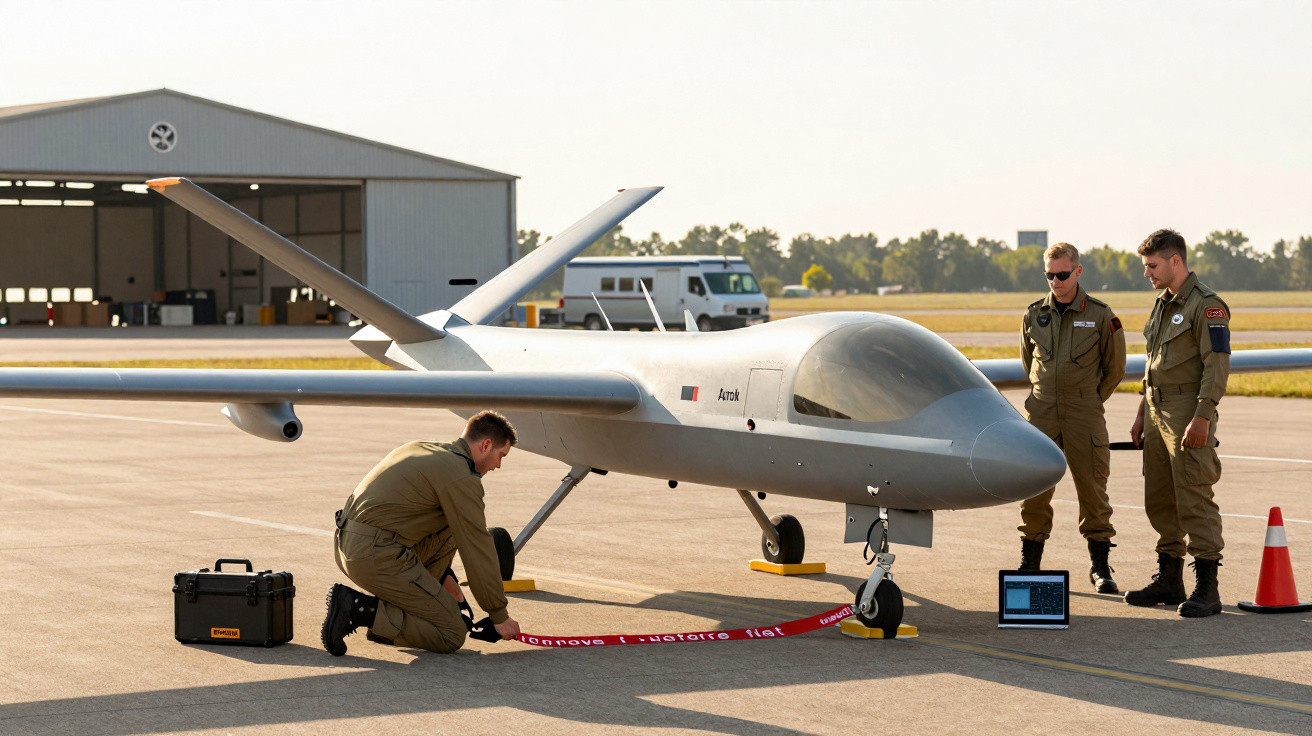
On 9 September, a large unmanned aircraft resembling a US Reaper took off from Blois-Le Breuil airfield. It was neither American nor Israeli, but wholly French: Aarok, a new medium-altitude long-endurance (MALE) drone intended to challenge the foreign systems that presently dominate Europe’s skies.
A maiden flight with major political significance
French defence company Turgis & Gaillard has confirmed that its Aarok prototype has completed its first flight test successfully. For this first sortie, a pilot was on board and flew the aircraft as a conventional aeroplane.
This ‘manned’ arrangement has one principal aim: confirming the aircraft’s aerodynamics, engine performance and handling characteristics before tests progress to fully autonomous operation.
The first flight of Aarok marks a concrete step towards a European-made alternative to US Reaper drones.
The company presents the flight as an important milestone for a programme intended to answer French and allied demand for a large drone able to undertake intelligence, surveillance, reconnaissance and precision-strike tasks.
Taking on the Reaper’s dominance
For over ten years, France has used the US-made MQ-9 Reaper for long-endurance missions across the Sahel, the Middle East and other operational theatres. This reliance has prompted concern in Paris over strategic autonomy and access to essential systems during a crisis.
Aarok is being proposed directly as an answer to that dependency. Its stated specifications put it in competition with the Reaper and other MALE platforms already operating in service.
- Endurance: 24 to 30 hours of continuous flight
- Ceiling: around 14,000 metres (roughly 46,000 feet)
- Cruise speed: about 460 km/h
- Powerplant: 1,200 hp turbine engine
- Wingspan: approximately 22 metres
According to the company, these capabilities, together with French and European onboard equipment, could offer “a sovereign option” to replace American drones in the same class for France and perhaps other European buyers.
A 100% French platform using established systems
First revealed in 2023 and publicly displayed at the Paris Air Show at Le Bourget in June of that year, Aarok is presented as a modular, upgradeable platform rather than an aircraft designed for only one type of mission.
Aarok has been designed as a plug-and-play carrier for sensors and weapons already qualified by major European defence suppliers.
Onboard sensors and surveillance capabilities
For intelligence, surveillance and reconnaissance (ISR) missions, Aarok can be equipped with recognised French and European systems already used on other aircraft. Turgis & Gaillard has highlighted the following equipment:
- Thales AirMaster S radar for wide-area surveillance and target tracking
- Safran Euroflir 410 optronic turret for high-definition day/night imaging and laser designation
Employing established equipment reduces development times and is expected to simplify certification, while giving reassurance to military operators that already use these sensors aboard helicopters or crewed aircraft.
Strike missions and weapons load
Aarok is intended not just to observe, but also to strike. The drone is designed to carry up to two tonnes of weapons beneath its wings and fuselage.
| Weapon type | Origin | Role |
|---|---|---|
| A2SM (modular air-to-ground bomb) | Safran (France) | Precision guided strike against fixed or mobile targets |
| Akeron missile | MBDA (Europe) | Anti-armour and complex target engagement |
This mix would enable French forces to carry out so-called “ISR-strike” operations, with one platform able to find, identify and then attack a target while staying on station for many hours.
Support from Paris and a compressed timetable
The French Ministry of Armed Forces has already signalled public interest in the project. During a visit to the company’s Blois-Le Breuil facilities earlier this year, Sébastien Lecornu, then defence minister, praised Aarok’s potential to address a capability shortfall.
France’s defence procurement agency, the Direction générale de l’armement (DGA), has also announced financial backing for the programme. This support does not yet represent a full production order, but supplies funding to continue development and demonstrates political intent.
Turgis & Gaillard is targeting an initial operational capability for Aarok somewhere between 2027 and 2028, a relatively short horizon by defence standards.
Should that timetable be maintained, Aarok could enter service as several European countries continue to debate joint drone programmes that have already taken years to develop.
A small defence company aiming high
Turgis & Gaillard is not an established heavyweight such as Airbus or Dassault. Employing about 400 people and generating around €75 million in annual revenue, it belongs to the mid-sized tier of French industrial businesses.
Undertaking a major drone programme is a bold step for a company of this scale. However, that comparative agility can prove useful against larger, slower-moving groups, particularly where rapid entry into service is important.
The firm is wagering that a focused workforce, modular architecture and the reuse of existing sensors and weapons will make Aarok less costly and faster to field than more complicated multinational programmes.
What MALE drones bring to military operations
MALE means “medium altitude, long endurance” – a technical description that conceals highly practical advantages for commanders on the ground.
- Persistent surveillance: remaining airborne for more than 24 hours enables an area to be watched continuously without changing aircraft and crews.
- Reduced risk to pilots: once the drone is fully uncrewed, operations take place remotely, keeping personnel away from hostile fire.
- Flexible payloads: according to the mission, the same aircraft can carry cameras, radar, electronic sensors or precision weapons.
- Lower operating cost: over time, MALE drones may cost less to operate than fighter aircraft or large crewed surveillance platforms.
In counter-terrorism operations, border security, maritime patrols and support for ground forces, these qualities have made MALE drones central to modern military planning. Aarok has been designed to fit precisely into these roles.
Strategic autonomy and export opportunities
Beyond its raw capabilities, Aarok is part of the wider discussion about European strategic autonomy. For France, dependence on American drones also entails accepting US export regulations, software updates and data-sharing restrictions.
A European-built system can be tailored, improved and deployed without requiring Washington’s permission. It also means sensitive information collected by the drone’s sensors can remain under national or EU control.
For exports, Turgis & Gaillard is looking beyond France to other European and allied air forces seeking a capable MALE drone without the political conditions that can sometimes accompany US equipment sales.
Key terms and operational scenarios
A number of concepts regularly associated with programmes such as Aarok can appear abstract. In operations, however, they correspond to very practical circumstances.
Intelligence, surveillance and reconnaissance (ISR): this covers the entire process of detecting something, determining what it is and sending the information to decision-makers. During a Saharan-style operation, Aarok could follow a pick-up truck convoy across hundreds of kilometres, magnify the image to read markings, and then transmit imagery in near real time to a command centre in France.
Sovereign option: this expression means more than simply “made at home”. It also involves control over software, encryption, spare parts and upgrades. For instance, if a crisis arose in which US export rules prevented Reaper operations, a wholly French-controlled system such as Aarok could still be deployed without foreign authorisation.
There are risks and compromises as well. Long-endurance drones are susceptible to advanced air-defence systems. In a high-intensity conflict with a peer opponent, Aarok would probably have to fly behind friendly lines or beneath strong air cover. Cybersecurity is a further issue: command links and data flows must be protected against jamming and hacking.
Nevertheless, in the low- to medium-intensity operations that have characterised many Western interventions during the past 20 years, a platform such as Aarok can greatly cut the requirement for crewed sorties, maintain persistent observation over difficult terrain, and provide commanders with a flexible asset between a reconnaissance aircraft and a strike fighter.






Comments
No comments yet. Be the first to comment!
Leave a Comment