
Bosch stated this last summer and is reiterating the message at CES 2024: “we see hydrogen as a cornerstone of the future of mobility”.
To support that ambition, the technology giant is investing in several stages of the hydrogen value chain, from manufacturing fuel cells to developing and producing components for hydrogen internal-combustion engines.
Bosch hydrogen fuel cells and combustion engines
Fuel-cell production has already begun in Stuttgart, and Bosch says it has received its first orders from several European, Chinese and North American truck manufacturers.
Bosch will unveil its hydrogen combustion engine later this year. The company highlights that hydrogen combustion engines share most of their components with current Diesel engines. As a result, the switch is technically far less demanding than moving to an electric powertrain, whether battery-electric or fuel-cell based.
Furthermore, “when fuelled with green hydrogen (produced using renewable energy), the engine is virtually carbon-neutral”, Bosch said in a statement.
“If we enter the very heavy vehicle segment, we will not be able to do so with electrification alone. We will need a powertrain that provides the same flexibility as a Diesel or petrol engine.”
- Paul Thomas, president of Bosch Mobility Americas
Bosch’s investment in this technology, totalling €2.5 billion, could hardly come at a more timely moment, given the surge in hydrogen investment worldwide. In the United States, for instance, $7 billion (€6.4 billion) has been allocated to build regional hydrogen-production facilities.
What else will Bosch showcase at CES 2024?
Bosch’s announcements for this year’s CES (Consumer Electronics Show) extend beyond its use of hydrogen to decarbonise road transport. Autonomous-driving systems and digitalisation are also taking centre stage.
Automated parking and charging technology
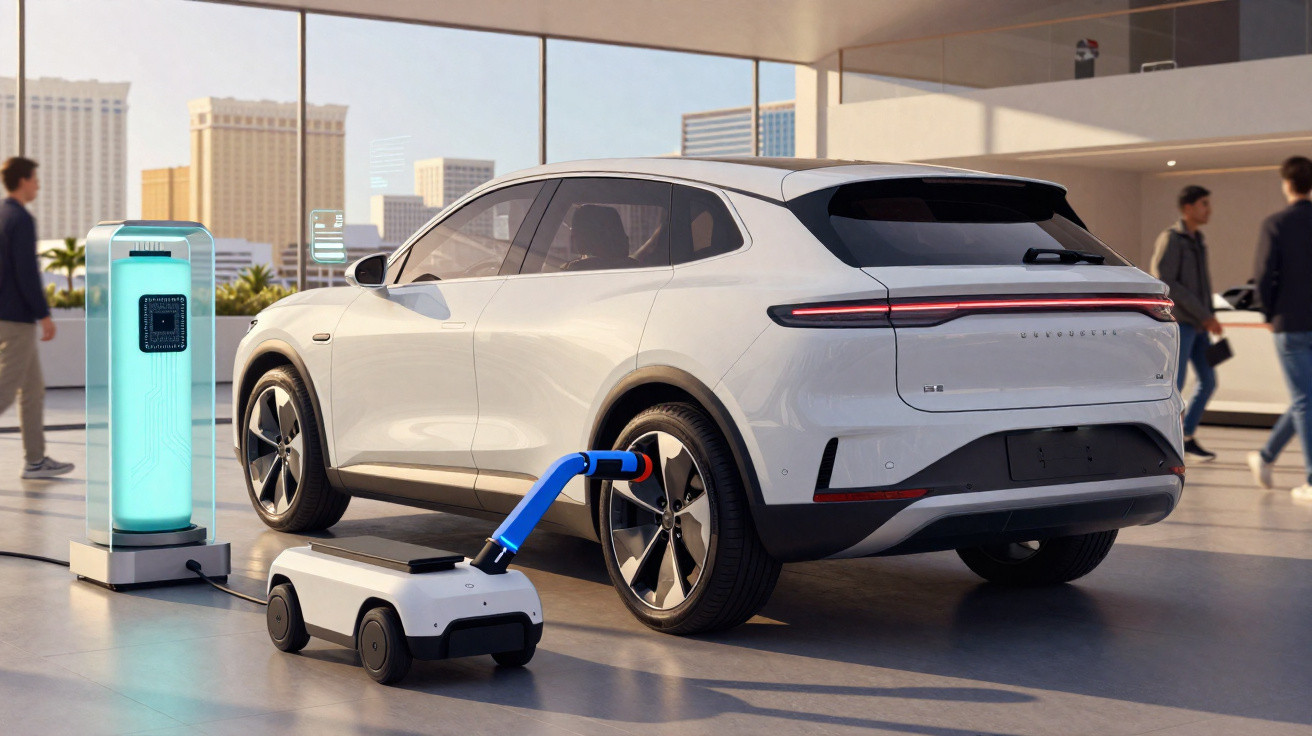
At CES 2024, the company will demonstrate an automated parking technology that requires no human intervention. Cariad, Volkswagen’s software division, is testing it in the employee car park in Ingolstadt.
In essence, the technology “guides” an autonomous electric vehicle through a suitably equipped car park to a space with a charging point. A robot then opens the vehicle’s charging flap and connects the cable.
Once the battery has been charged, the cable is disconnected and the vehicle autonomously looks for another, standard parking space without a charging point.
After charging is complete, the cable is removed and the vehicle independently moves from that bay to another one without a charging point.
By freeing up the charging bay for another vehicle, Bosch says the technology could save considerable time for drivers wishing to charge their vehicles.
Bosch has also developed a new chip that can simultaneously combine infotainment and driver-assistance-system (ADAS) functions. Reducing the number of chips from two to one will enable faster response times, lower energy consumption, less space usage and reduced cabling.
Finally, connectivity is another area in which Bosch has partnered with Amazon Web Services on several projects, including the development of a connected coffee machine. The goal? Imagine asking your car’s voice assistant for a coffee that is ready just as you arrive home. Welcome to the future.


Comments
No comments yet. Be the first to comment!
Leave a Comment