
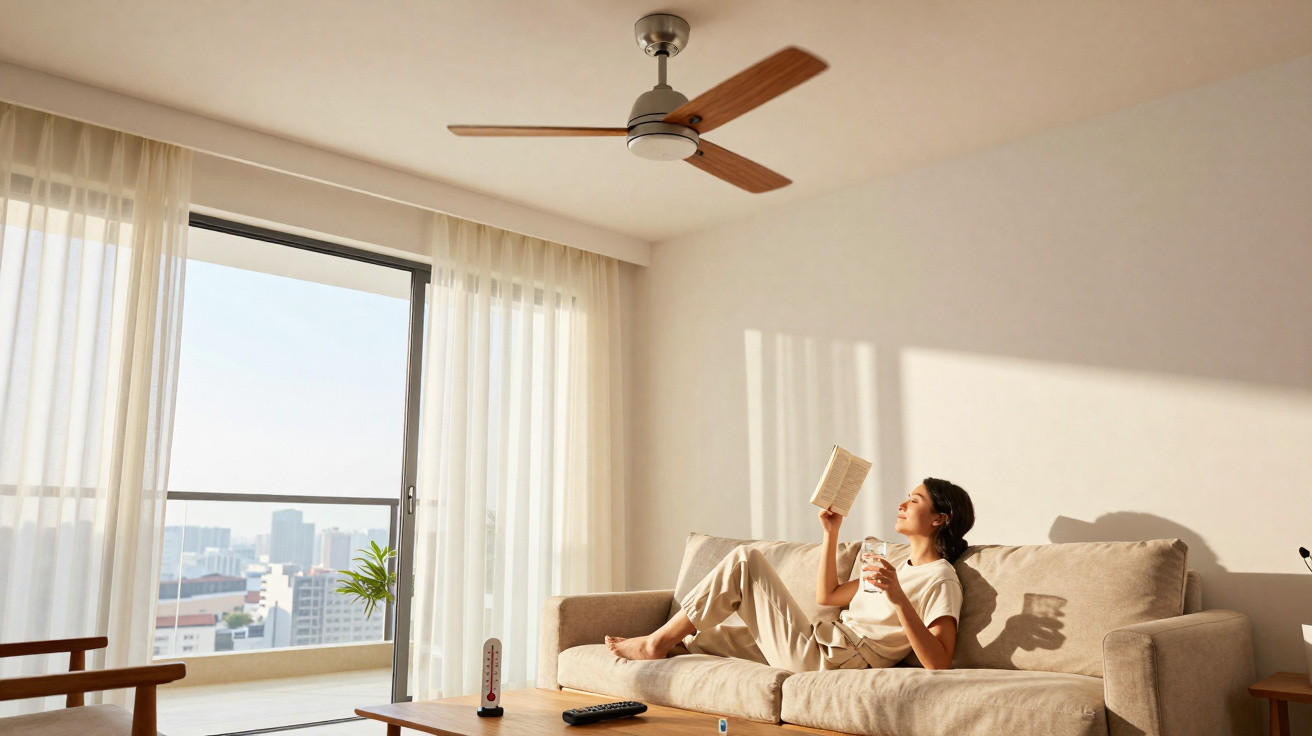
For years, the ceiling fan (or air circulator) has been dismissed as “poor man’s air conditioning”, yet it actually offers a host of benefits.
There was a time when summer days passed slowly to the steady hum of ceiling fans. You know the kind: spinning blades, tied to childhood memories, setting the pace for heatwave afternoons and air conditioning-free evenings. Their gentle breeze accompanied quiet moments and post-lunch naps, and even now they recall a calmer era, when time seemed to stand still - just like the fans suspended overhead. Nostalgia aside, however, ceiling fans remain remarkably effective.
The ceiling fan is far from “poor man’s air conditioning”
The French Agency for Ecological Transition is unequivocal: “Solutions exist for keeping a home cool. Air conditioning is not always essential.” Its advice includes shutting the blinds as soon as sunlight reaches the windows, closing those windows from mid-morning onwards, and avoiding appliances that generate heat, especially the oven.
ADEME also recommends using fans. Although they do not lower a room’s actual temperature, they keep the air moving and create a pleasant cooling sensation on the skin. With heatwaves now established in France, the agency could well help bring ceiling fans - also known as air circulators - back into fashion.
Ceiling fan cooling effect and electricity use
According to some specialists, a ceiling fan can move cooler air with its blades and reduce the perceived temperature by around 5°C. Better still, it is particularly energy-efficient. “An air circulator uses 25 to 40 times less electricity than air conditioning, while delivering a potentially comparable service,” says Robert Célaire, a bioclimatic engineer.
It also costs less to install. In Vénissieux, a suburb of Lyon, the local authority recently fitted 150 ceiling fans across around 30 buildings, at a cost of €90,000. The airflow helps the body shed heat through the skin by encouraging evapotranspiration, affecting how warm a person feels rather than the temperature shown on the thermometer.
Ceiling fan installation constraints and other benefits
Ceiling fans are thought to be present in 2.5% of homes in France, compared with more than 60% in the United States. Installing them in houses and flats can nevertheless be restricted by one very practical issue: ceiling height. In homes, this is generally limited to 2.50 metres, while a clearance of 2.30 metres between the floor and the blades is recommended. Where there is no air conditioning or ceiling fan, ice cubes can also be used to combat the heat.
Finally, ceiling fans may also help deter mosquitoes, which struggle to fly properly in moving air. They may also qualify for MaPrimeRénov’ support, albeit subject to various conditions. Perhaps the ceiling fan is not quite so old-fashioned after all?





Comments
No comments yet. Be the first to comment!
Leave a Comment