
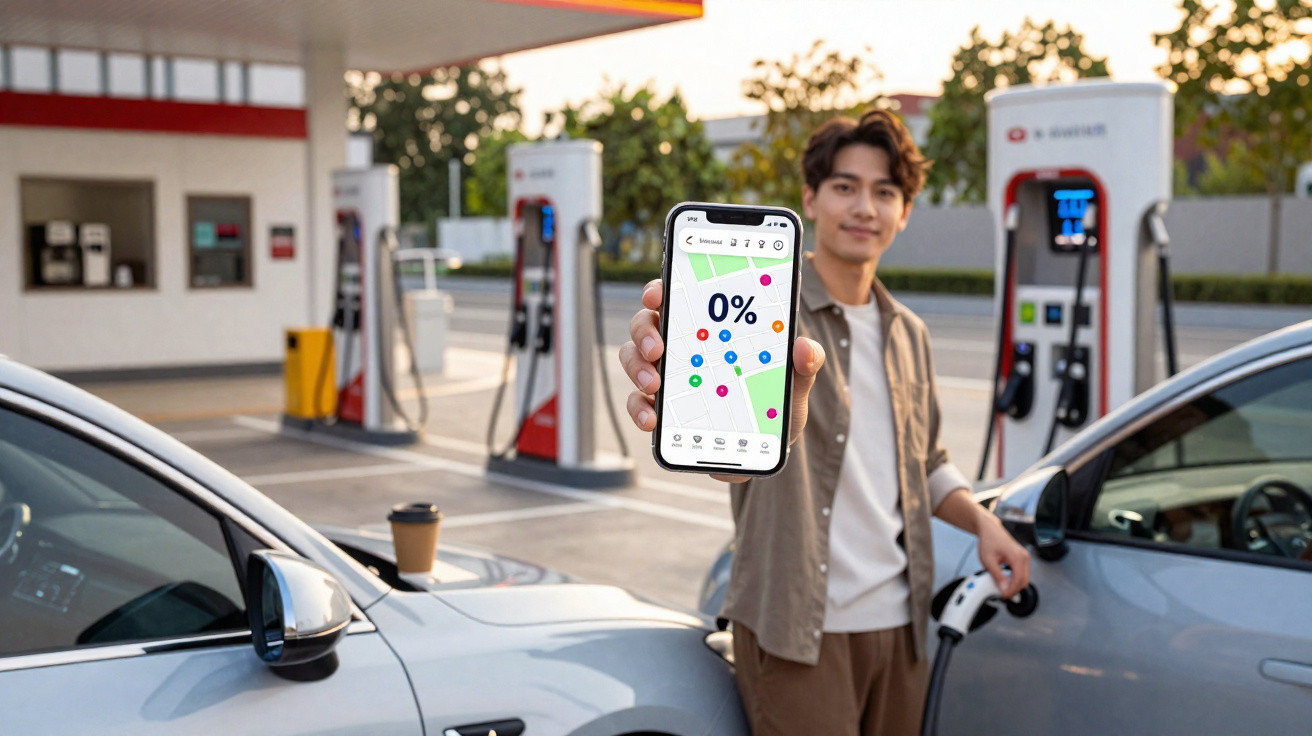
Allego, a European pioneer in ultra-rapid charging with a network of 350 stations in France, has launched its mobile app. It provides access to 1 million charging points across Europe, including rival networks, without charging any commission.
As France passes the milestone of one million electric-car drivers, electric mobility has officially moved beyond its niche status and into everyday household life. Yet the user experience remains fragmented, in a way that recalls the early days of computing: when charging away from home, motorists often have to switch between several proprietary apps, each restricted to its own network.
“Today, having one app for every operator is no longer viable for drivers,” Jean Gadrat, Allego's Chief Marketing Officer, told Presse-citron. This logistical headache creates both a mental and technical burden for users, who must manage multiple accounts and interfaces. At the same time, existing aggregation services may make it easier to find chargers, but they also cost users money: established providers such as ChargeMap, for instance, charge a commission of around 10% on every charging session.
The stakes are therefore significant. To support the all-time record for electric-vehicle sales set in March 2026, at almost 50,000 units, the infrastructure must fade into the background in favour of the service. Allego believes that seamless interoperability is the final barrier to overcome before charging becomes as intuitive as filling up a conventional petrol or diesel vehicle.
No commission on charging
The company has now introduced its own app, available on iOS and Android, offering near-comprehensive coverage of Europe's public charging network, with more than 1 million accessible charge points, including 200,000 in France. However, the real departure lies in its chosen business model: “zero commission” on competing networks.
Aggregators usually earn money by adding a mark-up to the price of electricity sold by third parties. Allego is taking the opposite approach. “When a user of our app selects a competitor's charge point, we waive any profit margin on that transaction,” explains Jean Gadrat. According to the executive, this transparent approach, in which the displayed price is exactly the public price set by each operator, is virtually absent from today's market.
It is a deliberate commercial strategy aimed at winning over users and making their journey simpler. The interface is designed as a single access point where users can find a charge point, check its power output and real-time availability, then start charging and pay in a single click, without needing multiple subscriptions or physical cards.
Discounts and subscriptions
The cost per kilowatt-hour (kWh) remains the key battleground. Against that backdrop, Allego is pursuing an aggressive pricing strategy on its own network. The first benefit for users is an automatic 5% discount on every charge made through the app on the Allego network, with no subscription or additional steps required.
For high-mileage drivers, the operator goes further with its Allego Plus premium plan at 9.99 euros per month. It reduces the price of ultra-rapid charging from 0.59 euros to 0.39 euros per kWh. Based on the company's calculations, using average consumption of 18 kWh/100 km from ADEME data, the subscription would pay for itself from 350 kilometres driven each month.
Jean Gadrat also highlights the financial advantage over conventional fuel: for a small electric car, the cost per 100 kilometres would fall to about 7 euros with the subscription, compared with 10 euros at the standard rate. “Today, driving electric costs less than driving a combustion-engine car, especially given the current effect of oil prices,” the CMO says. The saving is said to be even more noticeable on long journeys, with the company estimating savings of around 28 euros for a subscriber travelling from Paris to Marseille.
Allego's experience designed like a traditional filling station
Allego operates a network of 350 ultra-rapid charging stations in France and is targeting 600 locations by 2027. The aim is to deliver an experience similar to that of a traditional filling station. With chargers supplying between 300 and 400 kW, a 15-minute stop is enough to add around 350 kilometres of range.
“Two-thirds of our sites are what we call ‘destination’ locations: places people visit to do something, such as shopping or eating a burger. They park their car there for 30 to 60 minutes, and use that time to charge it. The remaining third is dedicated to pure motorway travel,” explains Jean Gradat.
This strategy is reflected in very practical partnerships. On major routes, the operator works with Vinci Autoroutes and APRR to provide long-distance coverage. The app is therefore intended to become a tool embedded in consumer routines: by using their loyalty number, for example, a customer can benefit from a Happy Hour offer at Burger King, bringing the kWh price down to 0.30 euros.
By combining ultra-high power with nearby services such as restaurants and shopping, the operator is seeking to make electric-vehicle use routine and fully compatible with modern lifestyles.


Comments
No comments yet. Be the first to comment!
Leave a Comment