
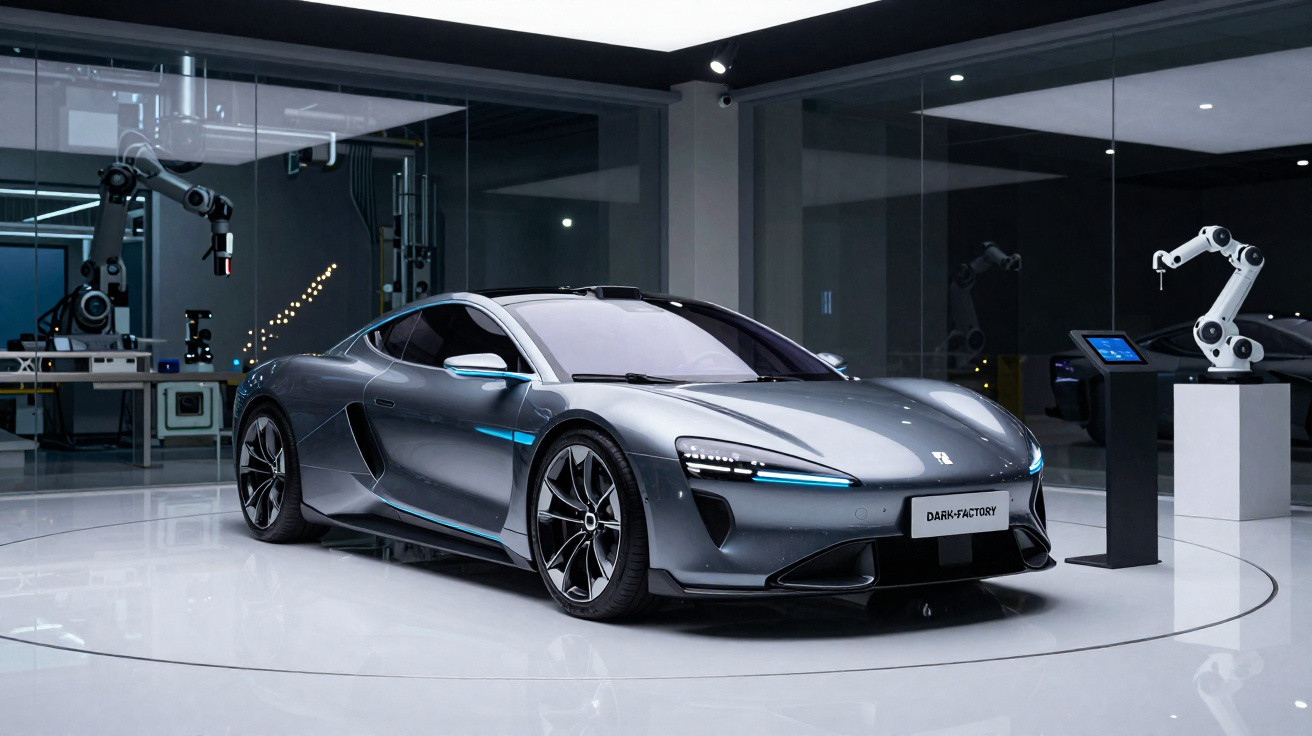
China is currently developing a new generation of car factories in which robots no longer merely assist but take charge of the entire manufacturing process. Before 2030, the first fully unmanned plant there is expected to build vehicles from start to finish - from raw sheet metal to the completed car, without an employee ever touching the steering wheel.
From production line to ghost factory
For decades, people and robots have worked side by side in car plants. Welding robots, paint-shop arms and logistics vehicles - much of the process has long been automated. Final assembly, however, meaning the precise fitting together of every component, has until now remained a human stronghold.
That final area of human control on the factory floor is now under threat. In China, manufacturers are planning the first sites with no conventional jobs at all. The lines will keep moving, while the production halls remain almost empty.
“Robots weld, paint, tighten screws and inspect - without breaks, fatigue or holidays.”
Internationally, the idea has an evocative name: so-called “dark factories” - manufacturing sites that could, in principle, operate without lighting because nobody needs to see what is happening inside. Machines navigate using sensors, cameras, laser scanners and central control computers supported by AI.
Why China is accelerating automation
China has invested heavily in robotics and artificial intelligence in recent years. Service robots in public spaces, autonomous patrol vehicles and intelligent traffic management are no longer visions of the future there; they are already part of everyday life in many cities.
This experience is now moving into heavy industry. New car factories are being designed from the outset to require barely any staff. Sensors monitor each stage, while AI systems intervene if a component does not fit precisely or a machine deviates from its target value.
- 24/7 operation without shift changes or night-shift premiums
- consistent quality, as robots work precisely and repeatably
- flexible reconfiguration of production lines through software updates
- major savings on wages, benefits and building costs
Industry experts expect China’s first fully automated car factory to begin series production before the end of the decade. The United States is regarded as a close contender, while Europe is somewhat behind but does not intend to remain so permanently.
Automation in response to cost pressure
The global car industry is undergoing the costliest transformation in its history. Electric powertrains, new software platforms, connectivity and autonomous driving all consume billions. At the same time, margins are falling in many markets as competition becomes ever more intense.
This is precisely where fully automated plants come in: they are intended to reduce the cost per vehicle and substantially shorten development times. Studies such as those by consulting firm Accenture show the potential of this strategy.
“Advanced automation can reduce development and time-to-market by up to 50 per cent.”
Manufacturers that can move a car from concept to sale more quickly and at lower cost gain market share. That is why not only Chinese brands are investing in this technology, but western groups as well.
Hyundai, Tesla & Co.: the race towards the robot factory
Hyundai is among the manufacturers pursuing automation particularly aggressively. The group plans to deploy humanoid robots in its plants within just a few years. From 2028, Boston Dynamics models are set to operate at a factory in the US state of Georgia, helping with transport, maintenance and monitoring.
Tesla is taking a slightly different route. The US company relies on enormous casting machines, known as megacastings, to produce large sections of the vehicle frame in one piece. The fewer individual components there are, the easier it becomes to automate the remaining work. At the same time, Tesla is developing the humanoid robot Optimus, which is also intended for use in production over the longer term.
German manufacturers are not standing still either. BMW, Mercedes-Benz and other premium brands are already testing highly automated lines where only a small number of specialists are directly involved in production. They intervene only when something goes wrong or when particularly sensitive steps are required.
How processes could change in practice
A look at standard processes illustrates how far-reaching this shift could be:
| Production stage | Today | Fully automated factory |
|---|---|---|
| Body construction | Robots weld, people inspect | Robots weld and inspect using sensors |
| Painting | Robotic arms, monitored by staff | Fully sensor-controlled, remotely monitored from a control room |
| Final assembly | Many manual tasks, such as fitting the interior | Robotic arms, mobile platforms and automated tightening |
| Quality control | Test drives, visual inspections by technicians | Cameras, measuring systems and AI-supported data analysis |
What a “dark factory” means in practice
A factory with hardly any lights on may sound like science fiction. In practice, it relies on several technological building blocks:
- robotic arms with tactile sensors and cameras that identify and correctly position parts
- mobile robots that carry components between stations
- digital twins of the factory, used to simulate and optimise processes virtually
- AI systems that analyse production data in real time and automatically take corrective action where needed
The “dark” element is more symbolic than compulsory: in reality, many of these plants will at least be dimly lit, if only for maintenance work. Yet the central principle remains the same: people are no longer a permanent part of the process and, ideally, only attend for maintenance, supervision and further development.
Opportunities and risks for jobs
For manufacturers, fully automated plants may sound like a dream. From employees’ perspective, the picture is markedly different. When entire production sections can operate without staff, traditional industrial jobs come under immense pressure.
At the same time, new roles are emerging: data analysts, robotics engineers, maintenance specialists and IT security experts will be in greater demand. Required skills are shifting away from shift work towards highly trained technicians and software professionals.
For countries with high wages, such as Germany, extensive automation could paradoxically become an advantage as a manufacturing location. If labour’s share of production falls sharply, the wage gap with low-cost countries matters less. Companies may be more able to retain manufacturing in their home market rather than move it entirely to Asia - provided the necessary technology is available.
What car drivers and customers can expect
At first glance, car buyers will notice little difference between a vehicle made in a conventional factory and one built in a ghost factory. In practice, though, several consequences could directly affect customers:
- shorter model cycles, as new variants can be introduced more quickly
- more consistent quality, because faults are identified earlier and more systematically
- potentially lower prices, if manufacturers pass on cost advantages
- greater standardisation of platforms and components
It will be interesting to see how openly companies address this issue. Some may present glossy, unmanned factories as high-tech flagships. Others may prefer to keep a lower profile to avoid further fuelling debates about job losses.
Terms worth knowing
Anyone following this development will repeatedly encounter certain key terms. Two appear particularly often:
Digital twins: These are virtual replicas of a factory or a product. Engineers can test processes on the model before putting them into practice. For example, they can assess how a new robot cell affects the entire flow of materials.
Predictive maintenance: This refers to proactive maintenance. Sensors report early when a component is wearing out. The AI recommends an appropriate time for replacement so that unplanned downtime can be avoided. This plays a central role in a plant with no staff on the factory floor.
Whether China will actually be the first country to open a fully operational car factory without employees has not yet been definitively decided. What is clear, however, is that the direction has been set, and major manufacturers worldwide are aligning their strategies accordingly. Those who wait too long risk doing no more than playing catch-up in the next technological leap.





Comments
No comments yet. Be the first to comment!
Leave a Comment