
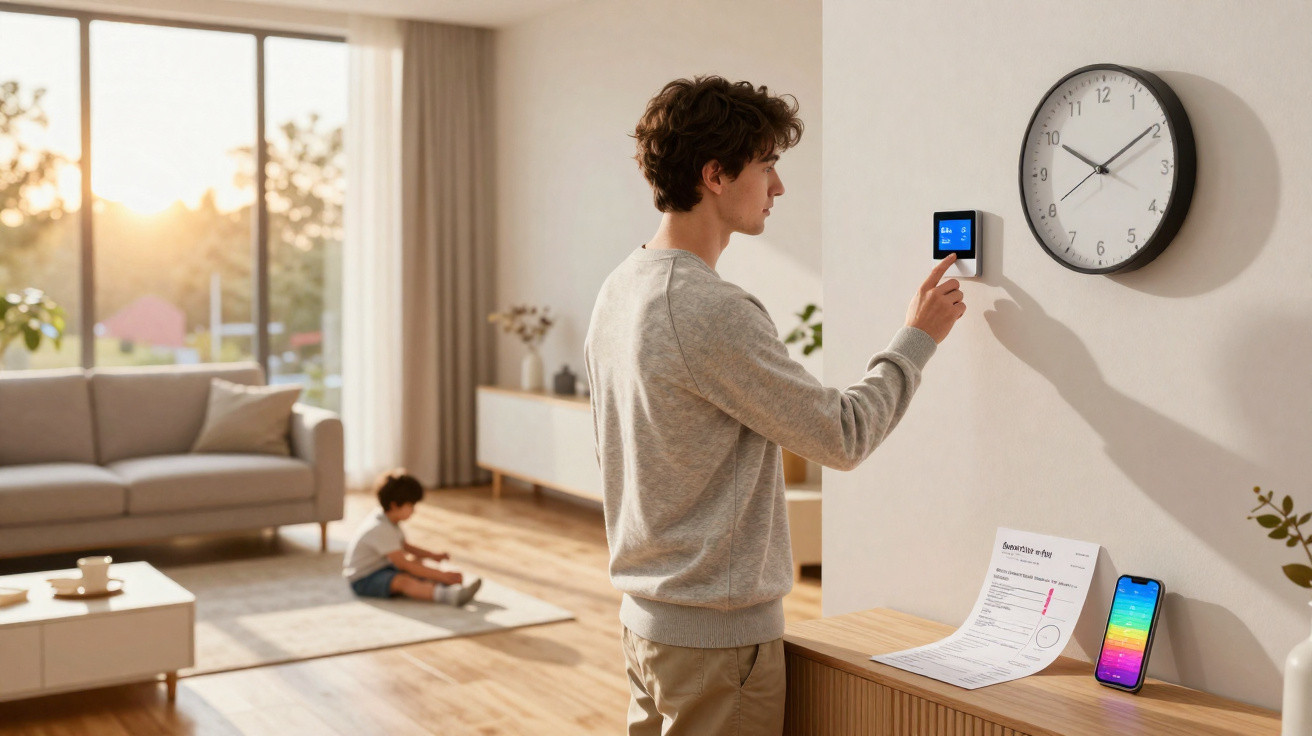
Energy prices remain high, winter puts pressure on electricity grids – yet radiators in many homes are turned up precisely when nationwide demand is at its highest. Small changes to everyday routines can deliver noticeable savings without having to sit indoors wearing a scarf.
Why heating timing matters almost as much as temperature
When people think about saving energy, their first thought is usually the number on the thermostat: 19 or 20 degrees, eco mode or insulated windows. What is often overlooked is that the time at which a radiator draws power can also have a significant effect on costs.
“Heating during the biggest electricity peaks not only costs more, but also puts strain on the grid at the very time it is most vulnerable.”
This effect is especially visible in France, where the electricity mix relies heavily on electricity. Analysis by energy adviser Hellowatt shows that typical heating habits clash directly with national peaks in consumption there.
The two major mistakes: after getting up and after work
The pattern is similar internationally, including in German-speaking countries: people get up, feel cold and turn up the heating. They return home in the evening, feel cold again and turn it up once more. It makes sense from a human perspective, but it is inefficient from an energy standpoint.
Between 7 and 9 am, many appliances are operating at once in households: heating, coffee machines, kettles, hairdryers and potentially the hob or oven. The same happens again in the early evening: between 6 and 8 pm, cooking, lighting, hot water and often even washing machines or dishwashers add to demand.
This concentration has two consequences: electricity demand rises to record levels, and suppliers must bring expensive additional power stations online. Where tariffs use time-varying pricing, or are increasingly set to do so, this peak is reflected directly in household bills.
“The ‘comfort minutes’ immediately after getting up and arriving home are among the day’s most expensive times to heat.”
There is another consequence, too: when large numbers of people heat their homes simultaneously, grid operators are more likely to need to intervene, for example by calling for energy-saving measures or selectively switching off individual large consumers.
Two smart time windows for lower heating costs
The recommendation from the data analysis is surprisingly easy to incorporate into daily life. Bringing heating periods forward slightly, or extending them a little, keeps a home warm while moving consumption away from the most expensive peak periods.
The best morning heating window
Recommendation: 6.30 to 7.30 am
The heating is already running before the national consumption curve reaches its maximum. The home warms up while demand on the grid remains more manageable. Anyone getting up at 7 am will then find a comfortably warm base temperature already in place.
Rather than turning the heating up only at 7 or 7.30 am – right in the middle of the demand peak – the system starts half an hour earlier, often operating at a lower output over a longer period.
The best evening heating window
Recommendation: 5.30 to 9 pm
Many people get home between 6 and 7 pm. Setting the heating to increase automatically at around 5.30 pm makes use of the transition from the working day into the evening peak. Rooms are warm on arrival, while the output can be reduced again later.
“Heating slightly ahead of peak periods creates a comfortable base temperature, reduces grid load and cuts the price premium caused by high demand.”
In well-insulated homes, maintaining a moderate setting until around 9 pm is usually enough for the temperature to fall gradually afterwards without anyone feeling cold.
How to set this heating strategy in practice
The good news is that nobody needs to get up early simply to adjust the thermostat manually. Most modern heating systems have a timer function, including basic electric heaters and wall-mounted thermostats.
Typical adjustments could include:
- Set the heating programme to 6.30–7.30 am rather than 7–9 am.
- Schedule the evening programme for 5.30–9 pm instead of 6–10 pm or leaving it on continuously.
- Raise the temperature only slightly, for example from 18 to 20 degrees, rather than suddenly increasing it to 23 degrees.
- Keep unused rooms cooler, such as hallways, guest rooms and rarely used home offices.
Heating experts estimate that households with well-configured programmes can save up to 15 percent of their energy on average, without reducing comfort.
Sensible room-by-room heating temperatures
As well as choosing the right time, setting an appropriate target temperature still matters. The following recommended guide values are useful:
| Room | Recommended temperature |
|---|---|
| Living room | 19–20 °C |
| Bedroom | 16–18 °C |
| Kitchen | 18–19 °C |
| Bathroom (when in use) | 21–23 °C |
| Hallways, ancillary rooms | 15–17 °C |
Controlling these areas separately can easily save several hundred kilowatt-hours a year compared with using a blanket 22-degree setting throughout the home.
What dynamic electricity tariffs change
With the expansion of smart meters and dynamic tariffs, the time of day becomes even more important. Many suppliers already offer day-and-night tariffs, while early pilot schemes link customer prices to the wholesale market on an hourly basis.
“Those who heat flexibly can avoid the most expensive hours of the day – much like commuters who deliberately travel outside rush hour.”
An intelligent heating schedule can therefore use not only the recommended morning and evening windows, but also particularly low-cost periods, such as midday when there is plenty of solar electricity on the grid.
Common misunderstandings about heating
Does switching it “completely off” always save the most?
Many people turn their heating off entirely during the day, then wonder why consumption is high in the evening. The reason is that cold walls absorb heat. By the time the room feels comfortable again, the system has to run at high output.
It is often more economical to lower the temperature only slightly, for instance from 20 to 17 degrees, and then heat moderately in the evening – ideally during the recommended time windows.
“Turn it right up briefly, then turn it down again”
Radiators do not work like taps. Setting them to full does not warm a room faster; it only raises the flow temperature. Energy use increases, but the gain in comfort remains limited. Slow, consistent operation is almost always better than “turbo mode”.
Everyday practical scenarios
Example: a family with school-age children
They get up at 6.45 am and everyone leaves home by 8 am. A sensible approach is a heating period from 6.15 to 7.30 am, set to 20 degrees in the bathroom and living room, followed by a reduction to 17 degrees. In the evening, raise it back to 20 degrees from 5.30 pm until around 9 pm, then lower it slightly to 18 degrees for the rest of the night.
Example: working from home in a flat
Anyone working from home during the day does not need extreme swings in temperature. A stable level of 19 degrees is often sufficient, rising slightly to 20 degrees during the 6.30–7.30 am and 5.30–9 pm periods. At other times, the temperature can drop by half to one degree without affecting comfort.
What supports grid stability also helps households
If many households heat a little more intelligently at the same time, extreme demand peaks are reduced. Suppliers then need to mobilise expensive reserve capacity less often. Over the medium term, this lower risk could result in more stable or even lower prices.
There is a further benefit: in strained situations, grid operators already call on consumers to reduce usage voluntarily. Anyone who has mastered their heating strategy can adapt easily without a sudden loss of comfort, while also reducing the risk of widespread supply bottlenecks.
Heating as a daily balancing act
Heating remains a matter of timing, technology and behaviour. Choosing the right time, distributing temperatures sensibly around the home and using a thermostat consistently can often achieve more together than costly individual measures.
Anyone who builds the two morning and evening time windows into their routine shifts consumption away from the most critical period. This protects the household budget, eases pressure on the electricity grid and makes remarkably little difference to actual comfort at home.



Comments
No comments yet. Be the first to comment!
Leave a Comment