
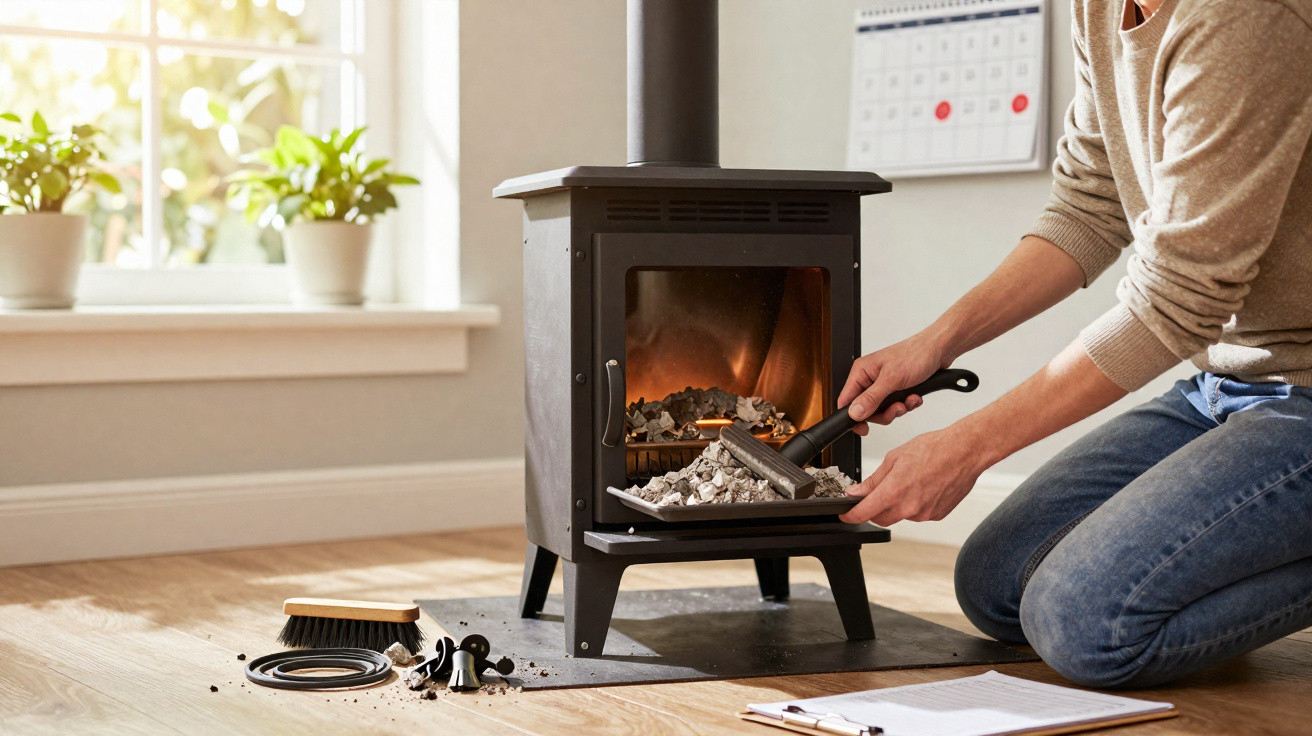
The last cool evenings of the year: the stove is glowing quietly, while thoughts have already turned to the garden, ice cream and sitting outside with a beer. For years, this was exactly when I overlooked the same task: thorough spring maintenance. Eventually, my pellet stove responded with faults, higher fuel use and a hefty repair bill.
How a minor maintenance lapse became a major issue
By March, I was using my pellet stove only occasionally. My thinking was: “I’ll get the full service done sometime in autumn, when the weather turns cold again.” A little ash left behind and some soot on the glass could not possibly cause much trouble, could they?
The answer arrived six months later. On the first chilly weekend in October, the stove lit, but the flame was sluggish, the glass blackened immediately and it burned through pellets faster than usual. Shortly afterwards, the display reported a fault. The engineer identified the cause within minutes: residue that had built up over months, pellets stuck together and obstructed air passages.
“What I treated as a small job in spring cost me several hundred euros in autumn – and left me without heating for a week.”
A brief but consistent spring service can prevent precisely this scenario. It is not simply about convenience; it is also essential for safety.
Why spring servicing for a pellet stove is essential
Although the stove may barely be used in spring, ash, fine dust and soot remain inside it, including in channels and corners that are not immediately visible. These deposits restrict the air and flue-gas routes, reduce efficiency and make the appliance burn more pellets to produce the same amount of heat.
There is another risk that many people never consider: inefficient combustion and poor extraction increase the chance of carbon monoxide entering the room air. In particular, modern, airtight homes require a stove that is clean and correctly adjusted.
“One focused check in spring means the stove will start in autumn as though nothing had happened – but with lower consumption.”
Key steps for pellet stove care in spring
1. Empty the burn pot and ash container thoroughly
The burn pot – a small bowl with air holes on many models – is the heart of the stove. If ash or clinker blocks these openings, combustion quality deteriorates straight away.
- Allow the pellet stove to cool down completely.
- Remove and empty the ash container.
- Clean it using an ash vacuum with a HEPA filter, never an ordinary household vacuum cleaner.
- Clear the burn-pot openings with a small brush or wooden stick.
Important: never vacuum up ash while it is hot, as this presents a fire risk. Even after several hours, remaining embers can still create problems.
2. Inspect the seals and door closure
The rubber seals around the door and ash compartment can become hard over time or split in places. The stove then draws in secondary air, upsetting its controls so that the flame and flue-gas temperature are no longer properly matched.
Typical signs include:
- The flame is difficult to ignite
- The viewing glass becomes heavily sooted
- Unusual smells occur during start-up
Anyone who spots clear cracks, or notices that the door no longer closes firmly, should have the seals replaced or, with some practical skill, replace them personally.
3. Clean the glass – for more than appearance
Being able to see the flame clearly is not merely pleasing to the eye. Glass that quickly becomes sooty also indicates that something is wrong with the combustion process. For a spring clean, you will usually need only:
- A microfibre cloth or soft kitchen roll
- A specialist stove-glass cleaner, or a simple household method: dip damp paper into a little fine ash, then rub the glass with it
Metal scouring pads and harsh cleaning products should never be used on the glass. Scratches will attract soot even more quickly later on.
4. Do not overlook air passages and the flue pipe
When the engineer visited in autumn, he found severely blocked air channels and a flue pipe with deposits inside. As a result, the stove received too little air, the pellets burned incompletely and even more residue formed – creating a vicious circle.
Many models have side or rear access panels that allow the air passages to be cleaned at least in part. A powerful ash vacuum and a narrow brush can already make a considerable difference. The flue pipe should be swept regularly by a qualified specialist.
Legal requirements: annual servicing is compulsory
Pellet stoves are classified as solid-fuel appliances. In many German-speaking countries, regulations and appliance certificates require regular maintenance and a specified number of sweeps each year. Ignoring this can lead not only to damage, but also to problems with the insurer and chimney sweep if something goes wrong.
A typical annual service by a qualified specialist includes:
- Full cleaning of the combustion chamber and air channels
- Inspection of the igniter, fan and feed screw
- Functional testing of the safety sensors
- Checking and cleaning the flue-gas route, including the flue pipe
- Optimising the settings for the particular type of pellet
The company will then issue a maintenance certificate. Keep this document safely filed, as it may be worth a significant amount of money in the event of damage.
Strong reasons to schedule the service in spring
1. Faults emerge before cold weather arrives
A spring inspection can reveal worn components, such as the ignition resistor, fan bearings or cracked seals, at an early stage. Having these repaired immediately means entering autumn without stress. Unexpected failures on a frosty Sunday evening can be avoided.
2. Specialist firms have more space in their schedules
In autumn, stove installers and chimney firms are fully booked for weeks. It is easier to secure an appointment in spring, sometimes on more favourable terms. Booking now means you will not be left waiting for spare parts while feeling cold.
3. Greater efficiency, fewer pellets
A clean pellet stove gets more heat from every kilogram of fuel. Anyone monitoring consumption over several years will often see a clear difference:
| Maintenance condition | Pellet consumption | Perceived heat output |
|---|---|---|
| Well maintained | lower | stable, even |
| Neglected | noticeably higher | variable, sluggish |
The savings from reduced consumption often recover the servicing cost after one or two heating seasons.
Common mistakes that prove costly for pellet stove owners
- Not emptying the ash container regularly: Ash keeps building up, air passages become blocked and the electronics report a fault.
- Buying cheap, uncertified pellets: These produce more ash, form crusts in the burn pot and may block the feed screw.
- Leaving the pellet hopper full for months: Pellets absorb moisture from the air and break down. Damp crumbs cause blockages and poor starting behaviour.
- Repeatedly putting off the annual service: At first, the stove may seem to continue working, but error messages then become more frequent and components start failing in greater numbers.
“Anyone who spends a few hours on care each year can often avoid having to replace the entire stove years later.”
Assessing everyday risks and benefits correctly
Pellet stoves are considered convenient and comparatively climate-friendly. They operate automatically, can be programmed and combine modern technology with the feel of a real fire. Yet this very convenience can make owners forget the technology working behind the scenes.
A dirty stove produces more fine particulate matter and, where the combustion chamber is leaking or the outlet is blocked, can allow carbon monoxide into the room. A CO alarm near the appliance is therefore a sensible addition to regular maintenance.
On the other hand, a carefully maintained system provides numerous benefits:
- Greater operational safety
- Consistent heat output, even during continuous operation
- Lower fuel use and therefore reduced costs
- A longer service life for the stove, fan and electronics
Practical advice for next spring
To avoid forgetting timely stove care again, set a reminder on your phone as soon as the heating season ends – mid-April or early May is a good time. Many owners also keep a small checklist directly on the appliance.
A combination of DIY work and professional servicing makes sense: smaller jobs, including ash removal, glass cleaning and a visual inspection of the seals, are easy to handle yourself. The flue pipe, electronics, settings and a complete safety inspection should remain the responsibility of a specialist firm.
Since making this routine a habit, my pellet stove has been running far more smoothly. There are no more fault messages, no panic when the first cold snap arrives, and the heating bill is easier to face. I will not miss the spring check again.





Comments
No comments yet. Be the first to comment!
Leave a Comment